127 posters, 10 topics, 20 sessions, 127 authors
ePostersLive by SciGen Technologies S.A. All rights reserved.
UCSF 2024 Inquiry Symposium
Conference ePosters

P045
Serologic evidence of Epstein-Barr Virus reactivation during acute COVID-19 in comparison to household contacts
Part of Topic
Clinical & Translational Sciences
Title: Serologic evidence of Epstein-Barr Virus reactivation during acute COVID-19 in comparison to household contacts
Introduction: Epstein-Barr Virus (EBV) is a ubiquitous human herpesvirus that infects more than 90% of adults in the United States. Infection is most often latent and asymptomatic, although EBV reactivation may occur in the setting of systemic stress responses, such as sepsis and acute infection. EBV is primarily a tissue-based virus; as such, direct viral measurement is challenging. However, serologies can be used as a marker suggestive of EBV reactivation. Recent evidence has suggested that EBV reactivation may be a driver of post-acute sequelae of COVID-19 (PASC), also known as Long COVID. If that is the case, the assumption is that the stress response to acute COVID-19 sets off EBV reactivation, and that “Long COVID” is actually related more directly to EBV reactivation than ongoing activity of SARS-CoV-2 itself. However, few studies have examined the presence of EBV reactivation in patients during their acute COVID-19 infection because biospecimens from this phase of infection are rarely accessible, especially among outpatients with mild-to-moderate COVID-19.
Hypothesis: Since EBV reactivation occurs during acute periods of systemic stress, we expect a higher proportion of detection of EBV serological markers suggestive of recent reactivation in individuals with confirmed SARS-CoV-2 infection in comparison to their COVID-negative household contacts.
Aims: 1) Describe the demographics of all participants and the illness severity of COVID+ cases 2) Compare the titers of Viral Capsid Antigen IgM, Nuclear Antigen IgG, Early Antigen-D IgG, and Viral Capsid Antigen IgG between COVID+ participants at Day 28 of their SARS-CoV-2 infection versus their COVIDhousehold contacts
Project Design/Methods: FindCOVID is a CDC-sponsored household-based study enrolling participants within 5 days of symptom onset of confirmed COVID-19 infection, as well as their COVID-negative household contacts, between June 2020 and 2023. Demographic information and illness characteristics were collected, and participants underwent interviewer-administered study assessments and biospecimen collection in their homes for the first 4 weeks of COVID-19 (Day 5, 9, 14, 21, and 28 post-symptom onset), and then quarterly at months 4, 8, and 12. At each visit, we collected blood, saliva, and nasal swabs. For this analysis, we used plasma samples collected at Day 14, serum samples collected at Day 28, and saliva samples collected between days 5-28 following COVID-19 symptom onset. EBV DNA was quantified from D14 plasma samples, and EBV serologies were assessed in D28 serum samples. We selected D28 for the serologic testing based upon the expected dynamics of EBV antibodies in the 4-6 weeks after reactivation. We first compared levels of these markers between COVID+ participants and COVID- household contacts using Chi-squared testing, to determine whether SARS-CoV-2 infection was associated with evidence of EBV reactivation.
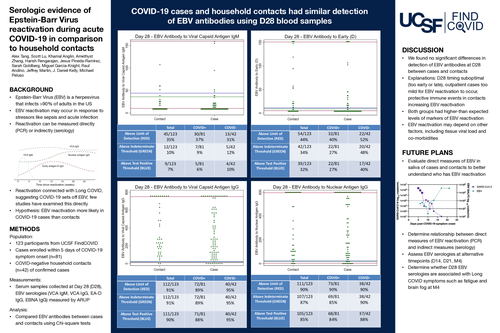
Results/Products: We assessed 81 COVID cases and 42 COVID-negative contacts. The mean age was 37 and 50.4% of participants were female. There were no statistically significant differences in age, sex, race/ethnicity, or BMI between COVID cases and their COVID-negative contacts. We identified plasma EBV reactivation via PCR at day 14 in only a single case. At the D28 timepoint, we did not identify statistically significant differences in the presence of antibodies suggestive of EBV reactivation between cases and contacts. 37% of COVID cases had detectable titers of Viral Capsid Antigen IgM, compared to 31% of COVID-negative contacts. 40% of COVID cases had detectable titers of Early Antigen-D IgG, compared to 52% of COVID-negative contacts. 89% of COVID cases had detectable titers of Viral Capsid Antigen IgG, compared to 95% of COVID-negative contacts. 90% of COVID+ cases had detectable titers of Nuclear Antigen IgG, compared to 90% of COVID-negative contacts.
Discussion/Conclusion: In our analysis of serological evidence for EBV reactivation, we found no significant differences in antibody levels at D28 between COVID cases and their COVID-negative household contacts. There are several possibilities that could explain this unexpected lack of difference. First, the timing of the D28 sample could have been suboptimal (too late for VCA IgM, too early for EA-D IgG, and longitudinal serologic analysis may be more informative. Second, it is possible that the COVID cases in this outpatient cohort had infection that was too mild to reactivate EBV. Third, it is possible that the immune response (B cell response) to SARS-CoV-2 could be a better predictor of EBV reactivation (and some of the COVID-negative contacts may have had robust immune responses that aborted the SARS-CoV-2 infection). Finally, it is likely that EBV reactivation within COVID cases may depend on several factors, including tissue viral load and co-morbidities. In future analysis, we will build upon this work to perform longitudinal measurements of EBV reactivation, perform direct measurements of EBV virus in saliva of cases and contacts to determine whether this is related to the serologic levels being measured, and assess the relationship between EBV reactivation at D28 and Long COVID symptoms at M4. Overall, while the lack of differences between cases and contacts in our results was surprising, the study further emphasizes the complexity of understanding the biology of COVID-19, as well as the post-acute sequelae of SARS-CoV-2 infection.