127 posters, 10 topics, 20 sessions, 127 authors
ePostersLive by SciGen Technologies S.A. All rights reserved.
UCSF 2024 Inquiry Symposium
Conference ePosters

P043
Reducing unnecessary waste from laceration repair in the Pediatric Emergency Department: a waste audit and provider survey​
Poster Presenter
Authors
Part of Topic
Social & Behavioral Sciences
ABSTRACT
Introduction
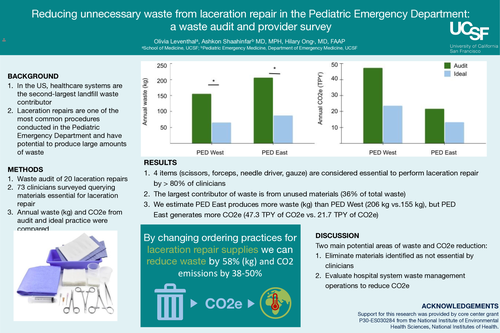
Laceration repairs are one of the most common procedures conducted in the Pediatric Emergency Department (PED) and have potential to produce large amounts of waste.The purpose of this study was to quantify waste from laceration repair and identify areas for waste reduction to reduce healthcare's negative impacts on climate change.
Methods
A waste audit of laceration repair procedures was conducted at two PEDs to quantify waste and carbon dioxide emissions equivalent (CO2e). A clinician survey investigated materials and instruments regularly utilized and which are essential for laceration repair. Survey data was utilized to determine ideal practices. Waste from ideal and audit conditions was quantified for a single laceration repair and annual estimates. Waste (g or kg) and CO2e from current and ideal practice were compared.
Results
Twenty procedural waste audits were performed. 76 clinician surveys were collected. Based on waste audits, we observed an average of 520 g of waste produced per laceration repair and an annual estimate of 361 kg at both PEDs combined, generating 36.9 tons per year (TPY) of CO2e. We estimated that with ideal practices, there is potential for a 58% waste (kg) and 38- 50% CO2e reduction.
Conclusion
This laceration repair waste audit in two PEDs and clinician survey quantified waste, estimated environmental impact, and proposed a clinician driven strategy for waste reduction from laceration repair.