127 posters, 10 topics, 20 sessions, 127 authors
ePostersLive by SciGen Technologies S.A. All rights reserved.
UCSF 2024 Inquiry Symposium
Conference ePosters

P038
Geographic and socioeconomic comparison of time to significant clinical milestones in UCSF patients with amyotrophic lateral sclerosis in urban and rural environments in California
Poster Presenter
Authors
Part of Topic
Clinical & Translational Sciences
Title: Geographic and socioeconomic comparison of time to significant clinical milestones in UCSF patients with amyotrophic lateral sclerosis in urban and rural environments in California
Introduction: Amyotrophic lateral sclerosis (ALS) is a progressive and fatal motor neuron disease, with average survival of 2-5 years from disease onset, with 5-10% of patients surviving for 10 or more years. The average age at diagnosis is between 55-65 years of age, with about 10% of cases of ALS being familial, and a slight male predominance, with a male to female ratio of 1.2-1.5. Aside from age, sex, and certain genetic mutations, there are no clearly established risk factors for the development or progression of ALS. Some studies have found slight differential risk of ALS across income brackets and racial and ethnic groups, and there have been reported geospatial clusters of ALS, suggesting possible links with socioeconomic status (SES) and environment. However, the independent roles of geography and socioeconomic factors in the development or progression of ALS remain to be determined.
Research Question: What are the independent roles of geography and socioeconomic factors in the natural history of disease progression of ALS?
Aims: To determine the impact of geography and SES on the development of clinical milestones of ALS in four geographically distinct cohorts of UCSF patients in California.
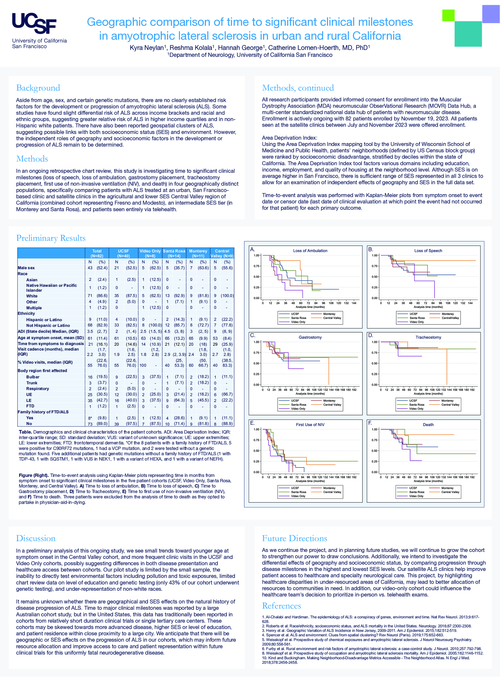
Project Design/Methods: In an ongoing retrospective chart review, this study investigates time to significant clinical milestones (loss of speech, loss of ambulation, gastrostomy placement, tracheostomy placement, first use of non-invasive ventilation, and death) in four geographically distinct populations, specifically comparing patients with ALS treated at UCSF in San Francisco (SF) and at UCSF satellite clinics in the agricultural and lower SES Central Valley region of California (combined cohort representing Fresno and Modesto) and an intermediate SES tier (in Monterey and Santa Rosa). All research participants provided informed consent for enrollment into a multi-center standardized national data hub of patients with neuromuscular disease. Enrollment is actively ongoing with 84 patients enrolled by January 11, 2024. All patients seen at the satellite clinics between July 2023 and January 2024 were offered enrollment. Using the Area Deprivation Index mapping tool by the University of Wisconsin, patients’ neighborhoods (defined by US Census block group) were ranked by socioeconomic disadvantage, stratified by deciles within the state of California. Time-to-event analysis was performed with Kaplan-Meier plots from symptom onset to event date or censor date (last date of clinical evaluation at which point the event had not occurred for that patient) for each primary outcome.
Results: In the preliminary analysis, 84 patients were included and were analyzed by cohort. The SF cohort (N=40) had age at symptom onset (ASO), reported as mean (standard deviation (SD)), of 61 (10.5) and time in months from symptom onset to diagnosis (TSD) of 20 (14.6). The Santa Rosa cohort (N=14) had ASO of 65 (13.2) and TSD of 21 (12.1). The Monterey cohort (N=11) had ASO of 65 (9.9) and TSD of 20 (18.0). The Central Valley cohort (N=11) had ASO of 50 (10.7) and TSD of 29 (24.3). Area Deprivation Index (ADI) score, reported as median (interquartile range (IQR)) in deciles within the state of California, was 2 (1, 4) for SF, 4.5 (3, 8) for Santa Rosa, 3 (2, 5) for Monterey, and 9 (8, 9) for Central Valley. Visit cadence, or the number of months in between patient visits, reported as median (IQR), was 1.9 (1.6, 2.5) for SF, 2.9 (2, 3.9) for Santa Rosa, 2.4 (1.8, 3.0) for Monterey, and 2.7 (1.4, 3.3) for Central Valley. Time-to-event analysis was completed using Kaplan-Meier plots for each clinical milestone.
Discussion: It remains unknown whether there are geographical and SES effects on the natural history of disease progression of ALS. In a preliminary analysis of this ongoing study, we see trends toward younger age at symptom onset in the Central Valley cohort, which has the highest ADI score, and more frequent clinic visits in the SF cohort, possibly suggesting differences in both disease presentation and healthcare access between cohorts. Our pilot study is limited by the small sample and the inability to directly test environmental factors including pollution and toxic exposures. This project, by highlighting healthcare disparities in under-resourced areas of California, may inform future resource allocation to communities in need and improve access to care and patient representation within future clinical trials for this uniformly fatal neurodegenerative disease.