127 posters, 10 topics, 20 sessions, 127 authors
ePostersLive by SciGen Technologies S.A. All rights reserved.
UCSF 2024 Inquiry Symposium
Conference ePosters

P037
The Use of Venlafaxine in Reducing Post-Surgical Pain and Opioid Consumption after Primary Total Knee Arthroplasty
Poster Presenter
Authors
Part of Topic
Clinical & Translational Sciences
Title: The Use of Venlafaxine in Reducing Post-Surgical Pain and Opioid Consumption after Primary Total Knee Arthroplasty.
Introduction: After knee replacement surgery, patients experience acute postoperative pain secondary to surgical manipulation. In addition, a subset of patients, up to 30%, may experience persistent pain usually associated with pain with movement and/or nerve pain. Serotonin– norepinephrine reuptake inhibitors have been widely used in treating chronic neuropathic pain, but their role in acute and transitional pain is less well known. Our study is the first study to our knowledge to examine the effect of perioperative administration of venlafaxine in reducing acute and chronic postsurgical pain in patients undergoing total knee arthroplasty.
Hypothesis: Our current hypothesis is that Venlafaxine may reduce opioid consumption and pain severity scores acutely as well as reduce incidence of chronic pain at 3 months post TKA.
Aims: This project’s goal has two Specific Aims. The first is to evaluate, in patients scheduled for total knee arthroplasty (TKA), Venlafaxine's efficacy in reducing pain intensity at 24 hours via the primary outcomes of pain severity score (numeric rating scale, NRS) and consumption of morphine milligram equivalent (MME). Secondary outcomes include NRS and MME at 1 week. The second aim is if Venlafaxine will reduce the incidents of chronic postsurgical pain at 3- month time point. From patient’s baseline level, we will measure disability scale and function 3 months post-op via PROMIS (Patient-Reported Outcomes Measurement Information System)10 Global Health, KOOS, JR. (Knee injury and Osteoarthritis Outcome Score Short Form), and VR12 (Veterans RAND 12 Item Health Survey) Scale.
Methods: Here, we conducted a prospective randomized clinical trial whereby study subjects are randomized to receive a 7- day course of venlafaxine 37.5mg or placebo pill starting on the day of total knee arthroplasty. The primary outcome of interest is total opioid consumption on postoperative day 1. In addition, pain severity and interference, and functional outcomes are measured at 1-week and three months after surgery. The results from this study may help us determine whether neuropathic agents have a role as part of a multimodal approach in treating acute postoperative pain and preventing the development of persistent postsurgical pain. This is a single center, randomized, prospective clinical trial study. We will be completing our study to enroll the remaining 30 patients for the total number of 100 patients next February, 2025. Patients whose age 18-75 years older and English speaking, American Society of Anesthesia physical classification I - III, scheduled for primary total knee arthroplasty (TKA) with planned spinal anesthesia plus adductor canal block as part of the pre-existing ERAS pathway are eligible for the study. Patients who are younger than 18 years of age, non-English speaking, body mass index > 40, history of repeated falls, contraindication for neuraxial or regional anesthesia, chronic opioid use >60 OME/day or use of slow-release preparations of opioids for at least 1 week prior to surgery. Hepatic failure, chronic kidney disease (CKDIII or greater) are excluded from this study. In addition, concurrent use of benzodiazepine, other psychiatric medications, triptans or linezolid or allergy to venlafaxine will make patients ineligible for the enrollment. Numerical pain scale during PACU stay and postoperative day 1 were recorded. Brief pain inventory and batter tests of (KOOS JR, PROMIS10, and VR12) were documented at the baseline and then at postoperative day 1 and 7 and 1 month and 3 months post-surgery. The occurrence of adverse events was noted.
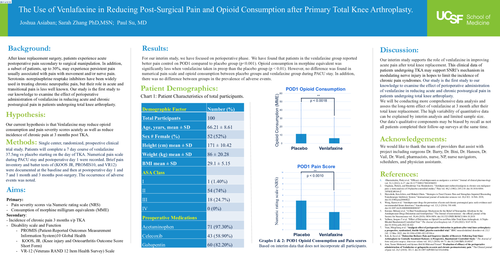
Results: For our interim study, we have focused on perioperative phase. We have found that patients in the venlafaxine group reported better pain control on POD1 compared to placebo group (p<0.001). Opioid consumption in morphine equivalent was significantly less when venlafaxine taken in preop than the placebo group (p < 0.01). However, no difference was found in numerical pain scale and opioid consumption between placebo groups and venlafaxine group during PACU stay. In addition, there was no difference between groups in the prevalence of adverse events. Discussion Our interim study supports the role of venlafaxine in improving acute pain after total knee replacement. This clinical data of patients undergoing TKA may support SNRI’s mechanism in modulating nerve injury in hopes to limit the incidence of chronic pain syndromes. Our study is the first study to our knowledge to examine the effect of perioperative administration of venlafaxine in reducing acute and chronic postsurgical pain in patients undergoing total knee arthroplasty. We will be conducting more comprehensive data analysis and assess the long-term effect of venlafaxine at 3 month after their total knee replacement. Our data’s qualitative components may be biased by recall as not all patients completed their follow-up surveys at the same time.