127 posters, 10 topics, 20 sessions, 127 authors
ePostersLive by SciGen Technologies S.A. All rights reserved.
UCSF 2024 Inquiry Symposium
Conference ePosters

P036
Association between psoriasis and cardiometabolic comorbidities in a racially and ethnically diverse low-income primary care population
Part of Topic
Epidemiology & Population Sciences
Title: Association between psoriasis and cardiometabolic comorbidities in a racially and ethnically diverse low-income primary care population
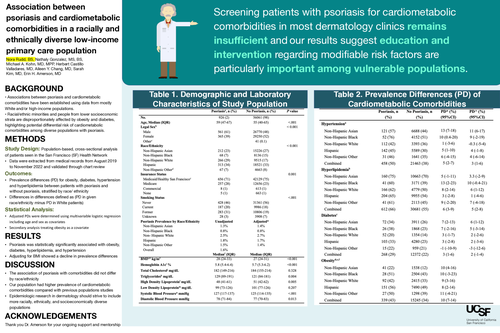
Introduction: Psoriasis is associated with cardiometabolic comorbidities, including obesity, diabetes, hyperlipidemia, and hypertension. Many studies that established these associations originated from primarily White and/or relatively affluent populations. Additionally, racial/ethnic minorities and people from lower socioeconomic strata are disproportionately affected by obesity and diabetes, highlighting potential differential risk of cardiometabolic comorbidities among diverse populations with psoriasis.
Aims: The aim of our project was to compare the prevalence of cardiometabolic comorbidities between those with and without psoriasis in a racially and ethnically diverse population of low-income patients, stratified by race/ethnicity, and to assess whether race/ethnicity acts as an effect modifier for cardiometabolic comorbidities.
Methods: We performed a cross-sectional analysis of patients seen through the San Francisco (SF) Health Network between August of 2019 and November of 2022. Demographics, smoking status, ICD10 codes, and most recent clinical measurements were extracted from the medical record. We manually reviewed records for all patients with a psoriasis ICD-10 code during the study period to confirm a psoriasis diagnosis. Comorbidities were defined based on ICD-10 code and/or lab or clinical measurement. The primary outcome was the prevalence difference (PD) for hypertension, hyperlipidemia, diabetes, and obesity between patients with psoriasis and patients without psoriasis. Adjusted PDs were determined using multivariable logistic regression including age and sex as covariates. We evaluated obesity as both an outcome and a covariate. In our secondary analysis we treated obesity as a covariate to evaluate how the association between psoriasis and the other comorbidities was mediated by obesity. All analyses were performed using Stata 16.1 (StataCorp).
Results: The study included 56,987 patients, 98% on Medicaid or Medicare health insurance, of whom 926 (1.6%) had confirmed psoriasis. Patients with psoriasis were older and disproportionately male. We found that psoriasis was statistically significantly associated with obesity, diabetes, hyperlipidemia, and hypertension. The association of psoriasis with comorbidities did not differ significantly by race/ethnicity; thus, we did not find evidence of effect modification. However, our diverse, low-income population had an extremely high baseline prevalence of cardiometabolic comorbidities compared with previous populations studied.
Conclusion: Screening for these comorbidities in most dermatology clinics remains insufficient and our results suggest education and intervention regarding modifiable risk factors are particularly important among vulnerable populations.