127 posters, 10 topics, 20 sessions, 127 authors
ePostersLive by SciGen Technologies S.A. All rights reserved.
UCSF 2024 Inquiry Symposium
Conference ePosters

P035
An Evaluation of Emergency Department Encounters for Non-English Preferred Patients During the COVID-19 Pandemic for Disparities in Care
Part of Topic
Clinical & Translational Sciences
Student: John Wong-Castillo, MS4 Primary Mentor Name: Riham Alwan, MD, MPH Secondary Mentor: Juan Carlos Montoy, MD, PhD
An Evaluation of Emergency Department Encounters for Non-English Preferred Patients During the COVID-19 Pandemic for Disparities in Care
Clinical Inquiry January 2024- April 2024
Background:
Patients who prefer to communicate in a language other than English, Non-English Language Preferred (NELP), are vulnerable to the consequences of medical communication barriers.
While many studies have identified racial and ethnic disparities in Emergency Medicine (EM) care, there is limited research on differences in EM care between NELP patients and English language-preferred (ELP) patients. Although some studies have evaluated differences in rates of hospital admission between NELP and ELP patients, few include languages other than Spanish or account for the patient’s acuity level when they present to the ED. This study will investigate operational differences in care between NELP and ELP patients across three categories: hospital admission rate, arrival to room, and arrival to disposition.
Methods:
This is a retrospective cohort study using Race, Ethnicity, and Language (REAL) Data and review of Electronic Health Records (EHR) for patients that visited an ED at an urban Level-1 trauma center between January 2020 to December 2020. Data was manually extracted from the EHR. Patient encounters who reported English as their primary language used in communicating with healthcare providers were marked as ELP. Patients who chose any other language were considered NELP. NELP languages were grouped into the three categories: Spanish, Chinese (Mandarin, Cantonese, and Taishanese), and Other (every other remaining language).
All patients who were triaged in the ED during the study period were included. Data was analyzed using linear and multiple regressions using STATA (StataCorp LLC, Texas, USA). Time between patient registration and their arrival to their ED room, total time spent in the emergency department before disposition, and number of patients admitted were queried along with patient age (<18, 40-64, 65-74, 75-84, 85+), language preference, and acuity level (Emergency
Severity Index 1-5).
Results:
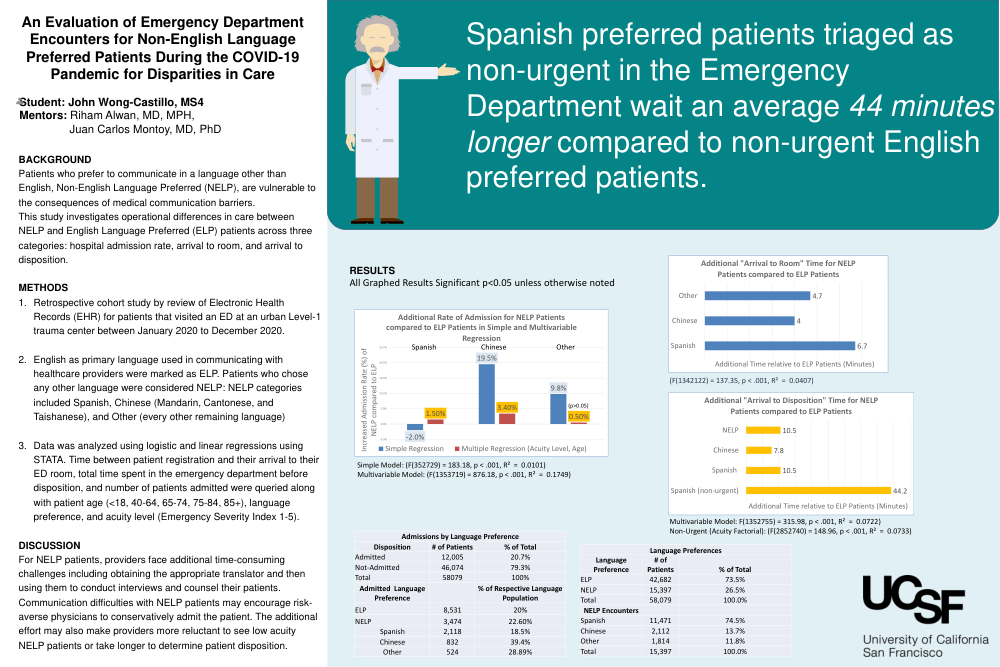
Of the 58,079 unique ED encounters in the study period, 26.5% (n=15,397) were NELP patients: 19.75% (n=11,471) preferred Spanish, 3.6% (n=2,112) preferred Chinese, 3.1% (n=1,814) preferred Other. Of the total ED encounters, 20.7% (n=12,005) of patients were admitted. Within their populations, 22.6% (n=3,474) of all NELP patients were admitted compared to 20.0% (n=8,531) of ELP patients.
When the simple regression was performed using language preference as the single independent variable, patients who selected Spanish were 2.0% less likely to be admitted compared to ELP patients (p=0.00). In contrast, patients who identified Chinese or Other as their preferred language had a 19% and 9.8% greater risk of admission compared to ELP patients (p= 0.00; p= 0.00). When the covariants of age and acuity level were included, patients who preferred Spanish and Chinese were 1.5% and 3.4% more likely to be admitted than ELP patients p= 0.00; p= 0.00). In contrast, Other language preferred patients were not significantly more likely to be admitted compared to ELP patients (p=0.52).
Patients who preferred Spanish, Chinese, or Other languages had an average increased time to arrival to room of 6.68, 4.02, and 4.69 minutes, respectively, compared to ELP patients
(p<0.001 for all three NELP categories). Time to disposition for Spanish language preferred patients and Other preferred patients averaged 10.5 minutes and 7.76 minutes longer than ELP patients (p=0.00; 0.03). NELP patients had an increased average arrival to disposition time of
10.5 minutes compared to ELP patients (p=0.00). This discrepancy varied with ESI level, with the lowest acuity ESI 5 Spanish-preferred patients waiting an average of 44.2 minutes more before disposition than ELP patients (p=0.03).
Discussion:
In the multivariable regression, Spanish and Chinese language preferred patients demonstrate increased overall admission rates compared to ELP patients. Admission rates for Other language preferred patients were only significant in the single variable regression. While this outcome might be correct, in the sample population, Other language preferred patients make up only 3.1% of all patients compared to the 19.75% that prefer Spanish. Thus, it is also likely that compared to the single variable regression, there may not have been sufficient sample size of Other preferred language patients to significantly uncover the true effect in the multivariable analysis.
The likelihood of admission for Spanish language preferred patients changed from less likely in the single variable regression to more likely in the multivariable regression. Spanish is the most common NELP language so there are likely more Spanish speakers/interpreters compared to other languages, which may help decrease diagnostic uncertainty and allow for more discharges. However, it is also possible that providers are underestimating this group’s illness severity, assigning lower acuity levels, and discharging inappropriately. On the other hand, the increased likelihood of admission noted in the multivariable regression may be more accurate since they account for variables that affect acuity such as acuity level and age.
Communication difficulties with NELP patients may encourage risk-averse physicians to conservatively admit the patient.
A similar discrepancy between ELP and NELP patients was observed in the times of arrival to room and arrival to disposition, with Spanish language preferred patients demonstrating increased length of time for both outcomes. This was the most concerning in
non-urgent acuity level 5 complaints where the encounters are an average 44 minutes longer for Spanish-preferred patients compared to ELP patients, reflecting stark differences in patient experience that could become clinically significant. In the ED, high-acuity and life-threatening presentations are treated urgently with algorithmic treatments. In contrast, low acuity complaints can entail complaints that require extensive interviewing. For NELP patients, providers face additional time-consuming challenges including obtaining the appropriate translator and then using them to conduct interviews and counsel their patients. Due to this additional effort, providers may be more reluctant to see low acuity NELP patients or take longer to determine patient disposition.
Limitations of this study include its single center design, with institutional resources and practices potentially limiting the generalizability of the results. Furthermore, inappropriate designations of NELP status, specifically inaccuracies in the EHR or inaccurate self-reporting would likely over- or underestimate the number of NELP encounters. Possible solutions could include increasing the availability of on-site multilingual interpreters and providers. These results should also warrant a re-evaluation of current interpretation services for both ease of access for providers and the translators’ competence in helping clinicians efficiently conduct the encounter.