127 posters, 10 topics, 20 sessions, 127 authors
ePostersLive by SciGen Technologies S.A. All rights reserved.
UCSF 2024 Inquiry Symposium
Conference ePosters

P024
Chronic low back pain mechanistic phenotypes: association with clinical features
Poster Presenter
Authors
Part of Topic
Clinical & Translational Sciences
Title: Chronic low back pain mechanistic phenotypes: association with clinical features
Authors: Roach, C., Scheffler, A., Ewing, S., Zheng, P., Hue, T., Lotz, J., Mehling, W., O’Neill, C.
Introduction:
Three pain mechanisms have been identified: nociceptive, neuropathic, and nociplastic. According to an International Association for the Study of Pain (IASP) Delphi expert consensus study certain clinical features- notably inflammation, sleep disturbance, fatigue, and cognitive impairment- can help discriminate between these mechanisms1. The aim of this study was to determine associations between clinical features and pain mechanism categories in a non- specific chronic LBP (cLBP) population.
Methods
Baseline data from 1,376 participants in BACKHOME, a longitudinal observational e-Cohort of
U.S. adults with cLBP that is part of the NIH Back Pain Consortium (BACPAC) Research Program, were analyzed. Back-dominant pain is an eligibility criterion. Survey data from several domains is collected via an on-line platform. Pain locations, number of chronic overlapping conditions (COPC’s), and responses to the PAINDETECT questionnaire were used to define the pain mechanism categories (i.e., mechanistic phenotypes), based on recommendations from a Delphi expert consensus study1 and from BACPAC investigators. The association of clinical features (risk factors) with the pain mechanism categories was assessed using multinomial logistic regression.
Results
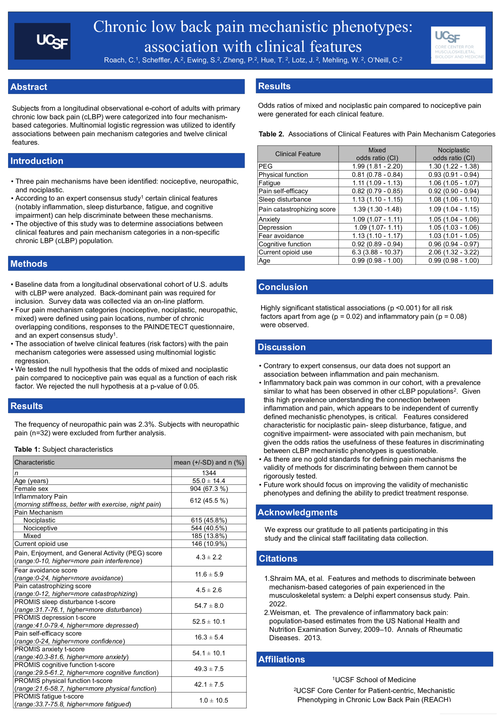
The frequency of neuropathic pain was 2.3%. Subjects in that category (n=32) were excluded from further analysis. The characteristics of the remaining subjects are in Table 1. We tested the null hypothesis that the odds of mixed and nociplastic pain compared to nociceptive pain was equal as a function of each risk factor. We rejected the null hypothesis at a level of
0.05 and found highly significant statistical associations (p <0.001) for all risk factors apart from age (p = 0.02) and inflammatory pain (p = 0.08). The odds ratios for the risk factors with statistically significant associations with the pain mechanism categories are in Table 2. Nociceptive pain is the reference category.
Discussion
Contrary to expert consensus, our data does not support an association between inflammation and pain mechanism. Inflammatory back pain was common in our cohort, with a prevalence similar to what has been observed in other cLBP populations2. Given this high prevalence understanding the connection between inflammation and pain, which appears to be independent of currently defined mechanistic phenotypes, is critical. Features considered characteristic for nociplastic pain- sleep disturbance, fatigue, and cognitive impairment- were associated with pain mechanism, but given the odds ratios the usefulness of these features in discriminating between cLBP mechanistic phenotypes is questionable. As there are no gold standards for defining pain mechanisms the validity of methods for discriminating between them cannot be rigorously tested. Future work should focus on improving the validity of mechanistic phenotypes and defining the ability to predict treatment response.
Table 1: Subject characteristics
|
Characteristic |
n = 1344 mean (+/-SD) and n (%) |
|
Age (years) |
55.0 ± 14.4 |
|
Female sex |
904 (67.3 %) |
|
Inflammatory Pain (morning stiffness, better with exercise, night pain) |
612 (45.5 %) |
|
Pain Mechanism |
|
|
Nociplastic |
615 (45.8%) |
|
Nociceptive |
544 (40.5%) |
|
Mixed |
185 (13.8%) |
|
Current opioid use |
146 (10.9) |
|
Pain, Enjoyment, and General Activity (PEG) score (range:0-10, higher=more pain interference) |
4.3 ± 2.2 |
|
Fear avoidance score (range:0-24, higher=more avoidance) |
11.6 ± 5.9 |
|
Pain catastrophizing score (range:0-12, higher=more catastrophizing) |
4.5 ± 2.6 |
|
PROMIS sleep disturbance t-score (range:31.7-76.1, higher=more disturbance) |
54.7 ± 8.0 |
|
PROMIS depression t-score (range:41.0-79.4, higher=more depressed) |
52.5 ± 10.1 |
|
Pain self-efficacy score (range:0-24, higher=more confidence) |
16.3 ± 5.4 |
|
PROMIS anxiety t-score (range:40.3-81.6, higher=more anxiety) |
54.1 ± 10.1 |
|
PROMIS cognitive function t-score (range:29.5-61.2, higher=more cognitive function) |
49.3 ± 7.5 |
|
PROMIS physical function t-score (range:21.6-58.7, higher=more physical function) |
42.1 ± 7.5 |
|
PROMIS fatigue t-score (range:33.7-75.8, higher=more fatigued) |
57.1± 10.5 |
Table 2. Associations of Clinical Features with Pain Mechanism Categories
|
Clinical Feature |
Mixed odds ratio (CI) |
Nociplastic odds ratio (CI) |
|
PEG |
1.99 (1.81 - 2.20) |
1.30 (1.22 - 1.38) |
|
Physical function |
0.81 (0.78 - 0.84) |
0.93 (0.91 - 0.94) |
|
Fatigue |
1.11 (1.09 - 1.13) |
1.06 (1.05 - 1.07) |
|
Pain self-efficacy |
0.82 (0.79 - 0.85) |
0.92 (0.90 - 0.94) |
|
Sleep disturbance |
1.13 (1.10 - 1.15) |
1.08 (1.06 - 1.10) |
|
Pain catastrophizing score |
1.39 (1.30 -1.48) |
1.09 (1.04 - 1.15) |
|
Anxiety |
1.09 (1.07 - 1.11) |
1.05 (1.04 - 1.06) |
|
Depression |
1.09 (1.07- 1.11) |
1.05 (1.03 - 1.06) |
|
Fear avoidance |
1.13 (1.10 - 1.17) |
1.03 (1.01 - 1.05) |
|
Cognitive function |
0.92 (0.89 - 0.94) |
0.96 (0.94 - 0.97) |
|
Current opioid use |
6.3 (3.88 - 10.37) |
2.06 (1.32 - 3.22) |
|
Age |
0.99 (0.98 - 1.00) |
0.99 (0.98 - 1.00) |
- Shraim MA, et al. Features and methods to discriminate between mechanism-based categories of pain experienced in the musculoskeletal system: a Delphi expert consensus study. Pain. 2022.
- Weisman, et. The prevalence of inflammatory back pain: population- based estimates from the US National Health and Nutrition Examination Survey, 2009–10. Annals of Rheumatic Diseases. 2013.