127 posters, 10 topics, 20 sessions, 127 authors
ePostersLive by SciGen Technologies S.A. All rights reserved.
UCSF 2024 Inquiry Symposium
Conference ePosters

P021
Dental block by ED providers gives substantial immediate pain relief in dental pain patients
Poster Presenter
Authors
Part of Topic
Clinical & Translational Sciences
Background and Objectives
Dental pain represents 2% of ED visits, with over 75% presenting with a severe level of pain. While dental nerve block (DNB) is described as a method for acute pain relief, there are no studies examining the magnitude of pain relief when performed by ED providers. We hypothesized that DNB would provide substantial immediate pain relief to ED dental pain patients.
Methods
This was a single-center, prospective, pragmatic observational cohort study of adult patients with dental pain felt by the ED p rovider to be able to benefit from DNB. Patients received DNB method with 0.5% bupivacaine with a 27-G needle according to the following teeth involved: Inferior alveolar nerve block (IAN) for mandibular teeth, posterior-superior alveolar block (PSA) for maxillary molars, and supraperiosteal (SP) for maxillary non-molars. No specialized dental equipment was used. Providers without prior experience in DNB attended either a short class or received in-ED training just prior to procedure. Primary outcome measure was pain VAS decrease on a 10-cm scale at 10 minutes post–injection, with a priori definition based on previous literature of 1.7 cm as minimum clinically significant decrease and 3.2 cm as substantial decrease. Patients could get one more injection.
Results
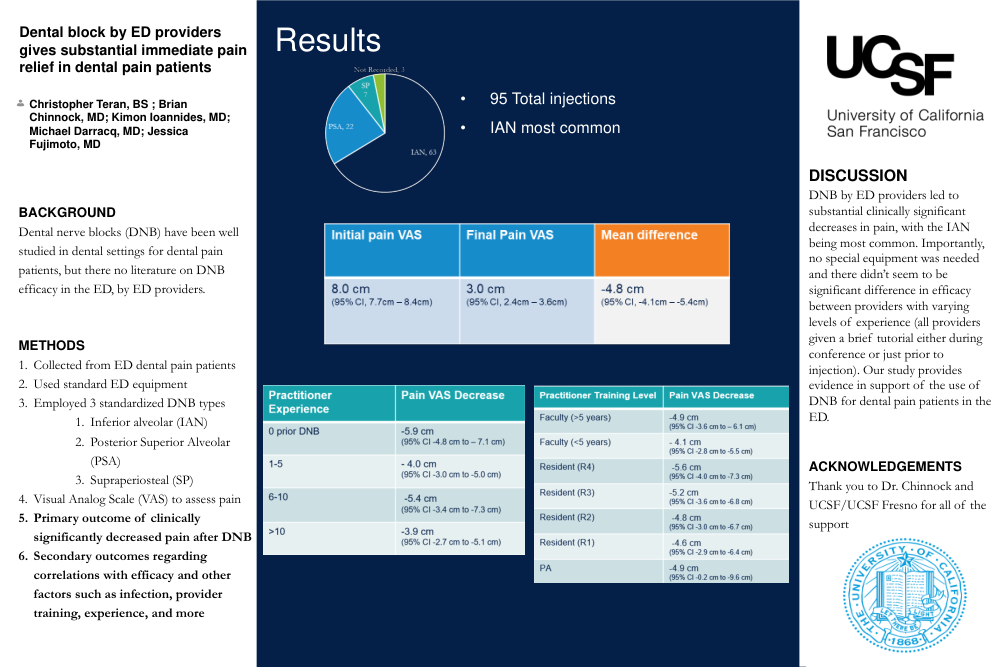
There were 95 DNB enrolled over 19 months. Mandibular molars were the source of pain in 68% of patients. The following DNB were performed: 63 IAN, 22 PSA, and 7 SP and 3 with pain scores recorded, but not the type of block. Initial pain VAS was 8.0 cm (95% CI 7.7 cm
– 8.4 cm), and decreased to 3.0-cm (95% CI 2.4 cm to 3.6 cm), with a mean difference of -
4.8 cm (95% CI -4.1 cm to -5.4 cm). Eleven patients (12%) required a second DNB, of which 6 got > 3.2 cm decrease in pain. Practitioner DNB experience did not significantly affect pain VAS decrease: 0 prior: -5.9 cm (95% CI -4.8 cm to – 7.1 cm); 1-5 prior: - 4.0 cm (95% CI -3.0 cm to -5.0 cm); 6-10 prior: -5.4 cm (95% CI -3.4 cm to -7.3 cm); >10 prior: -3.9 cm (95% CI -2.7 cm to -5.1 cm). Ninety-four percent of patients indicated they would want DNB if they presented to an ED with similar dental pain in the future.
Conclusion
DNB by an ED provider provided substantial immediate pain re lief to ED dental pain patients. Future research may examine whether decreasing pain and breaking the pain cycle gives any continued pain decrease past the duration of the anesthetic agent.