127 posters, 10 topics, 20 sessions, 127 authors
ePostersLive by SciGen Technologies S.A. All rights reserved.
UCSF 2024 Inquiry Symposium
Conference ePosters

P020
Impact of Cognitive Impairment from Frontotemporal Spectrum Disorder on Quality-of-Life Outcomes in Amyotrophic Lateral Sclerosis
Poster Presenter
Authors
Part of Topic
Clinical & Translational Sciences
Impact of Cognitive Impairment from Frontotemporal Spectrum Disorder on Quality-of-Life Outcomes in Amyotrophic Lateral Sclerosis
Author: Ariana Josefina Andere
Mentor: Catherine Lomen-Hoerth, MD, PhD
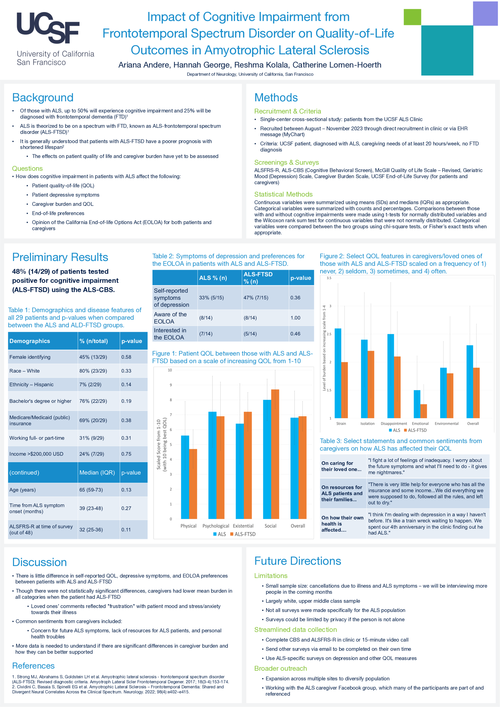
Background: Amyotrophic Lateral Sclerosis (ALS) is a neurodegenerative disease affecting both upper and lower motor neurons with a mean survival time is 2-5 years from the time of diagnosis. Of those with ALS, over 50% will experience cognitive impairment and 15% will be diagnosed with frontotemporal dementia (FTD), which causes rapid changes in behavior and considerable disability. ALS is postulated to be on a spectrum with FTD given this significant overlap in dual diagnosis and involvement of the frontal lobe. ALS with any level of cognitive impairment is often referred to as ALS-frontotemporal spectrum disorder (ALS-FTSD), with cognitive and behavioral subclasses. It is generally understood that patients with ALS-FTSD have a poorer prognosis with a shortened lifespan compared to those with ALS, but the effect of these diagnoses on patient and caregiver quality-of-life have yet to be determined.
Aims: To understand the quality-of-life preferences and caregiver burden in patients with cognitive ALS- FTSD when compared to those with ALS and their caregivers through a series of surveys.
Methods: single-center cross-sectional study. Patients recruited from July-November 2023 in the ALS clinic or via MyChart after their appointment. Criteria included: UCSF ALS clinic patient, diagnosed with ALS, caregiver needs of at least 20 hours/week, and no FTD diagnosis. Patients signed up for a 2-hour video survey appointment on Zoom with the surveyor. Demographics were collected from patient medical records and disease severity was assessed using the ALS Functional Rating Scale-Revised (ALSFRS-R). An initial patient assessment was completed with the ALS Cognitive Behavioral Screen (ALS-CBS), which determines if patients are categorized into the ALS or ALS-FTSD diagnosis. Patients and their caregivers then completed four surveys: the caregiver burden scale (CgBS), the McGill Quality of Life Survey – Revised (MQOL-R), the Geriatric Depression Scale (Mood Scale), and a UCSF End-of-Life Options Act (EOLOA) survey for patients and caregivers. Continuous variables were summarized using means (SDs) and medians (IQRs) as appropriate. Categorical variables were summarized with counts and percentages. Comparisons between those with and without cognitive impairments were made using t-tests for normally distributed variables and the Wilcoxon rank sum test for continuous variables that were not normally distributed. Categorical variables were compared between the two groups using chi-square tests, or Fisher’s exact tests when appropriate.
Preliminary Results: Our cohort included 29 patients (45% female-identifying, 80% white, 7% Hispanic) with a median age of 65 years (IQR 59-73). In this cohort, 48% (14/29) were positive for cognitive ALS-FTSD. There was no difference in self-reported symptoms of depression (33% ALS, 47% ALS-FTSD, p-value 0.36), and both groups of patients were equally aware of (p-value 1.00) and interested in (p-value 0.46) the EOLOA. There was no significant difference in quality of life of patients with ALS versus ALS-FTSD overall (p-value = 0.24) or in any subscale category. Regarding caregivers, while there was no significant difference in caregiver burden, there was higher caregiver burden in the ALS group in all categories compared to ALS-FTSD group (scaled from 1-4 with increasing burden): strain 2.6 vs 2, isolation 2.4 vs 2.2, disappointment 2.5 vs 2.1, emotional 1.5 vs 1.25, environmental 1.9 vs 1.8, and overall burden 2.3 vs 1.9. Qualitatively, common themes expressed by loved ones included anxieties in meeting future care needs for the patient, lack of resources for patients and families, and how the diagnosis has negatively impacted their own physical and mental health.
Conclusion: There is a little difference in quality of life, depression symptoms, and EOLOA preferences between patients with ALS and ALS-FTSD. However, caregivers of patients with ALS have higher burden on average, which may be due to the patient’s cognitive ability to relay more worries regarding their illness onto their loved one. More data is needed to better understand if there is a significant difference in caregiver burden in these groups and how we can better advocate for patients with ALS and their loved ones.