127 posters, 10 topics, 20 sessions, 127 authors
ePostersLive by SciGen Technologies S.A. All rights reserved.
UCSF 2024 Inquiry Symposium
Conference ePosters

P018
Expectations and Experiences of Spanish-Speaking Caregivers in the Pediatric Perioperative Setting
Poster Presenter
Authors
Part of Topic
Clinical & Translational Sciences
Expectations and Experiences of Spanish-Speaking Caregivers in the Pediatric Perioperative Setting
Pedro Gallardo, MS4 Odinakachukwu Ehie, MD, FASA
Introduction:
The perioperative period is a time of critical information exchange between patients and their operative teams. Pediatric patients pose unique communication considerations during this period, including communication with both patients and their adult decision makers and parental presence during induction of anesthesia. Meanwhile, non-English language preference (NELP) and Hispanic ethnicity are independently associated with decreased patient satisfaction and worse post-operative outcomes. Yet, little is known about the quality of communication with NELP caregivers nor their experiences in the perioperative setting.
Aims and Hypothesis:
The primary aim of this study is to understand whether preferred language is associated with differences in measures of quality communication during the perioperative period. The secondary aim of this study is to identify themes in caregivers’ expectations and experiences in the perioperative area.
In line with previous studies in the pediatric surgical setting, we hypothesize that Spanish-speaking caregivers have similar satisfaction scores during the perioperative period but place greater emphasis on the importance of language-concordant care compared to English-preference caregivers. Different expectations for medical care, influenced by health literacy and prior experiences in the healthcare system, may underlie similar satisfaction scores.
Project Design:
This is a sequential explanatory study examining the associations between caregiver language and self- reported satisfaction measures in the pediatric perioperative setting, which included the preoperative, intraoperative, and post-anesthesia recovery unit (PACU) areas. Participants were a convenience sample of English- or Spanish-speaking caregivers awaiting scheduled surgeries at a large academic medical center. On the day of their child’s procedure, and after speaking with their multi-disciplinary care team, participants completed a novel 9-item Likert-scale questionnaire assessing their perceptions of their team’s communication. This questionnaire was modeled after validated surveys used in the pediatric surgical setting and assessed four communication domains, including perceived understanding, trust in their healthcare team, quality of information received, and the importance of language concordance. At least two weeks following their child’s procedure, we conducted follow-up interviews with caregivers from both language groups to further delineate their views of quality perioperative care.
Parametric testing and descriptive analyses were used to analyze questionnaire responses. Meanwhile, inductive coding was used to identify themes underlying caregiver-reported expectations and experiences in the perioperative setting.
Results:
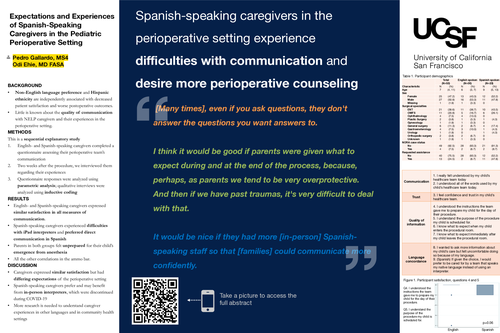
This study included 53 participants, 24 of whom primarily communicate in Spanish. Children of surveyed respondents ranged from 2 months to 19 years (median 7 years). Most NELP respondents communicated via an interpreter (92%) or Spanish-speaking staff (21%) in the pre-operative holding area. Notably, 48% of the Spanish-preference group requested that the survey be read to them, compared to 6.7% of the English-preference group.
Caregivers in both groups expressed satisfaction in all measures of trust, perceived understanding, and quality of information received (median 5; IQR 4, 5). That said, caregivers in the Spanish-preference
group expressed less comprehension of pre-operative instructions and the purpose of their child’s procedure, which trended toward significance (p=0.06). Spanish respondents also preferred to be communicated with directly in Spanish as opposed to via interpreter (median 4, IQR 3,5).
We contacted 29 participants (23 Spanish, 6 English) and completed 16 follow-up interviews, 13 of whom were Spanish-speaking. Caregivers in both language groups expected and valued child-centered care, which was facilitated by child life specialists. Caregivers appreciated pre-operative counseling on the immediate preoperative and intraoperative periods but did not feel prepared for their child’s emergence from anesthesia. Non-English-preferring parents expressed more implicit trust in their child’s healthcare team compared to their English counterparts and this trust was affirmed by many touchpoints from multidisciplinary colleagues. They also identified multiple logistical and technological difficulties with iPad interpreters, reasons for which they preferred in-person interpretation and Spanish-speaking staff.
Discussion/Conclusion:
This is the first study to describe interpreter use and caregiver experiences in the pediatric perioperative setting. More caregivers reported using interpreters in the outpatient setting compared to the preoperative holding area, whereas communication with Spanish-speaking staff was more common on the day of their child’s procedure. Spanish-speaking respondents also expressed a strong preference for direct communication with Spanish-speaking staff, and in-person interpretation compared to iPad interpreters. These findings support the return of in-person interpreters following the hiatus during the COVID pandemic and suggests one possible intervention to target perioperative disparities.
While caregivers from both language groups had similar satisfaction scores, thematic analysis revealed different caregiver expectations and experiences by preferred language. Spanish-preferring caregivers expressed more implicit trust and gratitude for their perioperative teams, often drawing comparisons between their current experiences and those at other community and county hospital settings. This underscores the importance of studying disparities across the healthcare system, including in the perioperative setting. Moreover, the discordance between seemingly similar satisfaction scores and follow-up interviews affirms the importance of diverse data collection when working with minoritized populations. Lastly, caregivers’ perceived lack of preparation for their child’s emergence from anesthesia may help pediatric anesthesia teams adapt their preoperative counseling to their families’ needs.
Some limitations of this study include the lack of representation of caregivers with other language preferences, the number of participants sampled, as well as its focus on a single large academic medical center. This specific context offers unique resources and barriers not seen in rural or community health settings – barieres alluded to by multiple participants. Further research in these settings is paramount.
Limitations notwithstanding, this study contributes to a growing body of literature expanining NELP patient experiences across the healthcare system. It also highlights anesthesiology and perioperative care teams as instrumental figures in addressing disparities in the periopative setting.