127 posters, 10 topics, 20 sessions, 127 authors
ePostersLive by SciGen Technologies S.A. All rights reserved.
UCSF 2024 Inquiry Symposium
Conference ePosters

P014
Striato-limbic Beta Power is Associated with Diurnal Variation and DBS-induced Arousal in Patients with Severe OCD
Part of Topic
Clinical & Translational Sciences
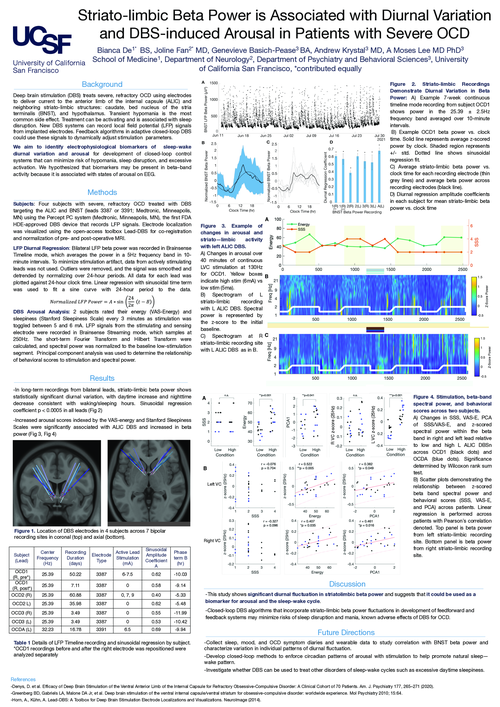
Striato-limbic Beta Power is Associated with Diurnal Variation and DBS- induced Arousal in Patients with Severe OCD
Bianca De1* BS, Joline Fan2* MD, Genevieve Basich-Pease3 BA, Andrew Krystal3 MD, A Moses Lee MD PhD3
School of Medicine1, Department of Neurology2, Department of Psychiatry and Behavioral Sciences3, University of California San Francisco, *contributed equally
Deep brain stimulation (DBS) of the anterior limb of the internal capsule (ALIC) and nearby bed nucleus of the stria terminalis (BNST) is a treatment for severe refractory OCD and depression. However, ALIC DBS is often activating and can be associated with disruptions in sleep and result in mania. Recent advances in DBS systems now allow for the possibility of conducting local field potential (LFP) recordings from implanted electrodes. These signals can be used to control DBS to develop closed-loop neuromodulation systems. Here, we were interested in identifying electrophysiological biomarkers of sleep-wake diurnal variation to develop closed-loop systems that can minimize the risk of excessive activation, sleep disruption, and mania. We were interested in beta band activity, which is associated with states of arousal on EEG. From 4 patients with severe OCD being treated with ALIC DBS, we recorded beta power (25Hz ± 2.5Hz) continuously over a period of 3.5 days to 5 weeks using the Medtronic Percept. Pairs of recording leads were primarily within the BNST. We identified strong diurnal variation in BNST beta activity (p<.00005, linear regression with sinusoidal time term). Beta increased during wakeful hours and vanished during sleep. In a separate stimulation studies, we identified that DBS was associated with increased arousal scores indexed by the VAS-Arousal and Stanford Sleepiness Scales as well as broadband increases in beta power. In a single patient, DBS-induced increases in measures of arousal were significantly correlated with changes in the beta activity.
Together, these studies demonstrate that BNST beta power can be used as a biomarker of diurnal variation associated with wakefulness and DBS-induced arousal. In the future, further investigations will be needed to determine if closed-loop ALIC DBS that enhances natural circadian variation in beta can be used to mitigate sleep disruption/mania risk in patients with OCD.