127 posters, 10 topics, 20 sessions, 127 authors
ePostersLive by SciGen Technologies S.A. All rights reserved.
UCSF 2024 Inquiry Symposium
Conference ePosters

P013
The Impact of the VEGA-1 trial on local hospital providers’ first line vasopressor use
Poster Presenter
Authors
Part of Topic
Clinical & Translational Sciences
TheImpactoftheVEGA-1trialonlocalhospitalproviders’firstlinevasopressoruse
Background:
The VEGA-1 trial, a pilot cluster randomized crossover study that established feasibility of alarger trial involving norepinephrine (NE) or phenylephrine (PE) for hypotension, provides agood base to study long-term effects of a pragmatic trial on local anesthesia practice. TheVEGA-1trialranfromJuly-December2021andshowedthatNEwassafewithnodifferenceinpostoperative outcomes. Before VEGA-1, PE was the most predominantly used vasopressor formajornon-cardiac surgeries atUCSF.
Hypothesis:
WehypothesizedthattheVEGA-1trialincreasedNEuseinmajorsurgeryatUCSF.
Aims:
WeaimedtodetermineiftheVEGA-1trialchangedlocalpracticeandestablishedequipoisebetween NE and PE as first-line vasopressor infusions.
Methods
This was a retrospective cohort study at three UCSF hospitals from January 2021-May 2023.Data from non-UCSF hospitals participating in VEGA-1 was not available. Time period A wasdefined as the 6 continuous months before VEGA-1. Period B was defined as the 6 months afterVEGA-1. The proportion of eligible cases (adults ≥ 18, inpatient admission, and majorsurgery>2hours under GA with cardiac, transplant, and obstetric surgeries excluded) receivingNE as 1st-line vasopressor outside of VEGA-1 was the primary outcome. Deidentified patientdata including surgery type, service, medical history, intraoperative medications, and laboratoryvalues was extracted from the electronic record. The primary outcome was compared for PeriodA and B using Chi-square. Interrupted time-series analysis was used to compare trends beforeand after VEGA-1. Statistical analyses were run in Stata.
Results
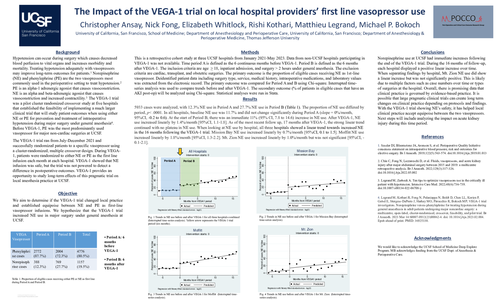
5933 cases were analyzed, with 11.6% NE use in Period A and 26.9% NE use in Period B. TheproportionofNEusedifferedbyperiod,p<.0001.BaselineNEusewas11%anddidnotchangesignificantly during Period A (slope = 0%/month, 95%CI, -0.2-0.6). At the start of Period B,there was an immediate 11.1% (95% CI, 7.8 to 14.6) increase in NE use. After VEGA-1, NE useincreased linearly by 1.5%/month [95%CI, 1.1-1.8). As of the most recent follow up, 17 monthsafter VEGA-1, the strong linear trend continued with no plateau in NE use.
Conclusions
Norepinephrine use at UCSF increased significantly after VEGA-1, exhibiting a linear rise overtime. We see that the local clinical practice changed after the VEGA-1 trial showing thatproviders were able to accept equipoise between the two vasopressors. This study had severallimitations. Although three hospital centers were included in the study, the case sizes at eachhospital were widely variable. Additionally, the surgical types were different at each hospitalwhich could create different situations that require different anesthesia medications. Next stepswill include analyzing the impact on acute kidney injury during this time period. Other furtherstudies should focus on the uptake of evidence-based medicine at hospitals not related to theoriginal setting of a clinical trial to truly elicit the effects of clinical results on anesthesiapractice.
ucsf2024.00e001b