127 posters, 10 topics, 20 sessions, 127 authors
ePostersLive by SciGen Technologies S.A. All rights reserved.
UCSF 2024 Inquiry Symposium
Conference ePosters

P128
Radiotherapy after Neoadjuvant Immunotherapy to Overcome Liver Metastasis Associated Tolerance
Part of Topic
Clinical & Translational Sciences
Kim, Luke
Inquiry Abstract
- Introduction
- Metastasis accounts for over 90% of cancer mortality. Checkpoint inhibitors (CPI) have shown efficacy in increasing antitumor immunity in solid and liquid tumors. Checkpoint inhibitor therapy (CPI) is a class of immunotherapy that can be used to induce complete and durable responses in melanoma. However, presence of liver metastasis (LM) has
been shown to decrease response rate, overall and progression-free survival. It is
unclear what molecular mechanisms drive liver-associated immune tolerance. Because the liver is a common site of metastasis, uncovering mechanisms for tolerogenesis is
crucial for advancing the field of immuno-oncology.
- Preliminary data from our group have shown that excision of liver tumor results in greater CPI response rate. The abscopal response is when radiotherapy (RT) to one
tumor site may lead to regression of tumor at distant sites not irradiated. We used RT to selectively ablate liver and skin lesions and administered neoadjuvant CPI.
- Hypothesis or question
- Question: How can current treatment modalities be combined with CPI to improve outcomes in liver-metastatic cancer?
- Hypothesis: RT to the liver site in conjunction with CPI in liver-metastatic melanoma will improve the systemic antitumor response, evidenced by greater abscopal effect.
- Aims
- Selectively ablate either SQ or LM site with RT to induce systemic antitumor immunity in a mouse model of liver-metastatic melanoma
- Perform flow cytometry analysis on SQ and LM TILs to determine cell-types and molecular pathways driving observed LM-associated tumor tolerogenesis
- Aims
- Project Design/Methods
- We used a mouse model of liver-metastatic melanoma, which utilizes orthotopic tumor implantation, to simulate liver-metastatic melanoma. We used the small animal
radiation research platform to perform RT. MC38 colon adenocarcinoma cells were used; these cells behave similarly to in vivo melanoma cells, exhibit low mutational burden, and have been validated in other preclinical studies as an effective melanoma model.
- Results
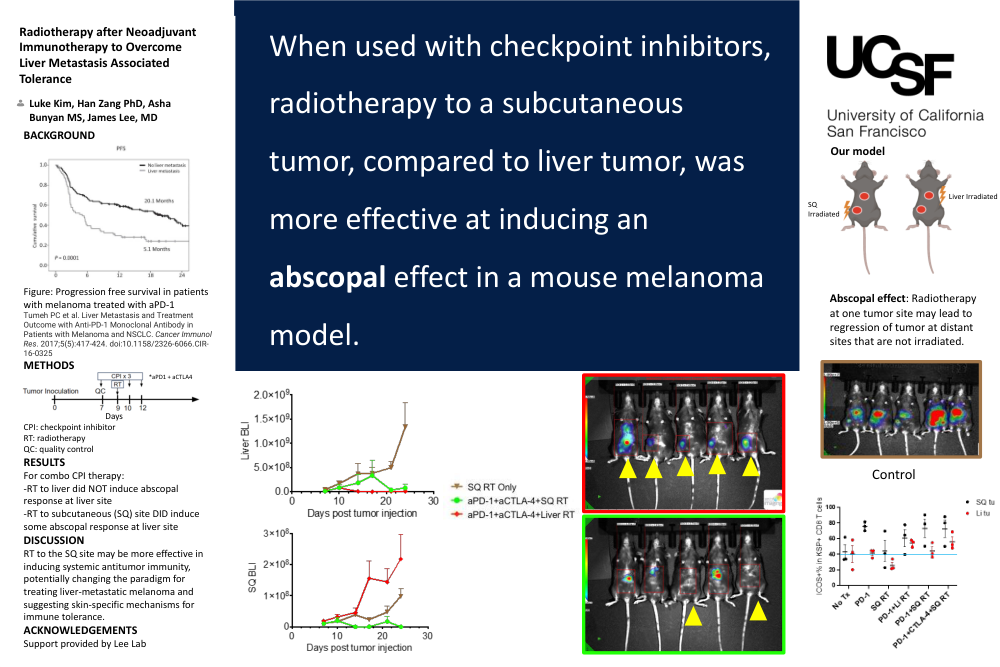
- We hypothesized that RT to the liver will improve the antitumor response, when you look at the total bioluminescence (BLI), Liver RT and aPD-1 appears superior to the SQ RT group.
- When you look at the liver BLI and SQ BLI separately, even though liver RT and aPD-1 seems to be effective at treating the liver tumor, all the SQ tumors were still present.
- When we look at the SQ RT treatment, we found there was one complete response (CR) due to the abscopal effect. aPD-1 alone does not induce response at the liver site, but in conjunction with RT is effective.
- We also tested treatment with a regimen commonly used in clinical settings, combo CPI with aPD-1 and aCTLA-4, which showed that SQ RT achieved two CRs out of five and achieved the best anti-tumor response.
- Discussion
- RT to the SQ site in a mouse model of liver-metastatic melanoma was more effective at
inducing the abscopal effect than RT to the LM. Our initial hypothesis was not supported by our results. This suggests the skin plays a significant role in mediating systemic anti-
tumor immune response. Prior studies have not documented the effect of targeting skin lesions with RT in metastatic melanoma or other cancers and contrasts with preliminary data collected by our group, which found that LM resulted in increased activation of CTLA-4hi Tregs, suppressive CD11b+MDSCs, and reduced CD80/86 costimulation. Flow
cytometry analysis of tumor infiltrating lymphocytes (TIL) from both liver and SQ sites revealed that “…”, suggesting that “…”.