127 posters, 10 topics, 20 sessions, 127 authors
ePostersLive by SciGen Technologies S.A. All rights reserved.
UCSF 2024 Inquiry Symposium
Conference ePosters

P126
Long-Term Appearance and Outcomes of Strip Craniectomy Compared with Cranial Vault Reconstruction in Sagittal Craniosynostosis
Poster Presenter
Authors
Part of Topic
Clinical & Translational
Long-Term Appearance and Outcomes of Strip Craniectomy Compared with Cranial Vault Reconstruction in Sagittal Craniosynostosis
Danial, Elizabeth; George, Elizabeth; Sun, Peter; Pomerantz, Jason
Introduction: Sagittal craniosynostosis is caused by premature fusion of the sagittal suture, which creates an elongated scaphocephalic head shape and may lead to increased intracranial pressure. Repair during the first year of life can help prevent social and neurodevelopmental complications. Common methods of repair are open cranial vault reconstruction (OCVR) and strip craniectomy with orthotic helmet therapy (SCOT). However, although both SCOT and OCVR are considered to be efficacious for treatment of sagittal craniosynostosis, direct comparisons of cranial shape and appearance are lacking.
Aims: The purpose of this study was to assess which technique produces optimal long-term outcomes by comparing perioperative surgical outcomes, cephalometric measurements, parent satisfaction, and subjective appearance ratings.
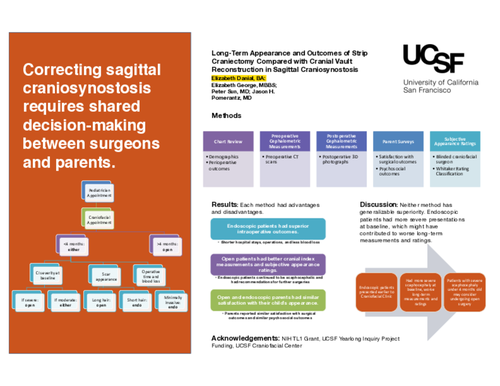
Methods: Patients who were non-syndromic and underwent OCVR or SCOT before 12 months of age for isolated sagittal craniosynostosis at our institution were included in the study. A chart review was conducted to record demographics and assess intraoperative outcomes. Preoperative anthropometric measurements were made using computed tomography to include cranial index (CI), frontal bossing, occipital bulleting, vertex-nasion-opisthocranion (VNO) angle, vertical height, and intracranial volume. Patients were recruited for 3D photography, and anthropometric measurements were made using Vectra software to include CI, auricular height, VNO angle and circumference. Recruited patients were asked to complete a satisfaction survey. Blinded Whitaker classification ratings were made on 3D photographs. Descriptive statistics were calculated.
Results: Forty-seven patients were included (18 SCOT and 29 OCVR), with a median age at the time of surgery of 3 months (2-4 months) and 7 months (6-8 months) in SCOT and OCVR patients, respectively. Follow-up at the time of recruitment was similar between groups (SCOT 6.7 +/-2.2 years, OCVR 7.0 +/-1.7 years). Patients who underwent SCOT had shorter operative times (p<0.001), less estimated blood loss (p<0.001), fewer blood transfusions (p=0.045), and shorter hospital stays (p=0.01). At baseline, the SCOT patients had more severe CI measurements (SCOT 67.29% vs. OCVR 73.1%; p=0.02) and occipital bulleting (SCOT 135.3° vs. OCVR 122.3°; p=0.01). There were no statistically significant differences in measurements on postoperative 3D photographs between OCVR and SCOT. However, SCOT patients continued to be more scaphocephalic postoperatively compared to OCVR patients. More patients had a Whitaker classification rating of 1 (no surgical recommendations) in the OCVR group compared to SCOT. OCVR and SCOT patients reported statistically similar satisfaction with the results of surgery (p=0.30), and SCOT patients were no more likely to report bullying (p=0.37).
Conclusions: This comparative analysis revealed that choosing the optimal method for correcting sagittal craniosynostosis is nuanced. OCVR had superior measurements and Whitaker classification outcomes, while SCOT had superior perioperative outcomes and equivocal parent satisfaction in most domains. A notable finding of this study is patients with more severe scaphocephaly underwent SCOT at our institution. This suggests that patients with severe scaphocephaly at baseline may consider undergoing OCVR if they are less than 4-6 months old. These data suggest that neither SCOT nor OCVR has generalizable superiority in terms of perioperative and outcome metrics. The optimal approach should be decided on a case-by-case basis.