127 posters, 10 topics, 20 sessions, 127 authors
ePostersLive by SciGen Technologies S.A. All rights reserved.
UCSF 2024 Inquiry Symposium
Conference ePosters

P125
Context-variant and context-invariant ensembles for socioemotional action in the murine medial prefrontal cortex
Poster Presenter
Authors
Part of Topic
Biomedical Science
Title:
Context-variant and context-invariant ensembles for socioemotional action in the murine medial prefrontal cortex
Introduction:
The prefrontal cortex is crucial for navigating social interactions, managing anxiety-driven avoidance, and adapting behavior to various contexts. However, it unclear how prefrontal neurons process socioemotional cues across different settings; are contextual and socioemotional information processed by different subcircuits, or are these disparate types of information encoded across the same neurons?
Hypothesis
We hypothesized an overlap between neurons belonging to ensembles modulated by socioemotional information and those modulated by environment. However, we also predict that neuronal ensembles modulated by socioemotional salience remain invariant with changes in environment.
Aims
Aim 1: To decode social activity-specific prefrontal ensembles and compare ensemble structure within similar social events across variable environments.
Aim 2: To decode anxiety-related prefrontal ensembles and compare ensemble structure across variable anxiogenic environments.
Project Design/Methods:
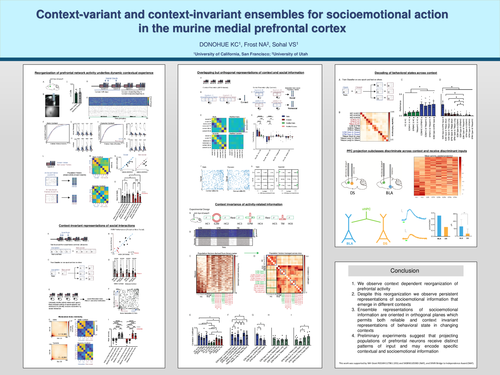
We utilized microendoscopic imaging of calcium-indicated neuronal activity in the medial prefrontal cortex of within two main domains of exposure: social interaction with novel juvenile mice or anxiety-related maze exposure. Neuronal activity within these exposures were compared to similar exposures in different environments; social encounters were studied in variable cages, whereas anxiety-related maze exposure occurred across differently-oriented elevated mazes. Neuronal activity was analyzed by converting calcium fluorescence activity of single cells (parsed by a PCA/ICA segmentation approach) into binary rasters of neuronal activity, within activity times linked to the behavior of the mouse at that time using manual scoring of live video.
Results:
8 mice underwent socio-contextual study, and 6 mice underwent anxiety-contextual study. Neuronal ensembles representing context and social interaction overlapped more than anticipated, yet remained orthogonal – that is, most neurons involved in both patterns were positively modulated by one type of salience and negatively by the other. Similarly, anxiety-related ensembles showed generalization across environments and shared neurons with ensembles modulated by environment, but again overlap was orthogonal.
These findings illustrate how the prefrontal cortex efficiently integrates multiple information streams using the same neurons, rather than relying on distinct subcircuits. This mechanism enables the encoding of socioemotional cues that remain consistent across various environmental contexts, despite the specific reorganization of neuronal activity patterns.
Discussion
These findings illustrate how the prefrontal cortex integrates multiple information streams using the same neurons, rather than relying on distinct subcircuits. This mechanism enables the encoding of socioemotional cues that remain consistent across various environmental contexts, despite the specific reorganization of neuronal activity patterns.