127 posters, 10 topics, 20 sessions, 127 authors
ePostersLive by SciGen Technologies S.A. All rights reserved.
UCSF 2024 Inquiry Symposium
Conference ePosters

P122
Use of Gender-Affirming Language in Medicine Notes for Transgender and Nonbinary Patients
Poster Presenter
Authors
Part of Topic
Social & Behavioral
Abstract: Use of Gender-Affirming Language in Medicine Notes for Transgender and Nonbinary Patients
Author: Jay Bindman
Mentors: Jae Sevelius and Nicole Rosendale
Introduction:
Transgender and nonbinary (TNB) individuals experience health disparities due to stigma in medical settings, including non-affirming language within health documentation. This is particularly important in the era of Open Notes where patients now have immediate access to view their medical records. This study aims to assess the prevalence of gender-affirming best practices in clinical notes and describe themes in clinicians’ use of non-affirming language to refer to and describe TNB patients.
Methods:
Clinical notes of adult TNB patients seen in primary care and inpatient medicine settings were identified using self-identified gender identity and sex assignment at birth data fields. A random sample with enrichment of 54 notes were selected and analyzed for the presence of best-practices for gender affirmation. Qualitative content analysis identified themes in the use of non-affirming language across the domains of personal pronouns, lived names, gender descriptors, and gender-related diagnoses. Descriptive statistics assessed adherence to gender-affirming best practices.
Results:
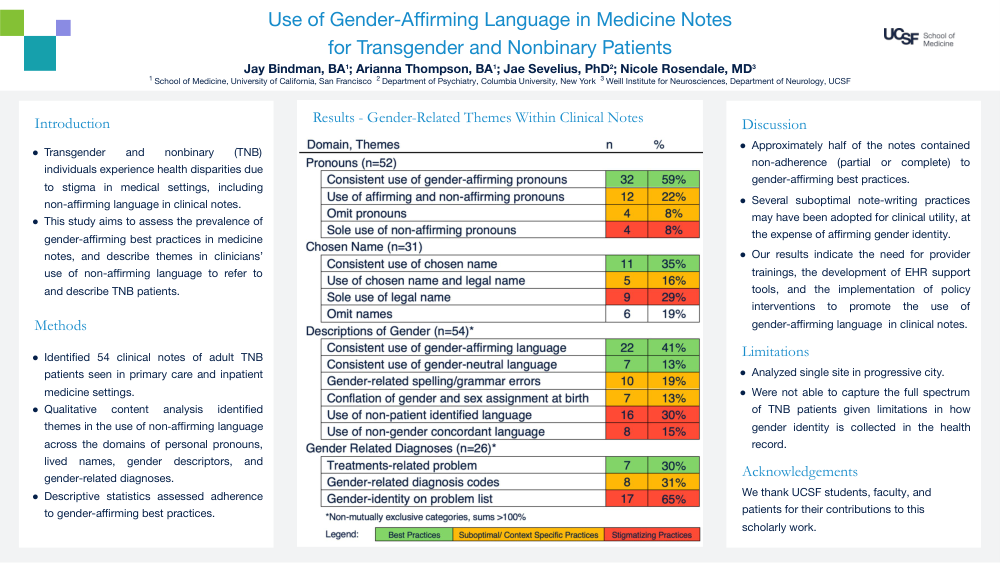
We identified that approximately half of notes contain non-adherence (complete or partial) to best practices in the use of gender-affirming language. Pronoun use was suboptimal with the presence of misgendering in a third of notes, particularly impacting patients using they/them pronouns. Chosen name use varied, with almost half of notes including the use of non-affirming names. Descriptions of gender identity often contained gross grammatical errors for nonbinary patients, and the use of outdated terminology for binary trans patients including “transwoman” and “female to male”. Notes frequently documented gender-related care with language that pathologized TNB individuals.
Discussion:
Our study underscores the need for improvement in adherence to gender-affirming best practices in clinical notes. Provider education, EHR support tools, and policy interventions may promote inclusive practices and reduce the prevalence of stigmatizing language in clinical notes.