127 posters, 10 topics, 20 sessions, 127 authors
ePostersLive by SciGen Technologies S.A. All rights reserved.
UCSF 2024 Inquiry Symposium
Conference ePosters

P121
A NOVEL HCC WAITLIST DROPOUT SCORE: BIOMARKER INTEGRATED DROPOUT GRADIENT ESTIMATION (BRIDGE)
Poster Presenter
Authors
Part of Topic
Clinical & Translational
Title: A Novel HCC Waitlist Dropout Score: BiomaRker Integrated Dropout Gradient Estimation (BRIDGE)
Background:
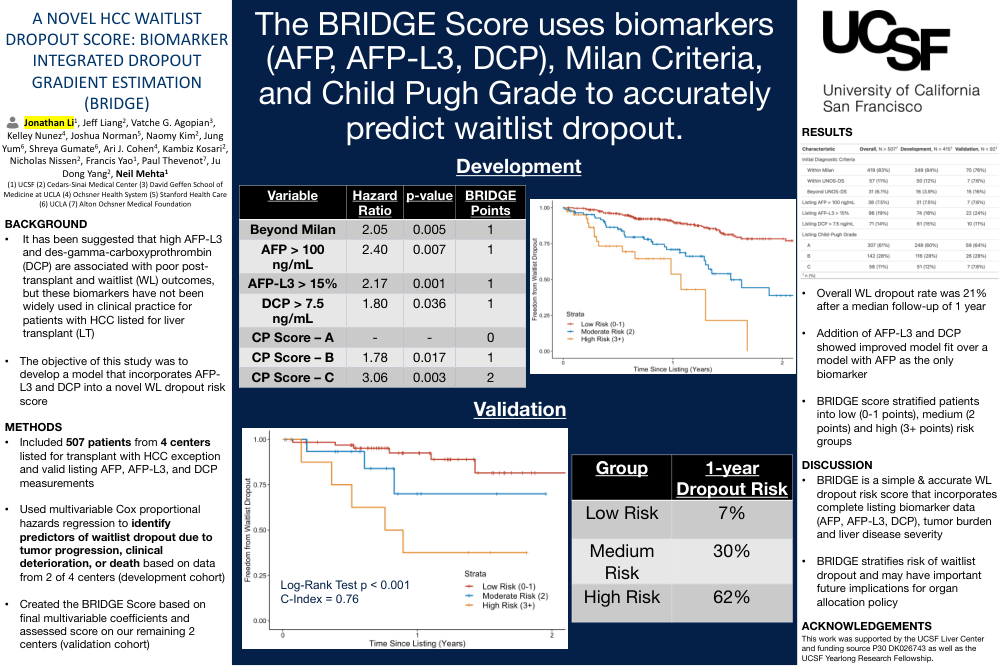
Liver transplant is a curative option for early-stage hepatocellular carcinoma (HCC). Given that demand for liver transplant outweighs availability of donor organs and the poor outcomes associated with post- liver transplant HCC recurrence, careful pre-transplant HCC management and selection of HCC liver transplant candidates is critical. Alpha-fetoprotein (AFP) is a well-established biomarker for HCC and current guidelines require AFP levels to be below a certain threshold to qualify for transplant. AFP-L3 and des-gamma-carboxyprothrombin (DCP) are additional biomarkers that have been recently shown to complement AFP in predicting high risk explant pathology, post-liver transplant HCC recurrence, and HCC waitlist outcomes. The objective of this study is to incorporate AFP-L3 and DCP into a novel risk score that predicts dropout from the liver transplant waitlist due to HCC progression, clinical deterioration, or death.
Methods:
We analyzed data from an ongoing, multicenter study of patients listed for transplant with MELD exception between July 2017 and May 2023 and had all three biomarkers (AFP, AFP-L3 and DCP) measured at listing. The primary outcome was waitlist dropout due to HCC tumor progression beyond transplant criteria, clinical deterioration, or death. Data was split into development and validation subsets. Using a Cox Proportional Hazards Regression Model (CoxPH), we built a multi-variable model for waitlist dropout based on the development subset. The BiomaRker Integrated Dropout Gradient Estimation (BRIDGE) dropout risk score was then created based on the final multivariable model coefficients, which was scaled and rounded to the nearest integer to produce a simplified point scale. The final BRIDGE Score’s accuracy was evaluated using the validation subset.
Results:
We included 502 patients from 4 study centers of which 22% experienced waitlist dropout and 59% underwent liver transplant. Median follow up time after listing was 11 months (IQR 7-18). Multivariable CoxPH analysis identified 5 variables predictive of waitlist dropout, and the final BRIDGE Score is scored from 0-6 as follows: tumor burden beyond Milan Criteria at diagnosis (1 point), AFP > 100 ng/mL (1
point), AFP-L3 > 15% (1 point), DCP > 7.5 ng/mL (1 point), and Child Pugh Grade (A – 0 points, B – 1
point, C – 2 points). On the validation data, the BRIDGE Score achieved a concordance index of 0.76 and was a significant predictor in a Fine and Gray model accounting for the competing risk of liver
transplantation. Patients with a high BRIDGE Score (3+) had an estimated incidence of waitlist dropout
>40% at 1 year whereas low BRIDGE Score (0-1) had an estimated incidence of <10%.
Conclusions:
To our knowledge, this is the first multicenter study incorporating complete biomarker data (AFP, AFP- L3, DCP at listing), tumor burden (Milan Criteria), and liver disease severity (Child-Pugh Grade) into a simple, novel HCC waitlist dropout risk score (BRIDGE). The ability of the BRIDGE score to stratify patients based on risks of waitlist dropout may have important implications for pre-transplant HCC management as well as donor organ allocation policy, which currently gives the same priority to all HCC patients listed for liver transplant.