127 posters, 10 topics, 20 sessions, 127 authors
ePostersLive by SciGen Technologies S.A. All rights reserved.
UCSF 2024 Inquiry Symposium
Conference ePosters

P120
Equity in Narrative Recovery Stories
Poster Presenter
Authors
Part of Topic
Social & Behavioral
Equity in Narrative Recovery Stories
Introduction
Mental health disparities research has identified several challenges faced by minorities in mental healthcare; however, it lacks the representation of voice, which limits understandings of individuals’ lived experiences. Systematic exclusion of marginalized voices perpetuates the inequities that exist within health care, as individuals are continuously under-represented in services planning and under-served by institutions. When there is a lack of meaningful participation in research, dialogue, and policy recommendations, the views of marginalized communities are routinely left out of the process of influencing policy and practice. This can have a negative impact on a people’s quality of life, mortality, and general health. It can also have a negative impact on treatment compliance, mental health service utilization, and engagement effectiveness (Hui 2021). Psychosis is a mental health condition that is uniquely associated with a loss of voice because it inherently creates major disruptions in a person’s narrative and sense of self (Lysaker, Wickett, Wilke, & Lysaker, 2003; Kline, Horn, & Patterson, 1996). Due to the highly subjective nature of psychosis, it is crucial to understand recovery in the cultural, societal and familial context of its narrator (Lee 2020). There is limited qualitative work exploring the lived experiences of people who identify as racial/ethnic minorities and/or LGBTQ with psychosis, in the context of their minority status. This study examines the role of bias, stigma, cultural factors, and injustice in people’s experiences with mental health care, through semi-structured interviews. Because it would be impossible to understand an individual’s story without it, we also explored the impact of intersecting identities in participants’ experiences with mental health care. We consider how investigators, educators, and clinicians can address these problems to improve health equity.
Aims
This aim of this study is to explore the role of bias, stigma, cultural factors, and injustice in the mental healthcare experiences of racial/ethnic minorities and/or LGBQT people with psychosis.
Methods
Nine participants were recruited through psychosis care networks including PEPPNET and EPI- CAL, re-contact of participants from previous early psychosis studies (PI: Loewy), and racial, ethnic, gender, and sexual orientation minority community centers. Semi-structured interviews were used to explore the role of bias, cultural factors, oppression, and intersectionality on participants’ experiences with mental health care. Three semi-structured interviews were conducted and recorded with each participant via Zoom video call. NVivo 12 was used for coding. Themes were developed and refined collaboratively by two coders. We conducted inductive thematic analysis, allowing the data to guide theme development.
Results
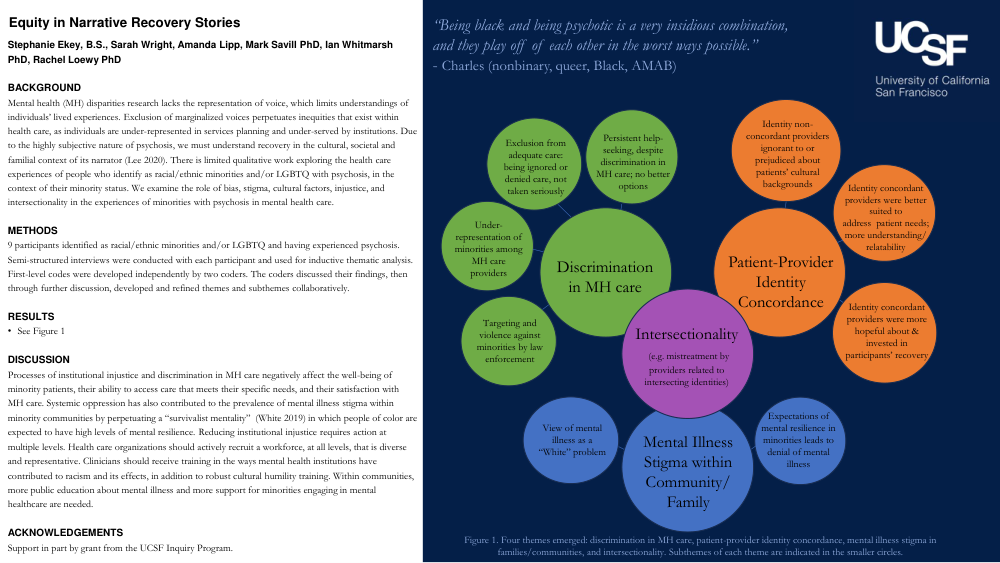
Six participants identified as both LGBTQ and a racial or ethnic minority, two participants identified as a racial or ethnic minority only, and one participant identified as LGBTQ only. Four themes emerged: discrimination in mental health care, provider identity concordance, mental illness stigma within the family/community, and intersectionality. Within the theme of
discrimination, three subthemes emerged: (1) exclusion from proper care, (2) under- representation of minoritized people among mental health care providers, and (3) targeting/victimization. Within the theme of identity concordance, three subthemes emerged: (1) ignorance in identity non-concordant providers, (2) understanding/relatability with identity- concordant providers, and (3) hope from identity-concordant providers. Within the theme of mental illness stigma, two subthemes emerged: the exclusion of people of color from the societal conceptualization of mental illness, and expectations of mental resilience in minoritized people.
Discussion
Processes of institutional injustice and discrimination in mental health care negatively affect well-being and satisfaction with mental health care. Despite experiencing discrimination in mental health care related to their minority status, many people continue to return to prejudiced institutions because there are no other viable options. Some choose not to re-engage with mental health care after experiencing discrimination, which delays treatment and leads to poorer outcomes. An expectation of mental resilience in racial/ethnic minorities leads to denial and dismissal of mental illness by community members. Poor representation of minorities among mental health care providers contributes to difficulty accessing care that meets people’s specific needs. Approaches to reducing institutional injustice must come from multiple levels.
Organizations should actively recruit a workforce, at all levels, that is diverse and representative. Clinicians should receive training in the ways mental health institutions have contributed to racism and its effects, in addition to robust cultural humility training. Mental illness stigma in minority communities indicates the need for more public education about mental illness, and for more support for minorities engaging in mental healthcare.