127 posters, 10 topics, 20 sessions, 127 authors
ePostersLive by SciGen Technologies S.A. All rights reserved.
UCSF 2024 Inquiry Symposium
Conference ePosters

P117
Brain network mapping with sEEG reveals functional stimulation targets for chronic pain
Poster Presenter
Authors
Part of Topic
Biomedical Science
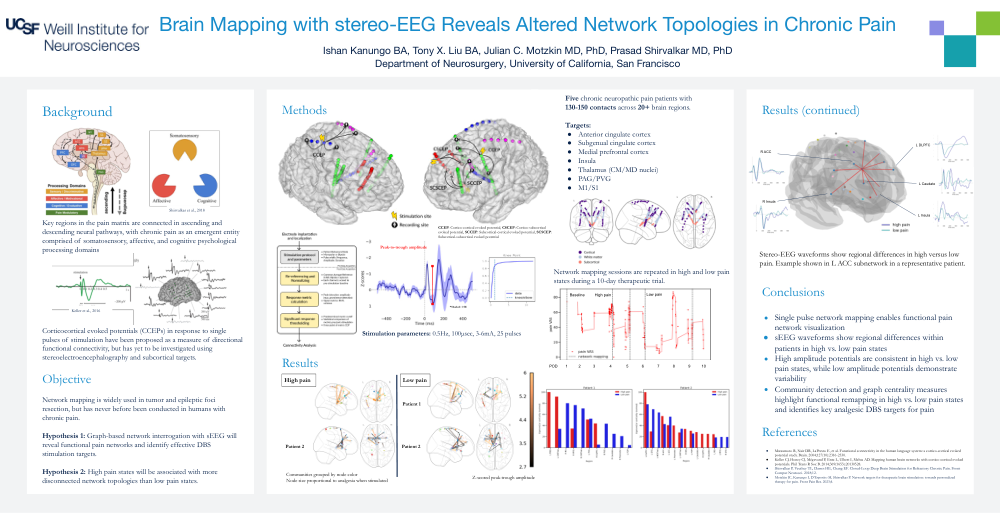
Brain network mapping with sEEG reveals functional stimulation targets for chronic pain
Objective
We developed a novel brain network mapping pipeline using stereoelectroencephalography (sEEG) that
identified network-level changes related to chronic pain intensity and stimulation targets that induced acute analgesia.
Background
Chronic pain is a holistic experience involving diverse brain regions mediating sensation, cognition, and
emotion, making targeted neuromodulation therapies challenging. The evoked response potential (ERP) is the electrophysiological response observed in an implanted brain electrode after direct electrical stimulation of another electrode, and has been used to map changes in cortical excitability. Combined with a
graph-based modeling approach, we can additionally infer properties of the network architecture from distributed signals across the brain.
Methods
Five patients undergoing sEEG for a therapeutic brain stimulation trial for chronic pain had 10 or more
temporary grid and/or depth electrodes targeting brain regions involved in the central processing of pain, including the anterior cingulate cortex, medial thalamus, insula, prefrontal and motor/sensory cortices.
During a 10-day trial, up to 10 unique regions were stimulated with 6mA bipolar pulses (0.5Hz with 25
pulses per region) during both high and low spontaneously occurring chronic pain states. Using our novel analysis software, evoked response potentials were appropriately pre-processed and averaged over a
1-second window locked to each pulse. Each signal was z-scored to its pre-stimulation baseline and amplitudes/latencies were detected and calculated using a prominence-based algorithm. Significant ERPs were thresholded using the optimal inflection point of the cumulative distribution function of the amplitudes. The Louvain method was used to cluster nodes into communities based on shared patterns of connectivity.
Results
Broad network topologies from a given pain state are stable within patients across days. Analgesic targets were more likely to be in the same Louvain community. Communities were more likely to be functionally connected in low pain states across patients. Brain regions with high eigenvector centrality, a measure of network hubs connecting other hubs, at baseline were more likely to be acutely analgesic when stimulated across patients, agnostic of stimulation parameters.
Conclusion
Graph-based network interrogation with single pulse electrical stimulation may offer unique insights on brain circuit dynamics and may help identify optimal stimulation targets for chronic pain.