127 posters, 10 topics, 20 sessions, 127 authors
ePostersLive by SciGen Technologies S.A. All rights reserved.
UCSF 2024 Inquiry Symposium
Conference ePosters

P116
Detecting local recurrence after primary treatment for invasive lobular carcinoma of the breast: surveillance strategies and interval cancers
Poster Presenter
Authors
Part of Topic
Clinical & Translational
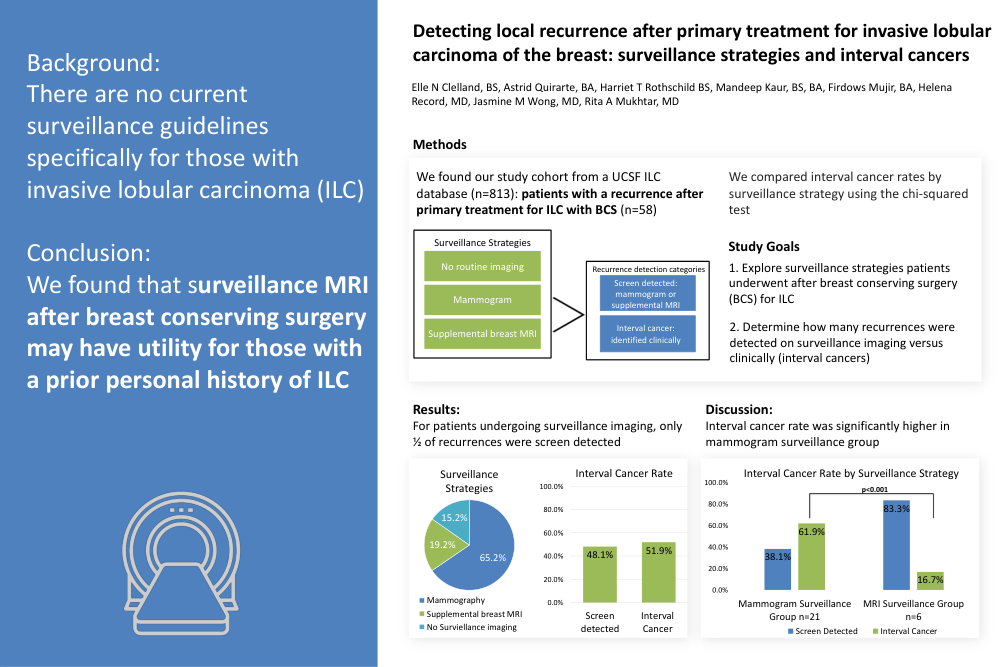
Surveillance Strategies After Primary Treatment for Patients with Invasive Lobular Carcinoma of the Breast: Method of Local Recurrence Detection After Breast Conserving Surgery
Elle N Clelland1, B.S., Astrid Quirarte2, B.A., Harriet T Rothschild1 B.S., Mandeep Kaur2, B.S., B.A., Firdows Mujir2, B.A., Helena Record2, M.D., Jasmine M Wong2, M.D., Rita A Mukhtar2, M.D.
Abstract
Background:
Invasive lobular carcinoma (ILC) is the second most common subtype of breast cancer. Although mammography is known to have low sensitivity for ILC, there are no data to guide the optimal surveillance after treatment. We explored surveillance strategies after breast conserving surgery (BCS) for ILC and determined the proportion of imaging detected recurrences versus interval cancers.
Methods:
From an institutional database of 813 women, we retrospectively identified patients who underwent BCS for stage I-III ILC and subsequently had a recurrence. We categorized patients by surveillance strategy and determined the modality of recurrence detection. Interval cancer rates for local recurrences were compared across surveillance strategies with the chi squared test. We evaluated overall survival with the log rank test and a Cox proportional hazards model.
Results:
We included 58 patients with ILC who had a recurrence after BCS. Of these, 22 (37.9%) had local recurrence, 27 (46.6%) had distant recurrence, and 9 (15.5%) had both local and distant recurrence. Most patients underwent routine mammographic surveillance (65.2%) with 19.6% having supplemental breast MRI, and 15.2% having no surveillance. The interval cancer rate was significantly higher in the mammographic surveillance group compared to the MRI surveillance group (61.9% versus 16.7%, p<0.001).
Conclusion:
In this study of patients with recurrence after BCS for primary treatment of stage I-III ILC, we found that most local recurrences were not detected by surveillance mammography. These data support further investigation of supplemental imaging beyond mammography specifically for patients with ILC who undergo BCS.