127 posters, 10 topics, 20 sessions, 127 authors
ePostersLive by SciGen Technologies S.A. All rights reserved.
UCSF 2024 Inquiry Symposium
Conference ePosters

P115
Maternal and neonatal outcomes with different screening strategies for gestational diabetes mellitus
Poster Presenter
Authors
Part of Topic
Clinical & Translational
Maternal and neonatal outcomes with different screening strategies for Gestational Diabetes Mellitus (GDM)
Shirley Shao BA1, Lucy Fu BA2, Llyke Ching PharmD3, Katelin P. Kramer MD4, Nasim C. Sobhani MD MAS5
Background: Standard diagnostic criteria for gestational diabetes mellitus (GDM) requires at least two out of four elevated values on the 3-hour fasting glucose tolerance test (GTT), although fasting hyperglycemia has a known association with adverse perinatal outcomes. Optimizations on GDM screening could identify additional patients for whom appropriate GDM treatment would reduce adverse perinatal outcomes.
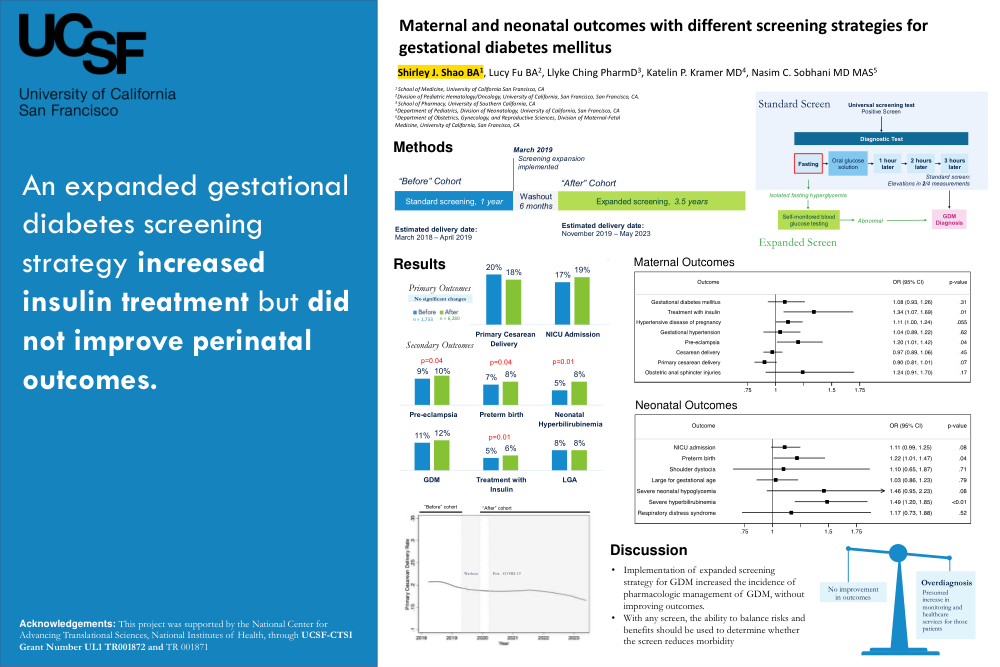
Research Question: At UCSF, we expanded the GDM screening strategy such that pregnant individuals with a single elevated value on the 3-hour GTT perform an additional week of self-monitoring of blood glucose (SMBG), with the possibility of GDM diagnosis based on those results. Our study evaluated the effect of this expanded screening protocol for GDM on perinatal outcomes in individuals before and after the implementation of this protocol.
Project Design/Methods: This was a cohort study of gravidas who delivered at UCSF before and after GDM screening strategy expansion in March 2019. The “before” cohort had estimated due dates (EDD) between March 2018 to April 2019 and were screened for GDM using the standard method. The “after” cohort had EDD between November 2019 to June 2023 and were screened using the expanded method. Multifetal gestations, delivery < 24 weeks, and patients screened during a 6-month washout period were excluded. Management of GDM was unchanged between cohorts. The primary maternal outcome was primary cesarean delivery (PCD), and the primary neonatal outcome was neonatal intensive care unit (NICU) admission. Secondary outcomes were exploratory and hypothesis-generating, and included hypertensive disorders of pregnancy, obstetric anal sphincter injury, severe neonatal hypoglycemia, severe hyperbilirubinemia, and large-for-gestational-age. Chi-square and Fisher’s exact tests were used to compare perinatal outcomes between the “before” and “after” cohorts.
Results: Outcomes for n=1,733 in the “before” cohort were compared with those for n=6,280 in the “after” cohort. The incidence of insulin-requiring GDM increased significantly after the expanded screening protocol was implemented (5% to 6%, p=0.01), but PCD and NICU admission rates did not change (20% to 18% [p=0.06], and 17% to 18% [p=0.11], respectively). With regards to secondary outcomes, the “after” cohort had significantly higher incidences of preeclampsia (9% to 10%, p=0.04), severe hyperbilirubinemia (5% to 8%), and preterm birth (7% to 8%, p=0.04).
Conclusions: Implementation of an expanded screening strategy for GDM was associated with a higher incidence of pharmacologic management of GDM but no reduction in primary cesarean delivery or NICU admission. These findings suggest that identification and treatment of patients with mild hyperglycemia does not improve outcomes, despite an increase in monitoring and healthcare services for those patients. The finding of increased incidence of several secondary outcomes is likely related to the COVID19 pandemic rather than the GDM screening strategy. Further investigation is required to identify the optimal GDM screening strategy that balances the risks of overdiagnosis with the beneficial reductions in perinatal morbidity availed by appropriate GDM treatment.