127 posters, 10 topics, 20 sessions, 127 authors
ePostersLive by SciGen Technologies S.A. All rights reserved.
UCSF 2024 Inquiry Symposium
Conference ePosters

P114
Supervised machine learning demonstrates peripheral inflammation precedes brain pathology in carriers of APOE4
Poster Presenter
Authors
Part of Topic
Biomedical Science
Scott Treiman
Inquiry Symposium 2024 – Abstract
Title:
Supervised machine learning uncovers peripheral inflammation that precedes brain pathology in human patients with an APOE4 allele
Introduction:
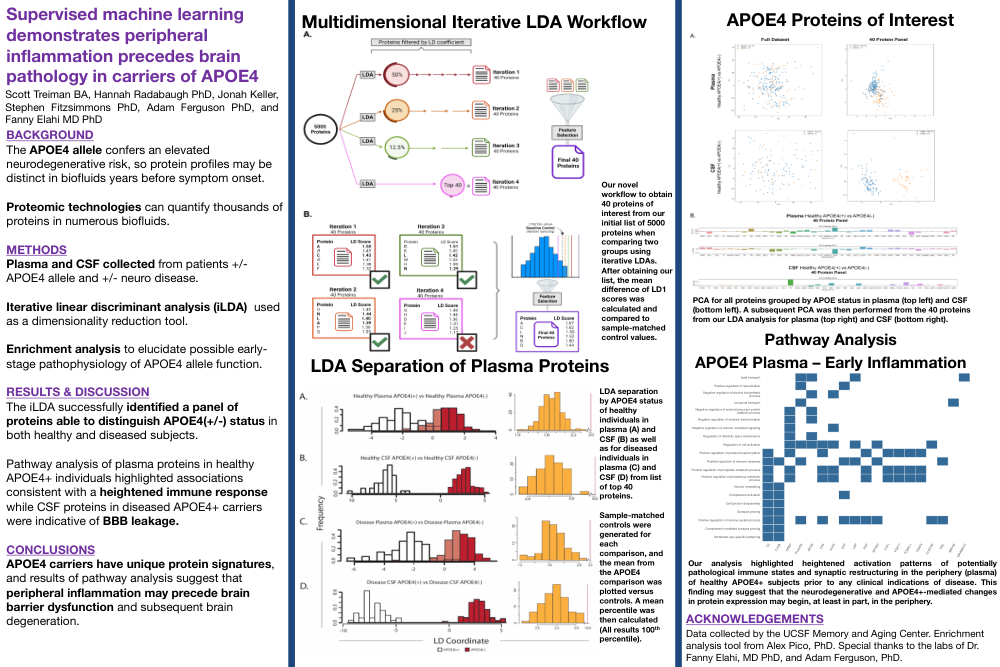
The E4 allele of the apolipoprotein E gene (APOE4) has consistently been implicated in neurodegenerative diseases, and growing evidence suggests that biological changes at the blood-brain barrier occur in asymptomatic APOE4 carriers long before the manifestation of symptoms. If pathological changes occur centrally or peripherally, alterations in protein composition should be present in CSF (central) or blood (peripheral). While previous methods were only able to detect changes in plasma or CSF by measuring a few proteins, proteomic technologies can now quantify thousands of proteins enabling researchers to interrogate the multidimensional underpinnings of biological phenomena associated with neurodegenerative diseases such as the apolipoprotein E4 allele (APOE4). Given these changes, we conducted a study to determine if asymptomatic APOE4 carriers had unique plasma and CSF protein profiles to the extent that a unique biomarker signature could be developed for the APOE4 genotype.
Hypothesis:
We predict that individuals with an APOE4 allele will have a unique protein signature in plasma and CSF, and we hypothesize that our multidimensional supervised machine learning workflow will uncover new proteins that could relate to APOE4 pathology.
Aims:
- To develop an iterative linear discriminant analysis (LDA) workflow to reduce the dimensionality of a proteomic dataset containing both plasma and cerebrospinal fluid (CSF) samples from human patients and see if that workflow could reliably identify panels of proteins that differed between groups with known biologically distinct phenotypes.
- To determine if our multidimensional workflow could construct a unique protein profile in plasma and CSF for asymptomatic APOE4 carriers.
- To utilize pathway analysis in order to identify proteins and pathways of interest and consequently elucidate possible mechanisms of APOE4-associated neurodegeneration.
Project Design/Methods:
Participants with a neurodegenerative disease or family members with possible at-risk alleles were recruited from the UCSF Memory and Aging Center and donated plasma and CSF. Samples were processed by SomaLogic technologies to quantify the amount of over 5000 proteins. We then separated groups by disease and APOE4 status in plasma and CSF, and we created a multidimensional workflow that utilized iterative linear discriminant analysis to maximally separate groups of interest. We then attempted to take our panel of 40 proteins that were most responsible for this group separation and observed if our workflow could separate groups in an independent validation dataset at a statistically significant level. Finally, we performed enrichment analysis to identify pathways of interest from our panel of proteins.
Results/Product:
Plasma and CSF samples were sent for 556 and 274 patients respectively to SomaLogic which sequenced over 5400 proteins. Individuals were classified by disease status and APOE4 status. Number of samples collected (plasma and CSF) per group were as follows: Disease – E4 (82, 41); Disease – Non-E4 (213, 100); Healthy – E4 (71, 42); and Healthy – Non-E4 (190, 93). Subjects with a neurodegenerative disease possessed differences in protein profiles compared to controls with the same APOE4 status in plasma and CSF in all but one comparison using our novel workflow. In our next aim, we determined that subjects with at least one APOE4 allele had distinct proteomic profiles in plasma and CSF regardless of disease status. Several proteins from the plasma panel (C3a anaphylatoxin des Arginine, Alpha-1-antichymotrypsin, and Tubulin-specific chaperone A) and the CSF panel (GSK3-beta interaction protein, Mitochondrial peptide methionine sulfoxide reductase, and Neurexin-2-beta) have previous links to neurodegeneration while Cardiotrophin-1 was prominently implicated across both biofluids. Results observed in the primary dataset were corroborated via external validation using an independently collected Alzheimer’s disease dataset. From the pathway analysis of APOE4 comparisons, plasma proteins in asymptomatic individuals were associated with immune system inflammation and synaptic function while CSF proteins in diseased individuals were associated with BBB dysfunction.
Discussion/Conclusion:
In the current study, we developed a multivariate iLDA approach to reduce the dimensionality of a proteomics dataset containing more than 5000 analytes. This approach yielded robust and unique protein signatures in both plasma and CSF based on APOE4 genotype alone. Recent reports in the literature have utilized aptamer-based proteomics to generate biomarker profiles in plasma and CSF, but to the best of our knowledge, the use of a multivariate and iterative approach including supervised machine learning, principal component analysis, and pathway enrichment analysis as a method to identify proteins and pathways most responsible for distinguishing between APOE4 status is a novel addition to the literature. Our pathway analysis demonstrated immune and synaptic dysfunction in the plasma of healthy APOE4 individuals along with diseased CSF individuals having BBB dysfunction, which supports the emerging hypothesis that the peripheral changes from APOE may occur before neurodegeneration. It is possible that our study captured younger and asymptomatic APOE4 individuals at an earlier timepoint where these individuals had only peripheral inflammation and a second timepoint where these same individuals developed subsequent neurodegeneration and BBB dysfunction. However, our results are limited by the arbitrariness of feature selection, as many possible ways exist in the reduction from 5000 to 40 proteins, and we are unsure if our unique multivariate approach was the most optimal way to perform feature reduction. Additionally, we are also limited by the ability to quantify LDA separation, as the inherent goal of an LDA is to do more than separate between groups. Nevertheless, our identification of a robust, unique protein signature in asymptomatic APOE4 individuals along with evidence that supports a possible pathology beginning outside the central nervous system. If APOE4-related neurocognitive symptoms originate in the periphery, then this genotype could be targeted with therapeutics systemically in asymptomatic patients, and the protein signatures found in our analyses should be evaluated as possible targets.