127 posters, 10 topics, 20 sessions, 127 authors
ePostersLive by SciGen Technologies S.A. All rights reserved.
UCSF 2024 Inquiry Symposium
Conference ePosters

P106
Sociodemographic Disparities in Educational Services in Children who are Deaf or Hard-of-Hearing
Poster Presenter
Authors
Part of Topic
Clinical & Translational
Title: Sociodemographic Disparities in Educational Services in Children who are Deaf or Hard- of-Hearing
Introduction: An Individualized Education Program (IEP) is a document developed for children who require special education services. Sociodemographic factors may impact the timely establishment of an IEP in children who are deaf or hard-of-hearing (D/HH). Delays in IEP establishment can result in educational disadvantage for D/HH children.
Hypothesis: We hypothesize that children from families with lower socioeconomic status or with public Medicaid insurance may experience delays in the establishment of an IEP.
Aims: To date, little research has examined the relationship between these sociodemographic factors and IEP establishment. This study aims to fill this gap in knowledge by examining the relationship between sociodemographic factors, including public insurance, non-English home language, URM status, as well as place-based levels of disadvantage/social vulnerability, and the time it takes to establish an IEP in D/HH children. By examining this relationship, we hope to contribute to the development of policies and practices that promote equity and access to education for children with hearing loss.
Project Design: This retrospective cohort study included data from 88 IEPs completed between 2009-2017. All participants were D/HH patients of the Hearing and Communication Clinic of University of California, San Francisco (UCSF). Primary outcome measures were defined as the
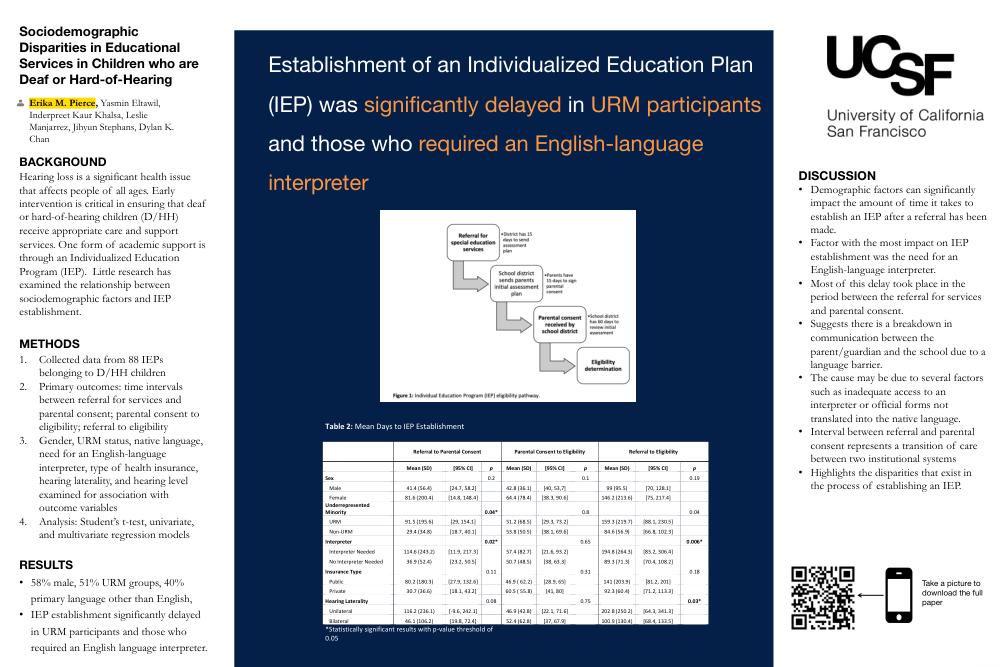
time intervals between initial referral for services and parental consent; parental consent to determination of eligibility; and initial referral to eligibility (the sum of the previous two intervals). Student’s t-tests and linear regression models were used to examine the association between sociodemographic factors and the primary outcome variables.
Results: Of the 88 participants, 51 (58%) were male, 45 (51%) were from underrepresented minority groups, 35 (40%) had a primary language other than English, and 53 (60%) utilized public insurance. IEP establishment was significantly delayed in participants who required an English-language interpreter. Most of the delay occurred in the time between the initial referral and parental consent (mean: 115 vs. 37 days, p=0.02), not in the period between parental consent and eligibility (mean: 57 vs. 51 days, p=0.65). There were also significant delays in IEP establishment from time of referral for services to eligibility in URM versus non-URM participants (mean: 159 vs. 85 days, p=0.04). Significant delays were also associated with Minority Status and Language within Social Vulnerability Index (SVI) percentile rankings.
Discussion: This study found that IEP establishment was delayed in both URM participants and those who required an English-language interpreter. These results highlight the importance of clear communication between the school system and caregivers in the IEP establishment process, particularly with families who require an English-language interpreter or identify as URM.