127 posters, 10 topics, 20 sessions, 127 authors
ePostersLive by SciGen Technologies S.A. All rights reserved.
UCSF 2024 Inquiry Symposium
Conference ePosters

P101
Unveiling Patterns: Racial Trends in Pre-Operative Evaluation and Completion of Aortic Valve Replacement for Severe Aortic Stenosis
Poster Presenter
Authors
Part of Topic
Biomedical Sciences
Title:
Unveiling Patterns: Racial Trends in Pre-Operative Evaluation and Completion of Aortic Valve Replacement for Severe Aortic Stenosis
Introduction:
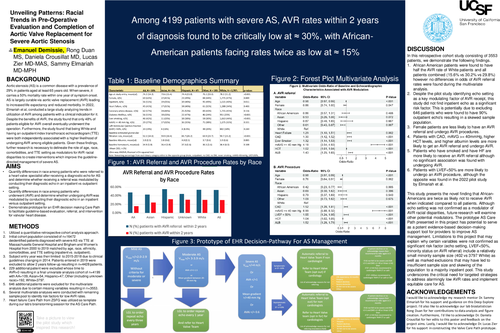
Aortic stenosis (AS) is a common disease with a prevalence of 29% in patients aged at least 65 years old. When severe, it carries a 50% mortality rate within one year of symptom onset. AS is largely curable via aortic valve replacement (AVR) leading to increased life expectancy and reduced morbidity. In 2022, Elmariah et al, conducted a large study analyzing trends in utilization of AVR among patients with a clinical indication for it. Despite the benefits of AVR, the study found that only 48% of patients eligible for AVR overall eventually underwent the operation. Furthermore, the study found that being White and having an outpatient index transthoracic echocardiogram (TTE) were both independently associated with a higher likelihood of undergoing AVR among eligible patients. Given these findings, further research is necessary to delineate the role of age, race, comorbidities, and TTE setting as modulators for AVR racial disparities to create interventions which improve the guideline-directed management of severe AS.
Aims:
1. Quantify differences in race among patients who were referred to a heart valve specialist after receiving a diagnostic echo for AS and determine whether receiving a referral was modulated by conducting their diagnostic echo in an inpatient vs outpatient setting.
2. Quantify differences in race among patients who underwent (AVR) and determine whether undergoing AVR was modulated by conducting their diagnostic echo in an inpatient versus outpatient setting.
3. Demonstrate prototype for an EHR decision making Care Path to facilitate guideline-based evaluation, referral, and intervention for valvular heart disease.
Project Design/Methods:
1. Utilized a quantitative retrospective cohort analysis approach.
2. Initial cohort population consisted of n=16472 deidentified patients diagnosed with severe AS via TTE at Massachusetts General Hospital and Brigham and Women’s Hospital from 2000 to 2019 matched by age, race, ethnicity, comorbidities, and TTE setting (inpatient vs. outpatient).
3. Subject entry year was then limited to 2015-2018 due to clinical guidelines changing in 2014. Patients entered in 2019 were excluded to allow 2 years follow-up resulting in n=4428 patients.
4. 229 additional patient were excluded whose time to AVR=0 resulting in a final univariate analysis cohort of n=4199 with AA=109, Asian=54, Hispanic=47, Other (including unknown race)=192, White=3797.
5. 646 additional patients were excluded for the multivariate analysis due to certain missing variables resulting in n=3553.
6. Several multivariate analyses were conducted with remaining sample pool to identify risk factors for low AVR rates.
7. Heart failure Care Path from ZSFG was utilized as template during our lab's brainstorming session for the AS Care Path.
Results/Product: In this retrospective cohort study consisting of 3553 patients, we demonstrate the following findings: 1) African American patients were found to have half the AVR rate of White patients and all patients combined (15.6% vs 30.2% vs 29.8%) however no differences in odds of AVR referral rates were found during the multivariate analysis. 2) Despite the pilot study identifying echo setting as a key modulating factor of AVR receipt, this study did not find inpatient echo as a significant risk factor. This is potentially due to excluding 646 patients who were found to have 90% outpatient echo's resulting in a skewed sample population. 3)Female patients are less likely to have an AVR referral and undergo AVR procedures 4) Patients with CAD, mAVG >= 40mmHg, higher HCT levels, and higher albumin levels are more likely to get an AVR referral and undergo AVR. 5) Patients who have smoked and have HF are more likely to receive an AVR referral although no significant association was found with undergoing AVR. 6) Patients with LVEF<50% are more likely to undergo an AVR procedure, although the opposite was found in the 2022 pilot study by Elmariah et al.
Discussion/Conclusion:
This study presents the novel finding that African-Americans are twice as likely not to receive AVR when needed compared to all patients. Although echo setting was not confirmed as a modulator of AVR racial disparities, future research will examine other potential modulators. The prototype AS Care Path presented in this project has potential to serve as a potent evidence-based decision-making support tool for providers to improve AS management. Limitations to this project that may explain why certain variables were not confirmed as significant risk factor (echo setting, LVEF<50%, minority status on AVR referral) include a relatively small minority sample size (402 vs 3797 Whites) as well as marked exclusions that may have led to insufficient sample size and skewing of the population to a majority inpatient pool. This study underscores the critical need for targeted strategies addressing racial disparities in AVR access to achieve equitable healthcare delivery.