127 posters, 10 topics, 20 sessions, 127 authors
ePostersLive by SciGen Technologies S.A. All rights reserved.
UCSF 2024 Inquiry Symposium
Conference ePosters

P099
Postoperative outcomes from robotic versus open ventral hernia repair surgery: A single-center retrospective cohort study
Poster Presenter
Authors
Part of Topic
Clinical & Translational Sciences
Postoperative outcomes from robotic versus open ventral hernia repair surgery: A single-center retrospective cohort study
Sohil Patel, Luke Rettig, Fayyaz Ahamed, Jonathan Carter, Stanley Rogers
Introduction
More than 500,000 ventral hernia repair operations are performed annually, with a significant proportion of open ventral hernia surgeries (OVHS) still being performed worldwide. Recent advances in technology have allowed robotic techniques to be applied to ventral hernia repair surgery (RVHS). However, data regarding patient outcomes following surgery is variable. Some studies report similar patient outcomes between the 2 approaches, but most studies report that RVHS is superior to OVHS, especially with regards to surgical-site infections.
Question
We sought to determine postoperative outcomes following RVHS vs OVHS.
Aims
The primary outcome of this study is postoperative length of stay after ventral hernia repair. Secondary outcomes are other postoperative outcomes, including number of ICU days, operative time, Clavien-Dindo score, surgical site infection, death, and readmission within 30 days to the hospital.
Project Design and Methods
Study design
This is a single-center, retrospective cohort study performed at University of California, San Francisco (UCSF) Medical Center from 2017 to 2022. UCSF Medical Center is a 600-bed tertiary academic center. All data were retrieved from UCSF’s electronic EPIC system Apex. Chart review was performed independently by two medical students (S.P. and F.A). Data was analyzed by a medical student (S.P.). The project was supervised by a fellow (R.R.) and 2 general surgeons (S.R. and J.C.)
Subjects
Patients were �18 years and included those who underwent ventral hernia repair surgeries with either robotic or open approach. Inclusion criteria were hernias that were suitable for robotic repair: elective, midline, 3-10 cm of rectus separation, no prior mesh, no loss of domain, no need for skin excision, and no need for concomitant additional procedure such as stoma takedown, bowel resection, etc.).
Intervention
The intervention was ventral hernia surgery with either robotic or open approach
Variables
The primary outcome was postoperative length of stay (LOS). Secondary outcomes were number of ICU days, operative time, Clavien-Dindo (CD) score, surgical site infection (SSI), postoperative complications, death, and readmission within 30 days to the hospital and to the OR. CD scores were grouped into 1-2 and 3-5. SSI were categorized as superficial, deep, or organ space. Complications included sepsis, transfusion within 72 hours, pneumonia, intubation, ventilator use >48 hours, renal insufficiency, deep venous thrombosis, pulmonary embolism, and UTI.
Statistical analysis
Demographic information included patient age, sex, race, BMI, comorbidities (diabetes, COPD, active smoking, immunosuppression, hypertension), functional status, and ASA. Hernia characteristics such as hernia type (primary or incisional), size, mesh location, and prior hernia repairs were also included. Continuous variables are presented as means and standard deviations, and categorical variables as numbers and percentages. Baseline demographic variables were compared using t test for continuous variables and Chi squared or Fisher exact test for categorical variables. We performed a test of interaction between surgery approach and each outcome variable using multiple linear or binary logistic regression controlling for immunosuppression, mesh location, mesh width, and surgeon. All statistical tests were 2-sided. P values of
<0.05 were considered statistically significant.
Results
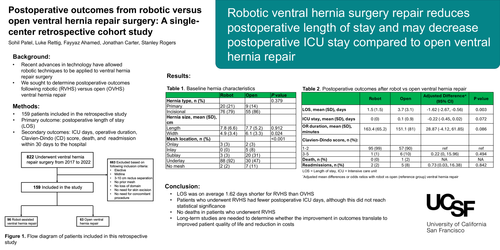
More patients underwent RVHS (n= 96) than OVHS (n=63) from 2017 to 2022. All baseline demographics and hernia characteristics were balanced except immunosuppression, hernia width, and mesh location (Table 1). More patients in the OVHS group were immunosuppressed (25% vs 8%, P=0.008). In addition, patients undergoing OVHS had wider hernias (mean cm of 6.1±3.3 vs 4.9±3.4, P=0.024) and were more likely to have mesh placement as a sublay (31% vs 3%, P<0.001). For outcomes, postoperative LOS was significantly shorter for RVHS (1.5±1.5 vs 3.7±3.1 days, P=0.003). On average, patients with RVHS had fewer postoperative days in the ICU, although this did not reach significance (0 vs 0.1±0.9, P=0.072). Finally, no patients in the RVHS group died, had an SSI, or were readmitted to the OR (Table 2).
Conclusion
In this retrospective study of 159 patients from 2017 to 2022, we found that robotic surgery for ventral hernia repairs reduces length of hospital stay and may reduce ICU stay. A limitation of this study was that this was a single-center study done at an academic institution, so these findings may not be generalizable to other hospitals.
Furthermore, our sample size was limited to patients who were unequivocally suitable for robotic surgeries. Therefore, more studies on a larger population need to be conducted to determine whether these findings are still consistent.
Table 1. Baseline demographic and hernia characteristics of patient undergoing robotic or open ventral hernia repair
|
|
Robot |
Open |
P Value |
|
Age, mean (SD), y |
59.1 (13.4) |
60 (12.4) |
0.662 |
|
Male sex, n (%) |
46 (48) |
28 (44) |
0.722 |
|
Race/Ethnicity, n (%) |
|
|
0.749 |
|
White |
63 (66) |
44 (69) |
|
|
African American |
6 (6) |
2 (3) |
|
|
Asian |
4 (4) |
3 (5) |
|
|
Native American/Alaska Native |
2 (2) |
0 (0) |
|
|
Other |
19 (20) |
15 (23) |
|
|
Declined |
2 (2) |
0 (0) |
|
|
BMI |
31.4 (6.8) |
29.9 (6.6) |
0.19 |
|
Comorbidities, n (%) |
|
|
|
|
Diabetes |
22 (23) |
10 (16) |
0.509 |
|
COPD |
2 (2) |
3 (5) |
0.39 |
|
Active smoker |
5 (5) |
2 (3) |
0.703 |
|
Immunosuppressed |
8 (8) |
16 (25) |
0.008 |
|
Hypertension |
47 (49) |
27 (42) |
0.497 |
|
Functional status |
|
|
0.275 |
|
Independent |
93 (97) |
64 (100) |
|
|
Dependent |
3 (3) |
0 (0) |
|
|
ASA, n (%) |
|
|
0.057 |
|
1 |
6 (6) |
0 (0) |
|
|
2 |
50 (52) |
30 (47) |
|
|
3 |
40 (42) |
33 (52) |
|
|
4 |
0 (0) |
1 (2) |
|
|
Hernia type, n (%) |
|
|
0.379 |
|
Primary |
20 (21) |
9 (14) |
|
|
Incisional |
76 (79) |
55 (86) |
|
|
Hernia size, cm |
|
|
|
|
Length |
7.8 (6.6) |
7.7 (5.2) |
0.912 |
|
Width |
4.9 (3.4) |
6.1 (3.3) |
0.024 |
|
Mesh location, n (%) |
|
|
<0.001 |
|
Onlay |
3 (3) |
2 (3) |
|
|
Inlay |
0 (0) |
5 (8) |
|
|
Sublay |
3 (3) |
20 (31) |
|
|
Underlay |
88 (92) |
30 (47) |
|
|
No mesh |
2 (2) |
7 (11) |
|
|
Prior hernia repair, n (%) |
|
|
0.531 |
|
0 |
83 (86) |
59 (92) |
|
|
1 |
10 (10) |
4 (6) |
|
|
2 |
3 (3) |
1 (2) |
|
COPD = Chronic obstructive pulmonary disease
Table 2. Postoperative outcomes after robot vs open ventral hernia repair
|
|
Robot |
Open |
Adjusted Difference* (95% CI) |
P Value |
|
LOS, mean (SD), days |
1.5 (1.5) |
3.7 (3.1) |
-1.62 (-2.67, -0.56) |
0.003 |
|
ICU stay, mean (SD), days |
0 (0) |
0.1 (0.9) |
-0.22 (-0.45, 0.02) |
0.072 |
|
OR duration, mean (SD), minutes |
163.4 (65.2) |
151.1 (81) |
28.87 (-4.12, 61.85) |
0.086 |
|
Clavien-Dindo score, n (%): |
|
|
|
|
|
1-2 |
95 (99) |
57 (90) |
ref |
ref |
|
3-5 |
1 (1) |
6 (10) |
0.22 (0, 15.96) |
0.494 |
|
SSI, n (%): |
0 (0) |
5 (8) |
NA |
NA |
|
Superficial |
0 (0) |
3 (5) |
|
|
|
Deep |
0 (0) |
0 (0) |
|
|
|
Organ space |
0 (0) |
2 (3) |
|
|
|
Other complications, n (%): |
6 (6) |
8 (13) |
0.43 (0.06, 3.82)† |
0.407 |
|
Sepsis |
1 (1) |
1 (2) |
|
|
|
Transfusion |
1 (1) |
3 (5) |
|
|
|
Pneumonia |
2 (2) |
0 (0) |
|
|
|
Intubation |
0 (0) |
0 (0) |
|
|
|
Ventilator use |
0 (0) |
0 (0) |
|
|
|
Renal insufficiency |
4 (4) |
7 (11) |
|
|
|
DVT |
0 (0) |
1 (2) |
|
|
|
Pulmonary embolism |
0 (0) |
1 (2) |
|
|
|
UTI |
0 (0) |
0 (0) |
|
|
|
Death, n (%) |
0 (0) |
1 (2) |
NA |
NA |
|
Readmissions, n (%) |
2 (2) |
5 (8) |
0.73 (0.03, 16.38) |
0.842 |
|
Readmissions to OR, n (%) |
0 (0) |
2 (3) |
NA |
NA |
LOS = Length of stay, ICU = Intensive care unit, SSI = Surgical site infection, DVT = Deep venous thromboembolism, UTI = Urinary tract infection
*Adjusted mean differences or odds ratios with robot vs open (reference group) ventral hernia repair
†Odds of having at least one complication