145 posters, 12 topics, 25 sessions, 145 authors
ePostersLive by SciGen Technologies S.A. All rights reserved.
UCSF 2023 Inquiry Symposium
10 May | University of San Francisco

P096
Anesthesia Breathing Circuit Reuse is Common Globally, But Rare in the United States: An International Cross-Sectional Survey
Poster Presenter
Authors
Part of Topic
Clinical & Translational Sciences
Introduction:
Healthcare systems in high income countries (HIC) contribute disproportionately to
climate change, and operating rooms produce a substantial share of material waste and
greenhouse gases. The anesthesia breathing circuit is one item that is commonly
disposed of between every patient in the United States, despite evidence that reuse is
safe (McGain, 2014) (Hartmann, 2009) (Dubler, 2016) and can save hospitals money,
water, and energy (McGain, 2014). Notably, in some HIC nations such as Germany and
the United Kingdom, circuits are used for up to 7 days (Kramer, 2010) (Association of
Anaesthetists, 2020). Little data is available about use patterns in the U.S., as well as in
middle- and low-income nations. More information on reuse and disposal practice
patterns across the globe could guide efforts to safely reduce the environmental impact
of our healthcare system.
Hypothesis:
1. There is no correlation between country income level and prevalence of reuse.
2. There is no difference in prevalence of reuse in the U.S. compared to other
countries.
Aims:
1. Characterize the evidence-practice gap among providers in the U.S. and
compare to practice patterns among those in other countries.
2. Identify barriers to uptake of practice of reusing breathing circuits in the U.S.
3. Determine readiness for change of providers in the U.S.
Methods:
We utilized snowball convenience sampling methodology. An English-language survey
was emailed to anesthesia and critical care providers in the U.S. and other countries
between January and March 2023. Participants were asked to forward the survey to
colleagues at other hospitals in their country, including by social media. Circuit reuse
was defined as continual use, with or without disinfection, between patients. Outcomes
measured include 1) percentage of providers who reuse breathing circuits, 2)
prevalence of concern for various perceived barriers to circuit reuse, 3) level of
readiness for change among U.S. providers who currently do not reuse circuits.
Outcomes were analyzed with the Chi-square test, with post-pairwise testing.
Results:
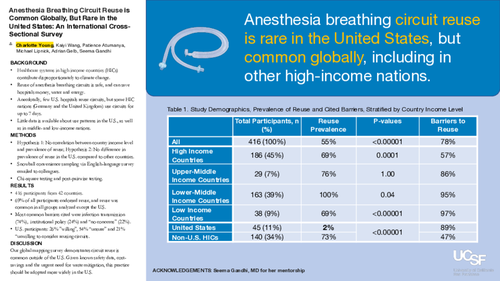
416 participants completed the survey from 42 countries. Prevalence of reuse was 69%
across all respondents. 45% of respondents were from high income countries (HICs),
7% from upper-middle income countries (UMICs), 39% from lower-middle income
countries (LMICs), and 9% from low-income countries (LICs). Prevalence of reuse was
55% in HICs, 69% in UMICs, 76% in LMICs, and 100% in LICs, and significantly
differed across income groups (P<0.00001). Post-hoc analysis showed that the greatest
contribution to differences came from LICs and HICs (P=0.0001, P=0.000001).
Prevalence of reuse among U.S. participants was 2%, and among non-U.S. HIC
participants was 73% (P < 0.00001). The most common concerns expressed with
reusing circuits were infection transmission (74%), institutional policy (24%), and no
concern (22%). Among U.S. participants who were not reusing circuits, 26% were
willing to consider reuse, 54% were unsure, and 21% were unwilling.
Discussion/Conclusion:
Our global mapping study found that breathing circuit reuse is rare in the U.S., but
common globally, including in other HICs. Infection transmission and institutional policy
were identified as the greatest barriers to change, but 22% of global participants had no
concerns about reusing circuits. Most U.S. participants were either willing to consider
reuse or unsure, and only 21% were unwilling. A potential limitation of this study is
response bias, with parties interested in sustainability and waste reduction perhaps
being more likely to complete our questionnaire. In conclusion, our study demonstrated
that reuse of the breathing circuit rare in the U.S., but common practice globally,
including in other HICs. Prior research has demonstrated the safety, efficacy and
financial benefit of circuit reuse. Adoption of this evidence-based practice should be
considered more widely to reduce healthcare’s environmental impact and reduce costs.
Future research should focus on the optimal protocol for circuit reuse.
Prevalence of reuse between income levels and between U.S. and non-U.S. HICs was
analyzed with Chi-square testing. Post-hoc pairwise testing compares each income
level to the aggregated of the other study groups to determine contribution of each
group to differences between observed and expected values.