145 posters, 12 topics, 25 sessions, 145 authors
ePostersLive by SciGen Technologies S.A. All rights reserved.
UCSF 2023 Inquiry Symposium
10 May | University of San Francisco

P002
Operative Outcomes and Fracture Patterns in Dysmorphic Sacrums
Poster Presenter
Authors
Part of Topic
Clinical & Translational Sciences
Introduction:
Sacral dysmorphism has been previously reported to occur in 30% to 40% of adult patients. It
has been described by 6 widely accepted parameters on outlet X-ray views of the pelvis. These
include a steep alar slope, retained S1-S2 disk, presence of mamillary bodies, a sacralized L5,
tongue in groove SI joint morphology, and finally non-round neural foramina.
Many studies have focused on the importance of identifying dysmorphism for safe treatment of
pelvic fractures with dysmorphic upper sacral segments. Less is known regarding whether sacral
dysmorphism may be protective against trauma. To our knowledge no studies have focused on
how dysmorphic sacrums fracture compared to non-dysmorphic (ND) sacrums, and whether they
require operative intervention at different rates.
Hypothesis:
H1: There will be different operative rates in dysmorphic fractures compared to normal sacrums.
H0: There will be no difference in operative rates between normal and dysmorphic sacrums.
Aims:
To assess the rate of operative fixation of sacral fractures between pelvises with dysmorphic and
ND sacrums, as well as whether a difference exists in fracture morphology between the two.
Design/Methods:
This is a retrospective cohort study based out of a single level 1 trauma center. Study participants
consisted of those sustaining a pelvic ring injury whose age was 18 years or older in which
orthopaedics was consulted, had CT imaging available, and did not have an isolated acetabulum
fracture. 355 subjects were included out of 671 pelvic ring injuries. Sacrums were deemed
dysmorphic if they met at least one of the six dysmorphic features, and it was determined
whether they underwent operative intervention in the EMR. Fracture classifications and
patterning were identified on CT imaging. SPSS was used for descriptive statistics, binary
correlations, and logistic regression. P values where set at <.05.
Results:
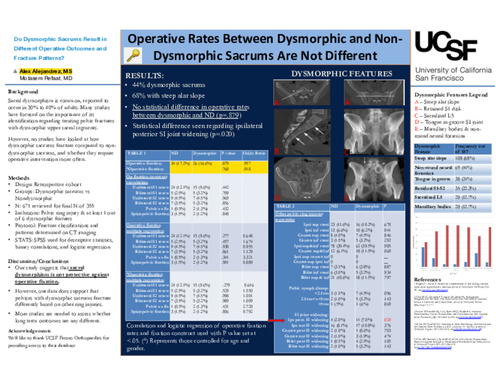
We found that 44% of inclusions had a dysmorphic sacrum with the most common feature to be a
steep alar slope (68%). 17.17% of subjects with a ND sacrum underwent treatment versus
16.56% for dysmorphic sacrums. No statistical difference regarding operative fixation rates was
uncovered (p=.879). However, we found a difference in fracture patterns regarding ipsilateral
posterior SI joint widening (p =.020), more often associated with dysmorphic pelvises.
Discussion/Conclusion:
Our study suggests that sacral dysmorphism is not protective against operative fixation based on
no difference in operative rates between groups. However, our data supports that pelvises with
dysmorphic sacrums may fracture differently based on the difference observed regarding other
pelvic ring injuries. Further studies are needed to assess whether long term outcomes are
different.