145 posters, 12 topics, 25 sessions, 145 authors
ePostersLive by SciGen Technologies S.A. All rights reserved.
UCSF 2023 Inquiry Symposium
10 May | University of San Francisco

P009
The Durability of Outreach Intervention on FIT Screening & Investigation of FIT Screening for Newly Eligible Patients
Poster Presenter
Authors
Part of Topic
Clinical & Translational Sciences
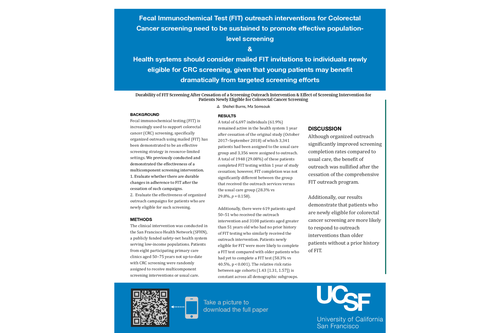
Introduction: Colorectal cancer (CRC) is the 3rd most common malignancy and the 2nd leading cause of cancer death among people in the USA [1]. Despite evidence that has shown that CRC screening is effective in reducing CRC mortality [2], CRC screening is underutilized by the general population and even more so among minority populations and in the safety net [3]. Fecal immunochemical testing (FIT) is increasingly used to support population-level screening [2], specifically organized outreach using mailed (FIT) has been demonstrated to be an effective screening strategy in resource-limited settings and has been increasingly used to improve colorectal cancer population-level screening rates [2–4]. Organized outreach using mailed fecal immunochemical testing (FIT) has been demonstrated to be an effective outreach strategy to improve colorectal cancer (CRC) screening; however, the effectiveness is significantly higher in patients with a history of FIT completion compared to those with no prior FIT completion [1–3]. As such, in resource-limited settings, population health initiatives at times have targeted outreach to patients with a track record of FIT completion while deferring patients who have yet to complete their first FIT to clinics and their primary care providers [4, 5] Among the group who have not completed FIT are those who are newly eligible for screening. Limited data exists on the effectiveness of organized outreach campaigns on CRC screening completion for patients who are newly eligible for such screening. We conducted an analysis of an existing clinical trial dataset to examine the effectiveness of organized outreach using mailed fecal immunochemical tests (FITs) to patients newly eligible for CRC screening. We also previously conducted and demonstrated the effectiveness of a multicomponent screening intervention [5]. The study randomly assigned patients to usual care or outreach. The goal of this study was to evaluate whether there are durable changes in adherence to FIT after the cessation of such campaigns.
Methods: This analysis used the data accumulated after the cessation of a larger randomized controlled trial of mailed FIT kits in the San Francisco Health Network (SFHN), a publicly funded safety net health system serving low-income populations [5]. In the original trial (NCT02613260), patients aged 50–75 years who were not up to date with CRC screening were assigned to receive multicomponent screening interventions that included the mailing of a FIT kit and were compared to usual care. Patients aged 50–75 years eligible for CRC screening from eight participating primary care safety net clinics were randomly assigned to outreach intervention vs usual care alone which began in 2016 and ceased in 2018. The intervention included a mailed postcard and call, followed by a mailed FIT kit and a reminder phone call if the FIT kit was not returned. Usual care was performed at the provider’s discretion and may have included tailored educational materials and coaching. For this secondary analysis, we identified patients active in the health system 1 year after cessation of the original trial intervention. The primary outcome was the difference in the cumulative proportion of completed FIT screening between study assignments 1 year after study cessation. Another primary outcome compared patients newly eligible for screening (50–51 years old) to older patients (≥ 52 years old) without prior history of FIT completion after having received multicomponent outreach intervention. For our secondary outcomes, we analyzed screening participation for newly eligible patients who received outreach intervention compared to those receiving usual care. We also compared the FIT screening rate for older patients (> 52 years old) with a prior history of FIT to patients newly eligible for FIT screening Comparisons were made using chi-square tests with a p-value less than 0.05 considered statistically significant. This trial was approved by the University of California San Francisco Institutional Review Board (IRB, 14-14861)
Results: Between January 2016 and October 2017, 10,820 patients were enrolled from eight clinic sites; FIT screening was statistically significantly higher in the intervention group (n = 5434) than in the control group (n = 5386) (57.9% vs 37.4%, p < 0.001). The effect of the outreach intervention consistently increased screening participation across all clinical sites and all patient demographic subgroups. Most notably, patients who had previously completed a FIT were more likely to complete a FIT than those with no record of prior FIT completion (70.2% vs 34.8%; p < 0.001). A total of 6,697 individuals (61.9%) remained active in the health system 1 year after cessation of the original study (October 2017–September 2018) of which 3,341 patients had been assigned to the usual care group and 3,356 assigned to outreach. A total of 1948 (29.08%) of these patients completed FIT testing within 1 year of study cessation; however, FIT completion was not significantly different between the group that received the outreach services versus the usual care group (28.3% vs 29.8%, p = 0.158). FIT completion was higher for patients who completed FIT during the study compared to those who had not (33.5% vs. 15.4%, p < 0.001). Among the patients who completed a FIT test during the study period, FIT completion 1 year after study cessation was lower in the outreach arm compared to the usual care arm (31.9% vs. 35.5%, p < 0.01). There were 619 patients aged 50–51 who received the outreach intervention and 3108 patients aged greater than 51 years old who had no prior history of FIT testing who similarly received the outreach intervention. Patients newly eligible for FIT were more likely to complete a FIT test compared with older patients who had yet to complete a FIT test (58.3% vs 40.5%, p < 0.001). The relative risk ratio between age cohorts (1.43 [1.31, 1.57]) is constant across all demographic subgroups including race (Caucasian:1.43 [1.18, 1.72], Black:1.58 [1.28, 1.94], Other:1.29 [1.088, 1.517]), primary language (English: 1.40 [1.24, 1.57], Spanish: 1.40 [1.18, 1.66]), gender (Male: 1.44 [1.27, 1.63], and insurance type (Medi-Cal: 1.32 [1.16, 1.50]). Older patients with a prior history of FIT were more likely to complete FIT screening compared to newly eligible patients aged 50–51 years (74.6% vs 58.3%, p < 0.001). In addition, newly eligible FIT-naive patients in the intervention were more likely to complete FIT screening compared to newly eligible patients in the usual care group (58.3% vs. 42.3%, p < 0.001).
Discussion: Although organized outreach significantly improved screening completion rates compared to usual care, the benefit of outreach was nullified after the cessation of the comprehensive FIT outreach program. Patients who received outreach services were no more likely than patients who did not receive FIT outreach to complete FIT screening 1 year after cessation of the outreach program. The outreach campaign resulted in a larger proportion of patients completing FIT tests during the study period; however, this subgroup of patients with a prior record of FIT completion was less likely to complete the FIT test compared to their respective group in the usual care arm. Altogether, these findings suggest that changes in patient behavior as it pertains to CRC screening are not durably improved through the multicomponent outreach program. Similarly, a patient outreach intervention demonstrated a lack of long-term improvement in cervical cancer screening rates after the intervention had ceased. In this same population, however, a population health outreach program, staffed by trained healthcare staff to identify, and reach out to eligible patients within an outpatient clinical setting, led to durable screening rates [6]. In our study, patients who received FIT outreach services had nominally lower FIT completion after study cessation compared to patients who received usual care. This result suggests that a proportion of patients who were recruited by the outreach service to complete screening may have not otherwise participated in screening in their usual care setting. The heterogeneous group of patients that completed screening during the outreach program, composed of patients who naturally completed screening through their clinic and the subgroup of patients who screened because of the outreach program, became less likely to complete screening without outreach compared to its usual care counterpart. These findings were evident in the subset of patients who completed FIT testing during the study period; once the outreach campaign ceased, they were less likely to continue FIT screening compared to patients who completed FIT testing in the usual care arm. Organized outreach to individuals newly eligible for FIT screening, those aged 50–51, had higher rates of FIT completion compared to outreach to FIT-naive individuals ≥ 52 years of age. This result was consistent throughout all demographic subtypes analyzed, including across gender, race/ethnicity, primary language, and insurance type, indicating newly eligible patients across diverse populations may benefit from broad outreach intervention. Overall, our results demonstrate that patients who are newly eligible for colorectal cancer screening are more likely to respond to outreach interventions than older patients without a prior history of FIT. Therefore, health systems should consider mailed FIT invitations to individuals newly eligible for CRC screening, given that newly eligible patients represent a subset of patients that may benefit dramatically from targeted screening efforts. Additionally, concerted outreach to newly eligible patients may extend the durability and cost-effective strategy of these outreach efforts [3]. In a previous analysis of patients with no prior FIT testing, the FIT completion rate was ~ 15% in the ensuing year in the absence of any intervention [6]. The substantial FIT completion rate of (~ 40%) in newly eligible patients without the outreach intervention highlights the relative potential of newly eligible patients to engage in FIT screening.
Citations: 1. Siegel RL, Miller KD, Sauer AG, et al. Colorectal cancer statistics, 2020. CA Cancer J Clin. 2020;70(3):145– 164. doi: 10.3322/caac.21601. [PubMed] [CrossRef] [Google Scholar] 2. US Preventive Services Task Force. Davidson KW, Barry MJ, et al. Screening for colorectal cancer: US Preventive Services Task Force Recommendation Statement. JAMA. 2021;325(19):1965–1977. doi: 10.1001/jama.2021.6238. [PubMed] [CrossRef] [Google Scholar] 3. Bretthauer M, Løberg M, Wieszczy P, et al. Effect of colonoscopy screening on risks of colorectal cancer and related death. N Engl J Med. 2022;387:1547–1556. doi: 10.1056/NEJMoa2208375. [PubMed] [CrossRef] [Google Scholar] 4. Issaka RB, Avila P, Whitaker E, Bent S, Somsouk M. Population health interventions to improve colorectal cancer screening by fecal immunochemical tests: a systematic review. Prev Med. 2019;118:113–121. doi: 10.1016/j.ypmed.2018.10.021. [PMC free article] [PubMed] [CrossRef] [Google Scholar] 5. Somsouk M, Rachocki C, Mannalithara A, et al. Effectiveness and cost of organized outreach for colorectal cancer screening: a randomized, controlled trial. J Natl Cancer Inst. 2019;112(3):305–313. doi: 10.1093/jnci/djz110. [PMC free article] [PubMed] [CrossRef] [Google Scholar] 6. Heidemann DL, Adhami A, Nair A, et al. Using a frontline staff intervention to improve cervical cancer screening in a large academic internal medicine clinic. J Gen Intern Med. 2021;36(9):2608–2614. doi: 10.1007/s11606-021-06865-8. [PMC free article] [PubMed] [CrossRef] [Google Scholar] 7. Patel SY, Mehrotra A, Huskamp HA, Uscher-Pines L, Ganguli I, Barnett ML. Trends in outpatient care delivery and telemedicine during the COVID-19 pandemic in the US. JAMA Intern Med. 2021;181(3):388–391. doi: 10.1001/jamainternmed.2020.5928. [PMC free article] [PubMed] [CrossRef] [Google Scholar] 8. Balzora S, Issaka RB, Anyane-Yeboa A, Gray DM, II, May FP. Impact of COVID-19 on colorectal cancer disparities and the way forward. Gastrointest Endosc. 2020;92(4):946–950. doi: 10.1016/j.gie.2020.06.042. [PMC free article] [PubMed] [CrossRef] [Google Scholar] 9. Patel S, Issaka RB, Chen E, Somsouk M. Colorectal cancer screening and COVID-19. Am J Gastroenterol. 2021;116(2):433–434. doi: 10.14309/ajg.0000000000000970. [PMC free article] [PubMed] [CrossRef] [Google Scholar] 10. Gupta S, Coronado GD, Argenbright K, et al. Mailed fecal immunochemical test outreach for colorectal cancer screening: summary of a Centers for Disease Control and Prevention-sponsored Summit. CA Cancer J Clin. 2020;70(4):283–298. doi: 10.3322/caac.21615. [PMC free article] [PubMed] [CrossRef] [Google Scholar]