145 posters, 12 topics, 25 sessions, 145 authors
ePostersLive by SciGen Technologies S.A. All rights reserved.
UCSF 2023 Inquiry Symposium
10 May | University of San Francisco

P006
ECMO Cannulation Outside of Normal Working Hours: Increased Complication Risk?
Part of Topic
Clinical & Translational Sciences
Introduction
The process of cannulating a patient for extracorporeal membrane oxygenation (ECMO) support involves inserting large drainage and return cannulas into major veins and arteries. This is occurring while the patient is critically ill and, by definition, unstable from an oxygenation, ventilation, or hemodynamic standpoint. As one might imagine, this is a potentially perilous time for the patient and the medical team, and many complications can arise during or after ECMO cannulation. Due to the unpredictable nature of patient instability, which can occur at any time, as well as limitation in available operating rooms, surgeons and other personnel, many ECMO cannulations occur outside of normal working hours. Approximately 45% of ECMO cannulations at Community Regional Medical Center occur outside normal working hours. It is unclear from the literature whether ECMO cannulations performed outside of normal working hours is a risk factor for increased complications.
Hypothesis
There is an increased risk of intra-operative and post-operative complications when ECMO cannulations are performed outside of normal working hours in comparison to ECMO cannulations performed during normal working hours.
Aims
1) Describe the frequency and nature of complications during ECMO cannulations. 2) Assess whether the risk of complications during and after cannulation is higher when cannulation occurs outside of normal working hours.
Project Design
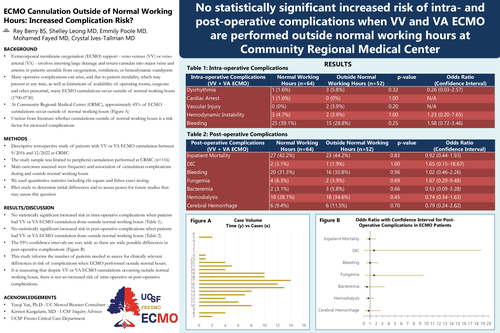
This was a descriptive retrospective study of patients who received ECMO cannulation between 9/1/2016 and 12/31/2022 at Community Regional Medical Center in Fresno, CA. There were 126 patients who were assessed for eligibility. 10 patients were excluded due to chart review restriction (1), cannulation performed at outside hospital (5), inaccurate medical record number (1), and central cannulation (3). There were 116 patients included in our study. 97 patients underwent VV ECMO cannulation and 19 patients underwent VA ECMO cannulation. Based on the documented start time of ECMO cannulation procedure, the cohort was divided into two groups: Normal working hours (0730 to 1700; n=64) and outside normal working hours (1700-0730; n=52). Quantitative statistics including chi-square and fisher exact testing were performed. Main outcomes assessed were frequency and association of cannulation complications (intra-operative and post-operative) between cannulations performed during and outside of normal working hours.
Results
The intra-operative complications assessed in this study included intra-operative dysrhythmia, cardiac arrest, vascular injury, hemodynamic instability, and bleeding. There was no statistically significant difference in frequency or increased risk of intraoperative complications when VV OR VA ECMO cannulations were performed outside of normal working hours. The long-term complications assessed in this study included cerebral hemorrhage, hemodialysis, bacteremia, fungemia, bleeding, disseminated intravascular coagulopathy, thromboembolism, and inpatient mortality. In addition, limb ischemia was assessed for VA ECMO patients. In the VV ECMO group, there was a trend towards increased risk of inpatient mortality, hemodialysis, cerebral hemorrhage, and bacteremia when performed outside normal working hours, but it did not meet statistical significance. The odds ratio was 0.85 (CI 0.38-1.91) for inpatient mortality, 0.56 (CI 0.22-1.41) for hemodialysis, 0.66 (0.19-2.33) for cerebral hemorrhage, and 0.10 (0.01-0.86) for bacteremia. In the VV ECMO group, The p-value for bacteremia was 0.02, but when controlling for COVID-19 status, the p-value was 0.05 and odds ratio was 0.11 (CI 0.01-0.95). In the VA ECMO group, there was no statistically significant difference in frequency or increased risk of any post-operative complications when VA ECMO was performed outside of normal working hours.
Discussion
To our knowledge, this is the first study that assesses the frequency and association of intra-operative and post-operative complications between ECMO cannulation performed during and outside of normal working hours. It is reassuring to know that despite approximately 45% of ECMO cannulations at Community Regional Medical Center occurring outside of normal working hours, there is no increased risk of intraoperative or post-operative complications. Unfortunately, given the small sample size and wide confidence intervals in this study, our conclusion can be stated with little confidence. There were trends towards increased risk of inpatient mortality, hemodialysis, and bacteremia when VV ECMO was performed outside normal working hours, which should be assessed in a future study with a larger sample size. For future studies that want to assess this question, our study informs the number of patients needed to assess for clinically relevant difference in risk of complications when ECMO is performed outside normal working hours.