145 posters, 12 topics, 25 sessions, 145 authors
ePostersLive by SciGen Technologies S.A. All rights reserved.
UCSF 2023 Inquiry Symposium
10 May | University of San Francisco

P011
Pediatric adverse childhood experiences and related life events screener (PEARLS) score as an individual predictor of child executive function
Poster Presenter
Authors
Part of Topic
Clinical & Translational Sciences
Introduction PEARLS is a validated primary care screening tool for Adverse Childhood Experiences (ACEs) and Related Life Events experienced by youth 19 and under. Numerous studies report that ACEs are associated with adverse health outcomes—such as asthma, obesity, and substance use disorder—and are good predictors of mean group differences in health outcomes. In this study, we examined whether the PEARLS tool is associated with children who have persistently poor or worsening executive function.
Hypothesis We hypothesized that a higher baseline PEARLS score is predictive of poorer child executive function in follow-up, as measured by the Behavior Rating Inventory of Executive Function (BRIEF) T-score.
Aims To examine the association between a child’s baseline PEARLS score and their measure of executive function after 9 months of follow-up in children 3 months to 11 years old.
Project Design/Methods Participants were enrolled in the Pediatric ACEs Screening and Resiliency Study at the University of California San Francisco (UCSF) Benioff Children’s Hospital Oakland Primary Care Clinic between March 2017-October 2018. Data from these participants were collected at baseline and at their 9-month follow-up visit. At both timepoints, patient demographics (age, gender, race, education level) and BRIEF T-scores were obtained. Participants with complete data at both timepoints were eligible for the present study.
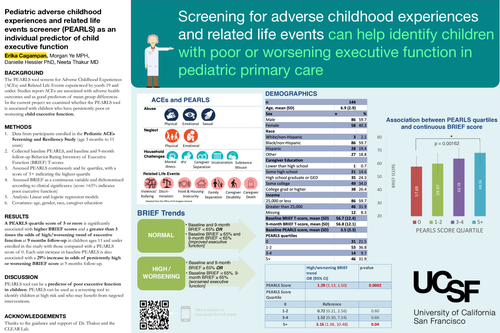
Our primary predictor variable was the PEARLS score at baseline. We categorized continuous baseline PEARLS scores into PEARLS Quartiles (0, 1-2, 3-4, 5+), and assessed BRIEF T-score as a continuous variable and dichotomized according to clinical significance (T-score >65%). “Normal” trend includes participants with baseline and 9-month BRIEF both < 65% or improved executive function with baseline BRIEF ≥ 65% and 9-month BRIEF < 65%. “High/worsening” trend includes participants with baseline and 9-month BRIEF both ≥ 65% or worsened executive function with a baseline BRIEF < 65% and 9-month BRIEF ≥ 65%. We performed linear and logistic regression models to determine associations between PEARLS quartiles and continuous BRIEF score, between continuous PEARLS score and BRIEF score trend, and between PEARLS quartiles and BRIEF score trend. Covariates used were child age, gender, race, and caregiver education.
Results 144 participants were included in this analysis, with a mean baseline PEARLS score of 3.5. About a third of participants reported a PEARLS score of 5+. Based on our analyses, a PEARLS quartile score of 5+ is significantly associated with higher BRIEF scores (Mean 68.16, SD 7.95; p = 0.00162) compared with those who have 0 PEARLS (Mean 57, SD 7.95). Moreover, the odds that an individual has a high/worsening trend of executive function after 9 months is higher in those who have 5+ PEARLS than in those who have 0 PEARLS (OR: 3.16; 95% CI: 1.06, 10.48; p = 0.04). Each unit increase in baseline PEARLS is also significantly associated with an increase in odds of persistently high or worsening BRIEF score trend (OR: 1.29; 95% CI: 1.13, 1.50; p = 0.0002).
Discussion/Conclusion Our study results show that the PEARLS tool can be a predictor of executive function in children ages 11 and under, with a PEARLS score 5+ demonstrating a significant association with poor or worsening child executive function after 9 months of follow-up. Our data is currently limited to a small sample size within the UCSF Benioff Children’s Oakland patient population. Thus, our findings may not be generalizable to other hospitals or clinics with varying patient demographics. As ACEs are also inherently challenging, sensitive, and traumatic, we must also consider the possibility of caregiver underreporting of ACEs. Despite these limitations, our study results support the use of the PEARLS tool in a pediatric primary care setting to identify children at high risk of clinically significant problems in child executive function in the future. These results are promising, and suggest that early screening may be helpful in identifying patients who may benefit from targeted interventions. The type and efficacy of such interventions remains to be explored.