145 posters, 12 topics, 25 sessions, 145 authors
ePostersLive by SciGen Technologies S.A. All rights reserved.
UCSF 2023 Inquiry Symposium
10 May | University of San Francisco

P095
The Power of the Patient Voice: A Community-Engaged Approach to Carceral Health Curricula Development
Poster Presenter
Authors
Part of Topic
Education Science
Introduction: People who have experienced incarceration face a higher burden of chronic illnesses, mental health disorders, past trauma/abuse, and disproportionately comprise of Black, Indigenous and Latinx individuals who additionally endure racism in health and healthcare. Many report sub-standard medical care in carceral settings and distrust in the healthcare system. Although most physicians will at some point care for incarceration-experienced individuals, medical student knowledge, attitudes and preparedness to care for this population is generally low. While the literature has described learner, educator and clinician perspectives on carceral health education needs in medical schools, little is known about the perspectives of people who have experienced incarceration. Because they are directly impacted by the care that medical trainees will provide, their perspectives are essential in developing carceral health curricula as part of a community-engaged approach to anti-oppressive medicine.
Aims: Our qualitative study gathers perspectives from people with a history of incarceration on how physicians can provide them with better medical care. Our goal is to help develop medical curricula that empowers medical students, residents and fellows to build the knowledge and skills to provide equitable, trauma-informed care to patients who are currently or formerly incarcerated.
Methods: One-hour in-depth, semi-structured phone interviews were conducted from Sept. to Dec. 2022 with individuals who were formerly incarcerated, recruited through convenience sampling. We oversampled for non-binary people, trans women, trans men and cis-women, in order to represent perspectives often underrepresented among the incarceration-experienced population. Participants were asked about their experiences receiving medical care during and after incarceration, and advice on how physicians can provide better care to their population in carceral and community health settings. Participants received a $75 gift card honorarium. Interviews were audio-recorded, and transcripts were analyzed on Dedoose using inductive thematic analysis. Our research team included two community leaders who were formerly incarcerated, who advised on the study design and conducted recruitment.
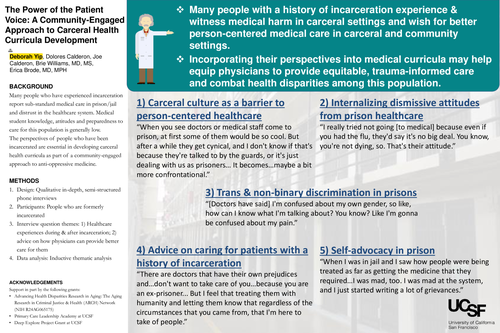
Results: Among the 13 participants, there was 1 non-binary person, 3 trans women, 2 trans men, 4 ciswomen and 3 cis-men. Ten different self-reported racial/ethnic identities were represented. Prison terms ranged from 3 to 40 years (median 25 years), and half began their prison sentence prior to 1990. All participants reported negative healthcare experiences during incarceration, with some reporting challenges with healthcare access upon re-entry. We identified preliminary themes: 1) Carceral culture as a barrier to person-centered healthcare; 2) Internalizing dismissive attitudes from prison healthcare; 3) Trans & non-binary discrimination in prisons; 4) Advice on caring for patients with a history of incarceration; 5) Self-advocacy in prison. Participants want physicians to foster safe, non-judgmental spaces in carceral and community healthcare settings that allow them to fully express their needs. They want physicians to recognize and resist prison/jail culture influence on clinician bias and behaviors toward patients. Incarceration is generally traumatizing and can strip away people’s sense of agency. However, people who are incarcerated have successfully advocated for their rights and safety when faced with discrimination and medical harm at the interpersonal and systems level.
Discussion/Conclusion: Many people with a history of incarceration experience and witness medical harm in carceral settings. Many wish for better person-centered medical care in carceral and community settings. Incorporating perspectives from incarceration-experienced individuals into medical curricula may help equip physicians to provide equitable, trauma-informed care and combat health disparities among this population.