145 posters, 12 topics, 25 sessions, 145 authors
ePostersLive by SciGen Technologies S.A. All rights reserved.
UCSF 2023 Inquiry Symposium
10 May | University of San Francisco

P024
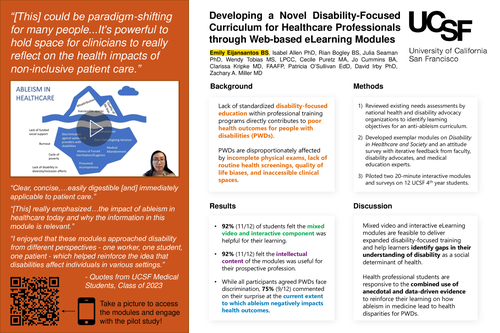
Developing a Novel Disability-Focused Curriculum for Healthcare Professionals and Trainees through Web-based eLearning Modules
Poster Presenter
Authors
Part of Topic
Education Science
Introduction
Research supports that lack of standardized disability-focused education within medical education curricula
directly contributes to poorer health outcomes for people with disabilities. People with disabilities are
disproportionately affected by incomplete physical examinations, stereotypes that lead to health
misinformation, and lack of accommodations to support the shared decision-making process. They also
face a wide range of disparities in the healthcare provided to them, from decreased rates of cancer
screenings and lack of sexual health counseling to erroneous clinician assumptions about their quality of
life.
Question
What learning objectives should be included in a foundational disability-focused curriculum to prime health
professional trainees on evidence-based strategies to address ableism (discrimination in favor of able-
bodied persons) in healthcare practices? Can this curriculum be delivered through mixed interactive and
video modules?
Aims
Aim 1: To build a foundational disability curriculum, conducting a review of existing needs assessments to
identify which specific learning objectives are most valuable and relevant to health professionals.
Aim 2: To create a set of two introductory online learning modules that will prime health professional
trainees on ways providers can identify ableism in healthcare practices.
Aim 3: To assess the participant satisfaction with these modules and their content through surveys
measuring satisfaction rates and eliciting open-ended feedback from a pilot group of fourth year medical
students.
Methods
To determine what learning objectives would be more relevant for health professional trainees and
providers, we reviewed literature and existing needs assessments completed by several national health
and disability advocacy organizations, including the National Council on Disability. We identified learning
objectives suitable for an asynchronous anti-ableism curriculum, and from these, we narrowed our
objectives further, based on feasibility of coverage in within an interactive module and consistency across
needs assessments from different advocacy groups. Iterative feedback from medical education experts,
disability advocates, and faculty led to the development of an online modular series on Disability in
Healthcare and Society, and to the refinement of our introductory modules’ learning objectives for clarity
and concision. We designed a pre-module survey assessing participant attitudes toward the state of health
services for people with disabilities and a post-module survey collecting their ratings of satisfaction with the
module experience and open-ended feedback. Fourth year medical students were invited by email to
participate in a pilot of our modules and the surveys asynchronously and anonymously.
Results
We created two exemplar, 20-minute eLearning modules on “Introduction to Disability Theory and Ableism,”
and “Health Disparities Faced by People with Disabilities,” comprised of a video component and embedded
questions, designed for health professionals and trainees in patient-facing clinical fields. The full pilot can
be accessed here: https://ucsf.co1.qualtrics.com/jfe/form/SV_6h8CWHatl2ofIZU. Our learning objectives
are as follows:
• Module 1
o Define disability.
o Define ableism.
o Compare and contrast the social and medical model of disability.
o Discuss at least two examples of the social vs. medical model of disability.
• Module 2
o Identify at least three specific health disparities that people with disabilities face.
o Describe at least two specific strategies clinicians can employ to address ableism in healthcare
institutions.
Twelve volunteer fourth year medical students participated in our pilot and completed the modules. 92%
(11/12) of students felt the mixed video and interactive component was helpful for their learning. 92%
(11/12) felt the intellectual content of the modules was useful for their prospective profession. While all
participants agreed people with disabilities face discrimination, 75% (9/12) commented on their surprise at
the current extent to which ableism negatively impacts health outcomes.
Discussion
Mixed video and interactive eLearning modules are feasible to deliver expanded disability-focused training
and reinforce how examples of ableism in medicine lead to health disparities, given overall high ratings of
satisfaction with the module experience and intellectual content from student participants. Though students
who participated were those who elected to learn more about anti-ableism in medicine and overall held
attitudes that disability training was relevant to medical education in the pre-module survey, most
participants still commented on their surprise at the growing evidence of the negative impacts of ableism
on health outcomes, suggesting that information on these disparities is poorly disseminated during
undergraduate medical training. In open-ended feedback, most participants felt that the learning objectives
were satisfactory and responded positively to the combination of anecdotal and data-driven evidence used
in the modules’ case-based and didactic learning.
One study limitation includes the small number of student participants who completed the modules in our
pilot study. These students who voluntarily participated in this pilot program are themselves individuals who
likely have an interest in disability-focused training, and as such, their opinions do not necessarily reflect
the general student population. Another limitation is the use of an unvalidated pre-module survey measuring
attitudes toward disability and healthcare services. From our review of published instruments measuring
attitudes toward disability among healthcare professionals, we concluded that those questionnaires were
less relevant to disability education and the content of our modules. Thus, we designed our own attitude
survey, though our current sample size is too small to draw conclusions about medical student attitudes on
this topic. To determine if the results of our pilot study apply to the broader medical student population and
if this intervention in efficacious in helping learners identify gaps in their understanding of disability as a
social determinant of health, further studies with a larger sample size of learners are needed.