145 posters, 12 topics, 25 sessions, 145 authors
ePostersLive by SciGen Technologies S.A. All rights reserved.
UCSF 2023 Inquiry Symposium
10 May | University of San Francisco

P052
Expansion and Understanding Point-of-Care Ultrasound in an Existing Undergraduate Medical Curriculum
Poster Presenter
Authors
Part of Topic
Education Science
Introduction:
Point-of-care ultrasound (POCUS) is increasingly commonly used by numerous specialties in the
inpatient and outpatient settings, with clinical benefit including reduced time to diagnosis in
acute dyspnea and improved diagnostic accuracy in dyspnea, nontraumatic hypotension, and
shock. (J Clin Ultrasound 46(3):167-7; Ultrasound J 11(1):31; Chest 151(6) 1295-301; Eur J
Intern Med 106:9-38) Overall, there is great interest in POCUS education at multiple levels of
medical training. (Acad Med 97(5):723-7) However, many barriers to implementing POCUS
education at the undergraduate medical level persist, including limited curricular time, limited
access to appropriately knowledgeable faculty, and limited access to adequate hardware. (ibid.)
One approach to enhancing undergraduate POCUS education longitudinally has been adding
supplemental figures to suitable clinical vignettes in the existing curriculum. Previously, Megan
Pendleton, a UCSF student, had developed POCUS images for a portion of the UCSF
Foundations 1 curriculum, with positive feedback from students and small group facilitators.
Aims:
In this project, we first aim to further expand POCUS exposure in the preclinical curriculum at
UCSF to curricular blocks currently lacking ultrasound references, due to greater barriers to
expand POCUS teaching in these blocks. These blocks are Brain, Mind, and Behavior (BMB),
Pathogens and Host Defense (PHD), and Life Stages (LS). Second, we aim to better understand
the perspectives of curricular leadership regarding where in the UCSF undergraduate medical
education future POCUS education should occur.
Project Design:
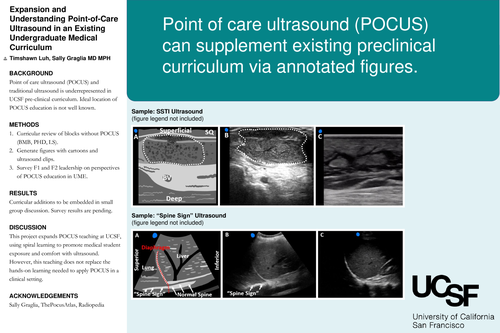
We primarily provide POCUS teaching by enhancing clinical vignettes already in the curriculum
with relevant POCUS images and concepts. To conduct a curricular review, we evaluated all
problem-based learning vignettes in small group discussion sessions for references to ultrasound
or suitability for ultrasound illustrations. To create each ultrasound figure, multiple media were
compiled: didactic ultrasound video clips were obtained from faculty, collaborators, and
published open-access sources; cartoons were drawn to highlight key features of the clips; both
video clips and cartoons were annotated and described with a figure legend.
To better understand where in the undergraduate medical education future POCUS curricular
efforts should be targeted, we surveyed leadership of all Foundations 1 elements and leadership
of clinical or didactic Foundations 2 blocks with an online survey via Qualtrics. Due to the
highly customized nature of Career Launch, leadership of these blocks were not surveyed.
Results:
To extend existing POCUS teaching, ultrasound images will be included in blocks throughout
the UCSF Foundations 1 curriculum. Images have been provided to block directors of BMB,
PHD, and LS. Results from the block director survey are pending.
Discussion:
Compared to pre-existing POCUS education at UCSF, this project is notable for expanding
student exposure to POCUS and ultrasound in general. It enhances spiral learning by providing
students with early pre-clinical exposure to different forms of imaging and normalizes the
interpretation of ultrasound by trainees. It also provides this benefit with minimal addition to the
curricular footprint. However, this project does not replace the kinesthetic hands-on experience
that is required to learn and successfully perform POCUS. In the future, students who have
completed this teaching would be ideal to survey regarding the impact of this exposure on their
subsequent POCUS learning.