145 posters, 12 topics, 25 sessions, 145 authors
ePostersLive by SciGen Technologies S.A. All rights reserved.
UCSF 2023 Inquiry Symposium
10 May | University of San Francisco

P029
Student Perspectives on Bias in Standardized Patient Encounters
Poster Presenter
Authors
Part of Topic
Education Science
Introduction: Several studies have found that standardized patients (SPs) exhibit bias in their evaluations of students, both on the basis of perceived gender and race/ethnicity1,2,3. Despite this, students and educators alike perceive SPs to be an essential component of an encompassing medical education curriculum4. Researchers on this project have previously conducted interviews with SPs to better understand bias in simulation5. However, no such study has been conducted to hear student voices, which is of utmost importance as learners are key stakeholders in the field of medical simulation.
Aims: To better understand how learners perceive bias in their work with SPs.
Methods: Researchers conducted 12 semi-structured interviews with third- and fourth-year medical students at UCSF. Participants were selected using purposive sampling to ensure diversity on the basis of gender, race/ethnicity, and year in training. The interviews were professionally transcribed and analyzed by researchers using inductive thematic analysis. Researchers met iteratively to reconcile codes and identify themes until saturation was reached.
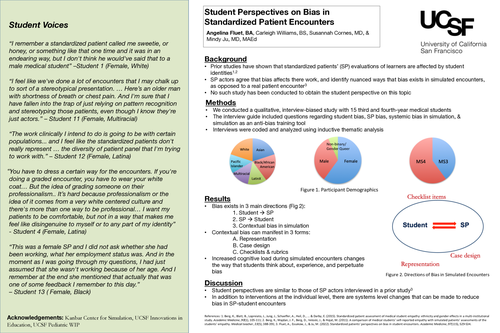
Results: Students identified that bias in SP encounters can occur in multiple directions: from SP-to-student, student-to-SP, and systemically in the context of simulation. While they reported very few instances of bias from SPs, they felt that this was because SPs were receiving ample anti-bias training and were encouraged to behave the same way during every encounter. With regards to their own biases, many students cited preferences for working with identity-concordant SPs, predominantly based on race, age, and gender identity. Students also identified bias in the context of simulation, which can occur as a result of rubrics, case design, and underrepresentation of actor and/or character identities.
Conclusions: Bias can occur on different levels in student-SP encounters, from the representation of identities in character roles to the preferences of students for identity concordance. We identified specific aspects of simulation design that can perpetuate bias in a way that is unique to simulation and does not occur in encounters with real patients. By identifying the areas where bias exists, educators can work to mitigate bias in simulation.
References: 1. Berg, K., Majdan, J. F., Berg, D., Veloski, J., & Hojat, M. (2011). A comparison of medical students’ self-reported empathy with simulated patients’ assessments of the students’ empathy. Medical teacher, 33(5), 388-391. 2. Chambers, K. A., Boulet, J. R., & Furman, G. E. (2001). Are interpersonal skills ratings influenced by gender in a clinical skills assessment using standardized patients?. Advances in Health Sciences Education, 6(3), 231-241. 3. Wiskin, C. M., Allan, T. F., & Skelton, J. R. (2004). Gender as a variable in the assessment of final year degree-level communication skills. Medical education, 38(2), 129-137. 4. Bokken, L., Rethans, J. J., van Heurn, L., Duvivier, R., Scherpbier, A., & van der Vleuten, C. (2009). Students’ views on the use of real patients and simulated patients in undergraduate medical education. Academic Medicine, 84(7), 958-963. 5. Fluet, A., Essakow, J., & Ju, M. (2022). Standardized Patients' Perspectives on Bias in Student Encounters. Academic Medicine: Journal of the Association of American Medical Colleges.