145 posters, 12 topics, 25 sessions, 145 authors
ePostersLive by SciGen Technologies S.A. All rights reserved.
UCSF 2023 Inquiry Symposium
10 May | University of San Francisco

P005
Analysis of Resident Feedback from a Pilot Trauma-Informed Care Curriculum for Pediatric Residents
Poster Presenter
Authors
Part of Topic
Education Science
Introduction: The American Academy of Pediatrics has identified childhood trauma as one of the most
serious public health epidemics facing our nation. The landmark Adverse Childhood Experiences (ACEs)
study, which evaluated the lifetime health effects of childhood trauma, demonstrated a strong and
compelling correlation between early life adversity and lifelong morbidity and mortality in a dose
dependent relationship. Despite this, graduate medical education often lacks explicit training via
didactics on trauma-informed care (TIC). Pediatric medical trainees need more practical instruction on
TIC skills, including safe communication, basic counseling, reflective practice, community partnership,
and non-harmful documentation.
Question: Can a didactic-based TIC curriculum for pediatric residents improve trainees’ TIC-related skills,
knowledge, and attitudes? What aspects of the curriculum do residents identify as significant areas for
improvement?
Aims: The objectives of the curriculum were to have learners become able to: 1) define and recognize
the effects of toxic stress, 2) apply principles of TIC to establish trust and safety in clinical encounters, 3)
reflect on how their experiences of privilege and trauma influence their work as healers, 4) utilize
motivational interviewing and basic counseling skills, 5) counsel families on promoting relational and
individual protective factors to mitigate the effects of toxic stress, and 6) document traumatic stress
exposures in a way that prevents harm and preserves privacy. The objectives of the analysis were to
understand the curriculum’s effects on residents’ skills, knowledge, and attitudes related to TIC as well
as to understand the strengths and weaknesses of the curriculum.
Methods: We designed and implemented a trauma-informed care (TIC) curriculum for pediatric
residents following a literature review and mixed-methods needs assessment. Residents completed four
synchronous, virtual, 1 to 2 hour-long sessions focusing on: 1) introduction to TIC and adverse childhood
experiences (ACEs), 2) physician meaning and burnout (in partnership with a local community-based
organization), 3) basic counseling techniques and motivational interviewing, and 4) protective factors
and documentation considerations. Evaluation measures included pre- and post-participation surveys
querying residents’ knowledge, attitudes, skills, and satisfaction; and qualitative analysis of open-ended
survey comments.
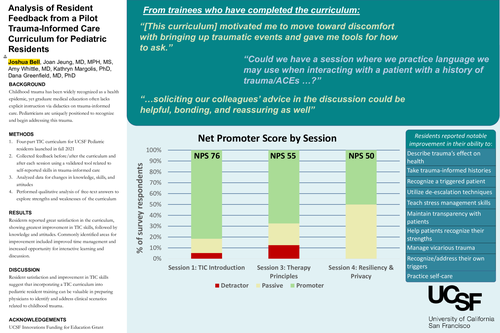
Results: A total of 43 first- and second-year residents completed the curriculum during academic year
2021-22. Residents indicated high satisfaction with the TIC curriculum, with excellent net promoter
scores (NPS). Pre- and post-curriculum ratings as well as resident comments indicated that the
curriculum had the greatest impact on TIC skills, followed by knowledge and, to a lesser extent, attitudes
(already high at baseline). The most common suggestions for change included time management and
interactive learning, with longer sessions offering greater opportunity for skills practice, feedback, and
longer peer discussion.
Discussion: One limitation of this pilot is that varying numbers of residents responded to the pre- and
post-curriculum surveys, making data interpretation difficult. Regardless, this pilot shows that
incorporating a TIC curriculum into pediatric resident training can strengthen the knowledge and skills
needed to address ACEs and practice TIC. This curriculum’s unique focus on therapeutic communication
skills, self-reflection, and partnership with a community-based organization may serve as a model for
other healthcare institutions seeking to build the necessary skills to actualize TIC in clinical practice.