145 posters, 12 topics, 25 sessions, 145 authors
ePostersLive by SciGen Technologies S.A. All rights reserved.
UCSF 2023 Inquiry Symposium
10 May | University of San Francisco

P037
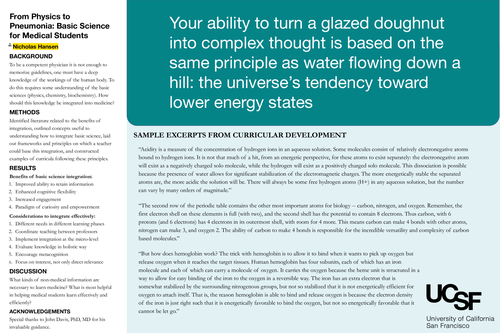
From Physics to Pneumonia: Basic Science Curricula for Medical Students
Poster Presenter
Authors
Part of Topic
Education Science
The original aims for the project were several. I intended to review the literature related to the
integration of basic science in medical school, identify strategies and frameworks that could be
used to facilitate and improve that integration, and provide examples of curricula using these
strategies and frameworks. The goal was to provide an in-depth look at an important aspect of
medical education and examine ways in which its implementation could be improved, as well
as attempting to use those lessons to create potential curricula.
All of these three goals were successfully completed, though of course the answers are far
from comprehensive or conclusive. I was able to review a significant amount of available
literature relating to basic science, and found that there are a number of potential reasons to
include basic science learning into medical curricula, including an improved ability to retain
clinical information, enhanced cognitive flexibility and an ability to work with information in
novel scenarios, increased engagement of students with the material, encouragement of a
paradigm of curiosity and empowerment, and to facilitate the physician’s role as a scientist.
In terms of exploring different ways to optimize integration, a number of characteristics were
identified and explained including how to integrate knowledge across different phases of
learning, what background knowledge is necessary before entry into medical school, how
teachers who are playing different roles can integrate their teaching effectively, how information
can be integrated at a micro scale, how students can be evaluated in a way that encourages
deep learning, how to set students up with metacognitive training, and how to make room for
what is interesting and engaging and not merely that which is obviously relevant.
In the final section of the project approaches to curricular development using these strategies
was attempted. The first segment covered a variety of concepts from physics and chemistry
that are helpful or even necessary to have a deep understanding of medicine. Ideally, students
would either know this before medical school or have an overview early in medical school.
Then, three examples of medical education combined with basic science curricula were
outlined: oxygen transport, MRI technology, and acid/base chemistry.
Working on this project was a wonderful opportunity to explore a subject I’ve long been deeply
interested in, and I found it to be a valuable experience. As a long time student of medicine
myself, I’ve always been fascinated by the incredible variety of teaching strategies employed.
Some point of my medical education was a phenomenal experience, where I was able to
explore exciting niches of human biology with peers. Other points felt like a slog, like nothing
but memorization of large lists. Figuring out what the difference between these experiences of
my own was the motivation for this project, and it was a great experience that furthered my
interest in curricular development. There is much interesting work to be done on helping people
learn medicine, and this project solidified my interest in curricular science and curricular
development.
I learned a few important lessons. The first is that curricular development is quite difficult, and
creating content that is educational and engaging requires a great deal of thought and
consideration. Part of this is a realization that principles will only take one so far — similar to
medicine, general guidelines do not obviate the need for individualized approaches to
curriculum development. Each school, each subject, and each type of student may have
different experiences with the same information and teaching styles. There is an enormous
need for thoughtful teachers thinking deeply about how to synthesize and present information,
and while broad principles can help guide teachers, there will never be a replacement for an
excellent teacher.
But the most important lesson I came away with was that there is a great deal of potential
benefit to be gained by improving and optimizing medical education, and the inclusion of basic
science into medical education will be an important part of that education. Continuing to think
deeply about how to create competent physicians will be a central part of my career, and I
believe working on the problem of basic science integration will continue to pay dividends.