145 posters, 12 topics, 25 sessions, 145 authors
ePostersLive by SciGen Technologies S.A. All rights reserved.
UCSF 2023 Inquiry Symposium
10 May | University of San Francisco

P093
Predictors of low-to-high grade progression in pancreatic neuroendocrine tumors
Poster Presenter
Authors
Part of Topic
Clinical & Translational Sciences
INTRODUCTION: Pancreatic neuroendocrine neoplasm (panNEN) heterogeneity is readily apparent in the current (2019) WHO classification system, which defines grade (G) by the Ki67 tumor proliferation index (<3% for G1, 3-20% for G2, and >20% for G3). The G3 NEN subgroup is further divided into well differentiated neuroendocrine tumors (NETs) and poorly differentiated neuroendocrine carcinomas (NEC). Progression to higher grades is a known clinical occurrence, and recent reports suggest that it is common in patients undergoing serial biopsies, including 54.5% of panNEN patients and 83% of patients with gastroenteropancreatic NETs. [Panzuto 2017, Botling 2020] Low-to-high grade (G1/2àG3) progression was associated with shorter overall survival (OS) and at times accompanied by morphological dedifferentiation into NEC-like features. While progression from low- to high-grade panNET has been shown to serve as independent prognostic factor, little is known about the timeframe over which progression occurs and what drives this change, thus adding uncertainty to individual clinical management and complexity to trial inclusion criteria.
AIMS - Aim 1: Determine incidence rate of longitudinal progression to G3 in UCSF patients with G1/2 panNET and at least two serial tumor biopsies. - Aim 2: Determine if low-to-high grade progression and grade migration are associated with altered survival outcomes. - Aim 3: Determine if any patient demographics, tumor characteristics, or prior therapies predict low-to-high grade progression.
METHODS: We conducted a retrospective review of patients with stage I-IV G1-3 panNENs diagnosed between 2010-2021 and identified from an IRB-approved UCSF Center for Neuroendocrine Tumors database. All patients received at least two serial tumor biopsies 3 months apart with Ki67 tumor proliferative index staining reviewed either at UCSF or an outside intstitution. Demographic, clinicopathological, treatment, and outcome data were recorded. Statistical analyses were performed with Graphpad Prism 9.5.0 and R version 4.0.5. Two-tailed Mann-Whitney U, Fisher’s exact, and log rank tests were performed for comparisons between groups. Statistical significance was declared for P<0.05 without adjustments for multiple hypotheses testing.
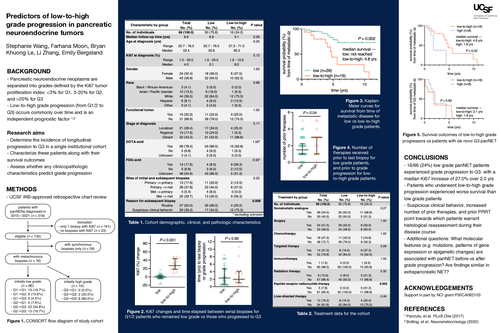
RESULTS: 318 patients from the database had panNENs diagnosed within the designated timeframe. 76 received metachronous biopsies with Ki67 staining, and 66 of these were initially low grade (G1/2). 16 out of 66 (24.4%) low grade panNET patients experienced low-to-high grade progression, with a median Ki67 increase of 27.0% over 2.0 years. In comparison, the 50 patients who were diagnosed as low grade and remained so throughout their disease course had a median Ki67 change of 0% upon serial biopsy. These low grade patients were followed for a similar amount of time, with 2.3 years elapsing from time of initial to time of last biopsy. PanNET patients who underwent grade progression were more likely to have had serial biopsies performed after a change in disease behavior (P<0.008), to be more heavily pretreated (P=0.04), to have received prior peptide receptor radionuclide therapy (PRRT) (P=0.003), and to experience worse survival than low grade patients (P=0.002). Compared to the 8 patients with de novo G3 panNET, low-to-high grade progressors had longer overall survival (P=0.02), but interestingly similar survival from time of G3 disease (P=0.82).
DISCUSSION: Our results highlight several features – suspicious clinical behavior, increased number of prior therapies, and prior PRRT – that may point towards which patients warrant histological reassessment during their disease course. A closer look at these select cases is needed to clarify whether PRRT leads to changes in tumor biology, or if this change simply reflects that PRRT is often used as a later line in patients who have failed multiple prior therapies. Future work will assess whether grade migration (e.g. Ki67 increases that do not necessarily lead to grade progression) also predicts survival, and if there are differences between G1à3 and G2à3 patients. Additional questions remain, including investigating what molecular features (e.g. mutations, patterns of gene expression or epigenetic changes) are associated with panNET before vs after grade progression, and evaluating if our findings are also seen in extrapancreatic NET.
REFERENCES: Panzuto F, Cicchese N, Partelli S, et al. Impact of Ki67 re-assessment at time of disease progression in patients with pancreatic neuroendocrine neoplasms. PLoS One. 2017; 12: e0179445. doi:10.1371/journal.pone.0179445 Botling J, Lamarca A, Bajic D, et al. High-grade progression confers poor survival in pancreatic neuroendocrine tumors. Neuroendocrinology. 2020; 110: 891- 898. doi:10.1159/000504392