145 posters, 12 topics, 25 sessions, 145 authors
ePostersLive by SciGen Technologies S.A. All rights reserved.
UCSF 2023 Inquiry Symposium
10 May | University of San Francisco

P092
Prospective Evaluation of a Deep Learning View Classifier for Pediatric Focused Assessment with Sonography for Trauma (FAST)
Poster Presenter
Authors
Part of Topic
Clinical & Translational Sciences
Introduction: Focused assessment with sonography for trauma (FAST) is a diagnostic point-of-care ultrasound study that rapidly identifies intra-abdominal hemorrhage in injured patients. The lack of pediatric FAST expertise is a barrier to widespread use in injured children. However, deep learningbased technologies offer enhanced clinical skills where expertise is scarce.1–3 Anatomic view classification is often the first step in the development of diagnostic deep learning models.4,5 Recently, a deep learning pediatric FAST view classifier was developed that identifies the different anatomic FAST views with an overall accuracy of 99.1%. However, the accuracy of the classifier decreases to 88.5% when discriminating between the right upper quadrant (RUQ) and left upper quadrant (LUQ) abdominal views.6 Retrospective labeling of the RUQ and LUQ is challenging due to their similar ultrasonographic appearances and may introduce bias to the model. Prospective validation is needed to determine its predictive performance.
Aim: The aim of this study was to validate the sensitivity of a deep learning FAST view classifier in discriminating between the right upper quadrant and left upper quadrant abdominal views by testing it on a prospective validation set and comparing its performance to the original retrospective validation set.
Hypothesis: We hypothesize that there will be a decline in sensitivity of the FAST view classifier on the prospective compared to the retrospective validation dataset.
Methods: We performed a prospective convenience cohort study of students undergoing routine FAST education at UCSF from September 2022 to February 2023. Students were included if they volunteered to have anonymous view clips recorded and excluded if images were not recorded. The primary outcome was FAST view classifier sensitivity with 95% confidence intervals (95% CI) by majority video view clip. For the prospective validation set, ground truth was determined by real-time image labeling at the time of acquisition by the study team. In contrast, the original retrospective validation set was developed using expert labeling.
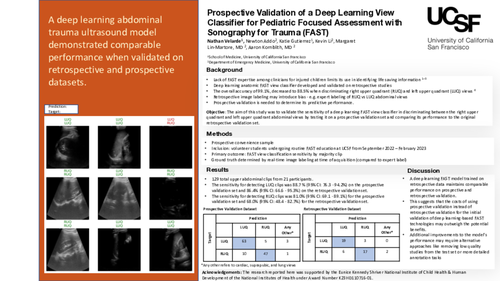
Results: 21 participants contributed 129 FAST upper abdominal view clips. 71 view clips were from the RUQ, and 58 view clips were from the LUQ. The sensitivity for detecting LUQ view clips was 88.7% (95% CI: 76.3 - 94.2%) on the prospective validation set and 86.4% (95% CI: 66.6 - 95.3%) on the retrospective validation set. The sensitivity for detecting RUQ view clips was 81.0% (95% CI: 69.1 - 89.1%) for prospectively validation set and 68.0% (95% CI: 48.4 - 82.7%) for retrospective validation set.
Discussion: We found that a deep learning pediatric FAST view classifier developed using retrospectively labels performs with greater or equal sensitivity for RUQ and LUQ views in prospective validation. Although retrospective labeling of RUQ and LUQ images is challenging due to their similar ultrasonographic appearance and can potentially introduce bias to the model, our model performed consistently when tested on the prospectively validation set. This suggests that the costs of using prospective validation instead of retrospective validation for the initial validation of deep learning-based FAST technologies may outweigh the potential benefits. Additional improvements to the model’s ability to discriminate RUQ and LUQ images may require alternative approaches like removing low quality studies from the test set or more detailed annotation tasks.
References: 1. Gold DL, Marin JR, Haritos D, et al. Pediatric Emergency Medicine Physicians’ Use of Point-of-care Ultrasound and Barriers to Implementation: A Regional Pilot Study. AEM Educ Train. 2017;1(4):325-333. doi:10.1002/AET2.10049/FULL 2. Steinemann S, Fernandez M. Variation in training and use of the focused assessment with sonography in trauma (FAST). Am J Surg. 2018;215(2):255-258. doi:10.1016/J.AMJSURG.2017.11.006 3. Scaife ER, Rollins MD, Barnhart DC, et al. The role of focused abdominal sonography for trauma (FAST) in pediatric trauma evaluation. J Pediatr Surg. 2013;48(6):1377-1383. doi:10.1016/J.JPEDSURG.2013.03.038 4. Madani A, Arnaout R, Mofrad M, Arnaout R. Fast and accurate view classification of echocardiograms using deep learning. NPJ Digit Med. 2018;1(1):6. doi:10.1038/S41746-017- 0013-1 5. Liu S, Wang Y, Yang X, et al. Deep Learning in Medical Ultrasound Analysis: A Review. Engineering. 2019;5(2):261-275. doi:10.1016/J.ENG.2018.11.020 6. Kornblith AE, Addo N, Dong R, et al. Development and Validation of a Deep Learning Strategy for Automated View Classification of Pediatric Focused Assessment With Sonography for Trauma. J Ultrasound Med. 2022;41(8):1915-1924. doi:10.1002/JUM.15868