145 posters, 12 topics, 25 sessions, 145 authors
ePostersLive by SciGen Technologies S.A. All rights reserved.
UCSF 2023 Inquiry Symposium
10 May | University of San Francisco

P091
An Eye to the Future: Prospective Remote Virtual Reality Glaucoma Monitoring over 2 Years
Poster Presenter
Authors
Part of Topic
Clinical & Translational Sciences
Deep Explore Abstract
Title: An Eye to the Future: Prospective Remote Virtual Reality Glaucoma Monitoring Over Two Years
Introduction: The current standard of care for visual function monitoring in glaucoma is through standard automated perimetry (SAP), commonly using Humphrey Visual Field (HVF) testing. However, this method is clinic resource intensive, requires large bulky equipment, is fatiguing to patients, and is not collected frequently enough for adequate glaucoma monitoring. Virtual reality (VR) visual field testing has the potential to overcome these barriers. In particular, frequent visual field testing can overcome the variability of test-retest reliability by collecting much more data. We introduce Vivid Vision Perimetry 10 (VVP-10), which consists of bundles of 10 tests taken over 14-day periods. In addition, VVP-10 does not require steady fixation, which is a major challenge for patients taking traditional visual field tests. We hypothesize that VVP-10 results would have a high concordance with HVF over the 2-year study period and that there would be a high adherence rate to the testing regimen.
Aims: 1) To assess the feasibility of this remote VR visual field testing strategy in a cohort of UCSF glaucoma subjects over an extended period. 2) To determine if VVP-10 can accurately assess subjects’ visual fields as compared to HVF.
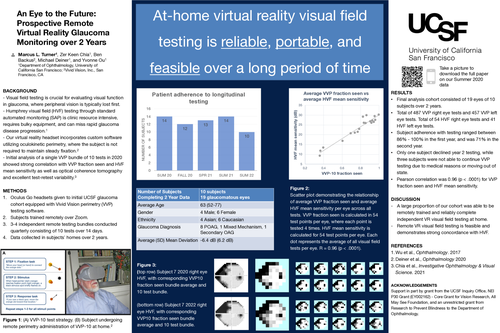
Project Design/Methods: Subjects were recruited from the UCSF glaucoma clinic to participate in VR visual field testing at home in addition to their standard of care HVF testing in clinic. Subjects were either given an Oculus Go headset in clinic or a device was delivered to them. All subjects were trained remotely over Zoom for device set up and practice testing with VVP software. All subjects were to then subsequently complete their VVP testing bundles independently in a quarterly manner (10 tests per bundle) over the span of the first year, and then once again one year later (total 50 tests). Data was uploaded remotely over Wi-Fi and compared to concordant HVF testing conducted in clinic within a 3-month span of each VVP-10 bundle. Comparisons between HVF and VVP were calculated with a Pearson correlation coefficient.
Results: Out of the initial 14 subjects that were recruited for long-term VR testing, 10 subjects with 19 glaucomatous eyes were able to complete the entirety of the testing over 2 years. Patient adherence with testing varied between 86% - 100% during quarterly testing in the first year and was 71% in the second year. A total of 487 VVP right eye tests and 457 VVP left eye tests were performed successfully over this time, compared to a total of 54 HVF right eye tests and 41 HVF left eye tests. Notably, only one subject declined year 2 testing, while three subjects were not able to continue VVP testing due to medical reasons or moving out of state. The Pearson correlation coefficient was 0.96 (p < .0001) between VVP fraction seen and HVF mean sensitivity (MS) average across all tests per subject.
Discussion: Our study demonstrated that a cohort of glaucoma patients can reliably take a large number of visual field tests at home on VR devices over an extended period of time with minimal guidance. These tests have a very strong correlation with HVF, which is the standard of care. Future research is needed to determine whether VVP-10 can more quickly identify patients whose visual fields are progressing compared to standard of care testing.