145 posters, 12 topics, 25 sessions, 145 authors
ePostersLive by SciGen Technologies S.A. All rights reserved.
UCSF 2023 Inquiry Symposium
10 May | University of San Francisco

P090
Tolerance of Awake Procedures (TAP): Examining the Safety, Efficacy, and Perceptions of Awake Esophageal and Airway Dilation
Poster Presenter
Authors
Part of Topic
Clinical & Translational Sciences
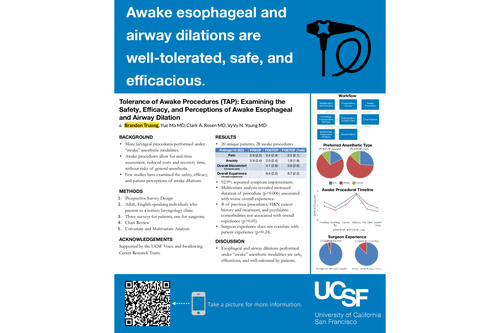
Introduction: With recent innovations in technology and visualization of the larynx, more laryngologists are turning towards procedures with monitored anesthesia care or procedural sedation in lieu of general anesthesia. These awake procedures allow for real-time assessment as well as cost and time savings, increased comfort, and avoidance of general anesthesia. No studies to date have systematically examined patient tolerance, safety, and efficacy of awake esophageal and upper airway dilations. Therefore, this study aims to better understand these procedures to better inform patients and surgeons in the treatment of esophageal and airway stenosis, leading to more widespread adoption of these procedures in the awake setting.
Hypothesis: Awake esophageal and airway dilations are well-tolerated by patients and physicians, have minimal complications, and are efficacious in the treatment of esophageal and airway stenosis.
Aims: To systematically explore patient perceptions of awake esophageal and airway dilations. To determine the safety and efficacy of awake esophageal and airway dilation procedures. To examine the surgeon’s experience in performing awake esophageal and airway dilations.
Project Design/Methods: The study utilized a prospective approach to explore patient tolerance, efficacy, and safety of awake esophageal and airway dilation. We identified adult, English-speaking patients who presented to the UCSF Voice and Swallowing Center for these procedures under procedural sedation or monitored anesthetic care. Patients with previous experiences or had previously participated in this study were included. Three surveys were provided: preoperatively, immediately postoperatively, and one week postoperatively. The surgeon also received a survey. Concurrently, a chart review was performed to provide context to each patient’s clinical course. Analysis of the data was performed using the Data Analysis ToolPak within the Microsoft Excel platform, allowing for both univariate and multivariate analysis.
Results: A total of 20 unique patients and 28 awake procedures were identified between August 2022 to March 2023 with an average age of 69.9 and a 1.9:1 male:female ratio. Average preoperative pain and anxiety scores were 3.9/10. All patients with previous experiences described their procedures as either “Great” (60.0%) or “Tolerable” (40.0%) with 37.9% describing their biggest concern as the idea of being awake during the procedure. The most uncomfortable section was the actual dilation with an average score of 5.5/10. Immediate postoperative pain and anxiety scores were rated at 3.4 and 2.5 out of 10 respectively. The overall experience was rated at 6.5/10 with 71.4% preferring the awake procedure to general anesthesia and 85.7% recommending their procedure to another patient. 53.6% of patients would prefer more sedation while 32.1% would not change their current procedure at all. Of patients who followed up in the clinic, 92.9% reported some level of subjective improvement in swallowing or breathing. 95.8% of procedures were successfully performed to completion as per the surgeon with only one procedure partially completed due to patient discomfort. 87.5% of procedures had no complications with the rest having only mild issues (e.g. mild epistaxis and limited nausea). Linear regression analysis identified both increased duration of the procedure and requiring pain medications in PACU as significantly associated with lower patient ratings of the overall experience (p=0.02, 0.03). When adjusting for age, maximum dilation size, and type of sedation, only duration remained significantly associated (p=0.006). The combination of increased dilation size, procedural sedation, increased procedure duration, and requiring pain medications in PACU were not associated with the overall experience (p=0.07) but were significantly associated with being unsure regarding a repeat procedure or sharing a desire to convert to general anesthesia (p=0.04). Number of previous procedures, history of H&N cancer and treatment, and psychiatric comorbidities were not significantly associated with the overall rating of the experience. Surgical difficulties of the procedure were also not significantly associated with overall rating of the experience (p=0.24).
Discussion/Conclusion: There were no significant complications in any of the procedures performed during this study, with nearly all procedures successfully completed, emphasizing both the safety and the surgeon’s experience in performing these procedures. All patients reported that the awake anesthetic modality was well tolerated although a majority preferred more sedation. Similarly, nearly all patients who followed-up postoperatively reported improvement of their clinical symptoms, showcasing its efficacy. Decreasing pain and anxiety scores pre- vs post-procedure as well as high rates of preferring and recommending awake procedures highlights their tolerability. Finally, identification of duration of the procedure marks a potential avenue for improvement in the patient experience. Limitations to this study include small sample size, missing data due to loss of follow-up, and the subjective nature of the surveys. While these limitations were accounted for with repeats and standardizing protocols, each can introduce bias and skew results. Future studies should compare these procedures to their general anesthetic counterparts and over a longer period for greater sample sizes. Nevertheless, this study exemplified how well-tolerated, safe, and efficacious awake esophageal and airway dilation is for both the patient and surgeon, paving the way for greater adoption of this anesthetic modality for these procedures and reducing the need for general anesthesia.