145 posters, 12 topics, 25 sessions, 145 authors
ePostersLive by SciGen Technologies S.A. All rights reserved.
UCSF 2023 Inquiry Symposium
10 May | University of San Francisco

P089
Characterization of tissue-based HIV reservoirs in the San Francisco Postmortem Systematic Investigation of Sudden Cardiac Death (POST SCD) Cohort
Poster Presenter
Authors
Part of Topic
Clinical & Translational Sciences
INTRODUCTION
With the widespread use of antiretroviral therapy (ART) in treating people with HIV by
suppressing HIV viral loads, new focus has been directed towards characterizing potential tissue
reservoirs of latent infection. Prior reservoir studies identified reservoirs in lymph nodes and
gastrointestinal tissue, spurring current research efforts to do the same in solid organs, samples of
which are not easily obtainable without other clinical indications for biopsy. The POST SCD
Cohort is a countywide postmortem study that banks samples of solid organs (brain, liver, lung,
heart, ileum, colon, lymph nodes) and autopsy data on people with HIV and uninfected controls
who were victims of sudden cardiac death. As such, this cohort serves as a major resource for the
study of HIV persistence through latently infected tissue reservoirs. The purpose of this study is
to determine the precise tissue locations of residual HIV transcriptional activity that may lead to
viral recrudescence following cessation of ART, thereby generating data that can advance efforts
towards HIV reservoir clearance and cure.
HYPOTHESIS
Infected CD4 T cells and various myeloid lineage cells within solid organs express full-length,
intact HIV RNA and DNA transcripts, and these cells are capable of viral recrudescence
following ART withdrawal.
AIMS
- To measure the total burden of intact and defective proviruses and HIV transcripts across
the full spectrum of different organs and tissues in vivo.
- To compare viral burdens across multiple organs and identify potential reservoirs of
latently infected cells with intact HIV transcripts.
PROJECT DESIGN
The POST SCD Cohort enrolled participants following the inclusion and exclusion criteria set by
the common, standardized definition of sudden cardiac death (WHO criteria) who were
documented to be HIV+. Tissue samples were obtained from the cohort, including organs from 9
ART-suppressed individuals and 1 viremic individual. Using standard nucleic acid isolation and
purification techniques, we extracted DNA and RNA from all tissues received. We performed
bulk quantification of the proviral DNA (pvDNA) via the intact proviral DNA assay (IPDA) and
quantified cell-associated RNA (caRNA) via quantitative PCR (qPCR). We analyzed the data
primarily with a qualitative approach to identify which organ groups showed HIV persistence in
the setting of suppressive ART. We also included a preliminary quantitative analysis in order to
compare relative levels of HIV transcriptional activity across organ groups.
RESULTS
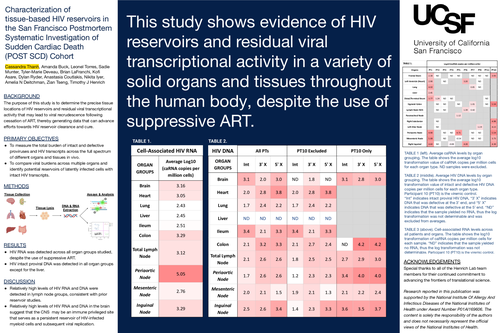
Extraction and analysis were performed on the following quantities of organs: 8 frontal brains, 4
hearts, 3 lungs, 1 liver, 8 ileums, 8 colons, and 38 lymph nodes (3 paratracheal, 2 subclavian, 5
hilar, 7 periaortic, 7 mesenteric, 6 inguinal, 8 not otherwise specified). In terms of qualitative
analysis, intact and non-intact pvDNA was detected across all organ groups except the liver, with
the recognition that only one liver sample was processed. CaRNA was detected across all organ
groups, including the liver. The quantitative analysis showed that the highest average intact
pvDNA levels were detected in the brain and ileum, with relatively high levels also detected
throughout heart, colon, and lymph node subsets. The highest average caRNA levels were
detected in the colon and in the periaortic lymph node subset, with relatively high levels
throughout other lymph node subsets.
DISCUSSION
This study shows evidence of HIV reservoirs and residual viral transcriptional activity in a
variety of solid organs throughout the human body despite the use of suppressive ART.
Consistent with prior studies, relatively high levels of HIV RNA and intact DNA were detected
in multiple lymph node groups and suggest that lymph nodes are a major reservoir of cells
latently infected with HIV. Additionally, HIV RNA and intact DNA in the brain suggest that the
CNS may be an immune privileged site that serves as a persistent reservoir of HIV-infected
myeloid cells and subsequent viral replication.
A major limitation of this project is the limited number of samples from certain organ groups,
such as the heart and liver, as well as the need for a negative control. While there is no concern
for potential contamination of the samples processed and the assays used have been
well-validated for the quantification of HIV DNA and RNA, the study would ideally include
organs from an uninfected control to allow for significance testing of HIV levels against a
baseline. These limitations will be addressed in subsequent studies, as we anticipate receiving
more samples from the POST SCD cohort for future data generation that will more accurately
compare the absolute and relative HIV RNA and DNA burdens within and across organ groups.