145 posters, 12 topics, 25 sessions, 145 authors
ePostersLive by SciGen Technologies S.A. All rights reserved.
UCSF 2023 Inquiry Symposium
10 May | University of San Francisco

P088
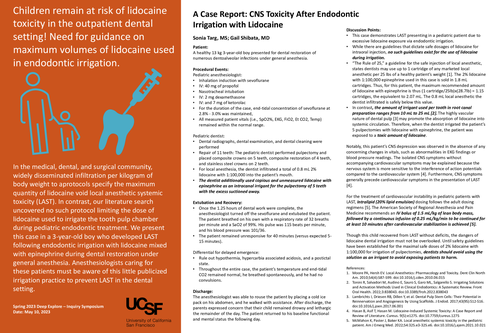
A Case Report: CNS Toxicity After Endodontic Irrigation with Lidocaine
Poster Presenter
Authors
Part of Topic
Clinical & Translational Sciences
Abstract:
In the medical, dental, and surgical community, widely disseminated protocols specify the
maximum quantity of lidocaineinfiltration per kilogram of body weight to avoid local anesthetic
systemic toxicity (LAST). In contrast, our literature search uncovered no such protocol limiting
the dose of lidocaine used to irrigate the tooth pulp chamber during pediatric endodontic
treatment. We present this case in a 3-year-old boy who developed LAST following endodontic
irrigation with lidocaine mixed with epinephrine during dental restoration under general
anesthesia. Anesthesiologists caring for these patients must be aware of thislittle publicized
irrigation practice to prevent LAST in the dental setting.
Introduction:
Medically, lidocaine is commonly administered by subcutaneous injection or topical
application.1In dentistry, administration routes include, intraoral injections2and endodontic
irrigation.3Dentists typically use a cartridge of 2% lidocaine with 1:100,000 epinephrine
(Xylocaine, AstraZeneca LP, Dentsply, York, Penn)4for infiltration analgesia. This solutionis also
used off-labelfor endodontic irrigation.3Irrigant solutions reduce friction between dental
instruments and dentine and washing away microbes, tissue remnants,and biofilm.5Effective
irrigants for pulpectomy includesodiumhypochlorite (NaOCl), chlorhexidine, and tetraacetic
acid (EDTA) amongst others.5Sterile water or saline may be used between these agents to
prevent a chemical reaction.5Irrigating with 2% lidocaine with 1:100,000 epinephrine causes
hemostasis due to the excellent vasoconstrictive property of epinephrine.6Additionally,
lidocaine with epinephrine offers the advantage of convenience since cartridges are found in
almost every dental operatory whereas specialized irrigation solutions may not be immediately
available.
While lidocaine is generally well-tolerated and safe when used correctly, local anesthetic
systemic toxicity (LAST) is a rare and dose-related complication.7,8Lidocaine achieves its effect
byblocking voltage-gated sodium channels, subsequently disrupting depolarization of the cell
membrane and transmission of the action potential.9Due to its mechanism of action, lidocaine
most greatly impacts the central nervous system(CNS) and cardiovascular system7, which both
rely on the propagation of action potentials to function properly.Effects of LAST on the nervous
systemmayincludealtered mental status,CNS depression,andseizures, whileeffects on the
cardiovascular system mayinclude hypotension, bradycardia, andventricular arrythmias.7
Because skeletal muscle serves as a reservoir for local anesthetic10and sequesters the drug
from systemic circulation, pediatric patients are at increased risk of LAST due to their small
size11and decreased muscle mass7relative to adult patients.
Note: Written HIPAA authorization was obtained.
Case Description:
A healthy 13 kg 3-year-old boy presented fordental restorationof numerousdentoalveolar
infections under general anesthesia. A pediatric anesthesiologist performed an inhalation
induction with sevoflurane. Once an IV was established, 40 mg of propofol were given to assist
in the nasotracheal intubation. For the duration of the case, end-tidal concentration of
sevoflurane at 2.8%-3.0% was maintained, and 2 mg dexamethasone and 7 mg of ketorolac by
IV were the only other medications administered for the case.All measured patient vitals (i.e.,
SpO2%, EKG, FiO2, Et CO2, Temp) remained within the normal range. Dental radiographs, dental
examination, and dental cleaning were performed, followed by the repair of 11 teeth. The
pediatric dentist performed pulpectomy and placed composite crowns on 5 teeth, composite
restoration of 4 teeth, and stainless steel crowns on 2 teeth. For local anesthesia, the dentist
infiltrated a total of 0.8 mL 2% lidocaine with 1:100,000 into the patient’s mouth. The dentist
additionally used copious and unmeasured lidocaine with epinephrine as an intracanalirrigant
for the pulpectomy of 5 teeth with the excess suctioned away. Once the 1.25 hours of dental
work were complete, the anesthesiologist turned off the sevoflurane and extubated the patient.
The patient breathed on his own with a respiratory rate of32 breaths per minute and a SaO2 of
99%. His pulse was 115 beats per minute, and his blood pressure was 101/36.
Children typically spontaneously regain consciousness in 5-15 minutes after pure sevoflurane
anesthesia, but this patient remained unresponsivefor 40 minutes.Possible causes for delayed
emergence ruled out by the anesthesiologist were hypothermia, hypercarbia associated
acidosis, and a postictal state. Throughout the entire case, the patient’s temperature and end-
tidal CO2remained normal, he breathed spontaneously, and he had no convulsions.The
anesthesiologist was able to rouse the patient by placing a cold ice pack on his abdomen, and
he walked with assistance. After discharge, the parents expressed concern that their child
remained drowsy and lethargic the remainder of the day. The patient returned to his baseline
functional and mental status the following day.
Discussion:
This case demonstrates LAST presenting in a pediatric patient due to excessive lidocaine
exposure via endodontic irrigation. While there are guidelines that dictate safe dosages of
lidocaine for intraoral injection8, no such guidelines exist for the use of lidocaine during
irrigation. “The Rule of 25,” a guideline for the safe injection of local anesthetic, states dentists
may use up to 1 cartridge of anymarketed local anesthetic per 25 lbs of a healthy patient’s
weight.12The 2% lidocaine with 1:100,000 epinephrine used in this case is sold in 1.8 mL
cartridges. Thus, for this patient, the maximum recommended amount of lidocaine with
epinephrine is thus (1 cartridge/25lb)x(28.7lb) = 1.15 cartridges, the equivalent to 2.07mL. The
0.8 mL local anesthetic the dentist infiltrated is safely below this value. In contrast, the amount
of irrigant used per tooth in root canal preparation ranges from10mL to 25 mL.13The highly
vascular nature of dental pulp14may promote the absorption of lidocaine into systemic
circulation. Therefore, when the dentist irrigated the patient’s 5 pulpectomies with lidocaine
with epinephrine, the patient was exposed to a toxic amount of lidocaine with the exact amount
unknowable due to the simultaneous needle irrigation and suctioning. The excessive amount of
local anesthetic resulted in LAST, presenting as delayed waking from anesthesia.
Notably, this patient’s CNS depression was observed in the absence of any concerning changes
in vitals, such as abnormalities in EKG findings or blood pressure readings. The isolated CNS
symptoms without accompanying cardiovascular symptoms may be explained because the
nervous system is more sensitive to the interference of action potentials compared to the
cardiovascular system.15Furthermore, CNS symptoms generally precede cardiovascular
symptoms in the presentation of LAST.15
For the treatment of cardiovascular instability in pediatric patients with LAST, Intralipid (20%
lipid emulsion) dosing follows the adult dosing regimens.7The American Society of Regional
Anesthesia and Pain Medicine recommends an IV bolus of 1.5 mL/kg of lean body mass,
followed by a continuous infusion of 0.25 mL/kg/min to be continued forat least 10 minutes
after cardiovascular stabilization is achieved.7
Though this child recovered from LAST without deficits, the dangers of lidocaine dental
irrigation must not be overlooked. Until safety guidelines have been established for the maximal
safe doses of 2% lidocaine with 1:100,000 for irrigation of pulpectomies, dentists should avoid
using the solution as an irrigant to avoid exposing patients to harm.
References:
1.Brosh-Nissimov T, Ingbir M, Weintal I, Fried M, Porat R. Central nervous system toxicity
following topical skin application of lidocaine.Eur J Clin Pharmacol. 2004;60(9):683-684.
doi:10.1007/s00228-004-0814-4
2.Bataineh AB, Nusair YM, Al-Rahahleh RQ. Comparative study of articaine and lidocaine
without palatal injection for maxillary teeth extraction.Clin Oral Investig. 2019;23(8):3239-
3248. doi:10.1007/s00784-018-2738-x
3.Jenkins JA, Walker WA, Schindler WG, Flores CM. An In Vitro Evaluation of the Accuracy of
the Root ZX in the Presence of Various Irrigants.J Endod. 2001;27(3):209-211.
doi:10.1097/00004770-200103000-00018
4.Fowler S, Drum M, Reader A, Nusstein J, Beck M. Pulpal Anesthesia of Adjacent Teeth
Following Infiltration of 2% Lidocaine With 1:100,000 Epinephrine in the Maxillary Lateral
Incisor and First Molar.Anesth Prog. 2019;66(1):14-19. doi:10.2344/anpr-65-04-03
5.Haapasalo M, Shen Y, Wang Z, Gao Y. Irrigation in endodontics.Br Dent J. 2014;216(6):299-
303. doi:10.1038/sj.bdj.2014.204
6.Vickers FJ, Baumgartner JC, Marshall G. Hemostatic Efficacy and Cardiovascular Effects of
Agents Used During Endodontic Surgery.J Endod. 2002;28(4):322-323.
doi:10.1097/00004770-200204000-00015
7.McMahon K, Paster J, Baker KA. Local anesthetic systemic toxicity in the pediatric patient.
Am J Emerg Med. 2022;54:325.e3-325.e6. doi:10.1016/j.ajem.2021.10.021
8.Saraghi M, Moore PA, Hersh EV. Local anesthetic calculations: avoiding trouble with
pediatric patients.Gen Dent. 2015;63(1):48-52.
9.El-Boghdadly K, Pawa A, Chin KJ. Local anesthetic systemic toxicity: current perspectives.
Local Reg Anesth. 2018;11:35-44. doi:10.2147/LRA.S154512
10.Fettiplace MR, Lis K, Ripper R, et al. Multi-modal contributions to detoxification of acute
pharmacotoxicity by a triglyceride micro-emulsion.J Controlled Release. 2015;198:62-70.
doi:10.1016/j.jconrel.2014.11.018
11.Barrington MJ, Kluger R. Ultrasound Guidance Reduces the Risk of Local Anesthetic
Systemic Toxicity Following Peripheral Nerve Blockade.Reg Anesth Pain Med.
2013;38(4):289-299. doi:10.1097/AAP.0b013e318292669b
12.Moore PA, Hersh EV. Local Anesthetics: Pharmacology and Toxicity.Dent Clin North Am.
2010;54(4):587-599. doi:10.1016/j.cden.2010.06.015
13.Tonini R, Salvadori M, Audino E, Sauro S, Garo ML, Salgarello S. Irrigating Solutions and
Activation Methods Used in Clinical Endodontics: A Systematic Review.Front Oral Health.
2022;3:838043. doi:10.3389/froh.2022.838043
14.Lambrichts I, Driesen RB, Dillen Y, et al. Dental Pulp Stem Cells: Their Potential in
Reinnervation and Angiogenesis by Using Scaffolds.J Endod. 2017;43(9S):S12-S16.
doi:10.1016/j.joen.2017.06.001
15.Hasan B, Asif T, Hasan M. Lidocaine-Induced Systemic Toxicity: A Case Report and Review of
Literature.Cureus. 9(5):e1275. doi:10.7759/cureus.1275