145 posters, 12 topics, 25 sessions, 145 authors
ePostersLive by SciGen Technologies S.A. All rights reserved.
UCSF 2023 Inquiry Symposium
10 May | University of San Francisco

P086
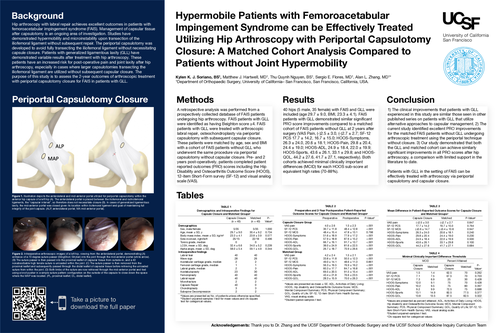
Hypermobile Patients with Femoroacetabular Impingement Syndrome can be Effectively Treated Utilizing Hip Arthroscopy with Periportal Capsulotomy Closure: A Matched Cohort Analysis Compared to Patients without Joint Hypermobility
Poster Presenter
Authors
Part of Topic
Clinical & Translational Sciences
Introduction: Hip arthroscopy with labral repair achieves excellent outcomes in patients with
femoroacetabular impingement syndrome (FAIS). Management of capsular tissue after capsulotomy is an
ongoing area of investigation. Studies have demonstrated hypermobility and microinstability upon
transection of the iliofemoral ligament without subsequent repair. The periportal capsulotomy was
developed to avoid fully transecting the iliofemoral ligament without necessitating capsule closure.
Patients with generalized ligamentous laxity (GLL) have demonstrated variable results after treatment
with hip arthroscopy. These patients have an increased risk for post-operative pain and joint laxity after
hip arthroscopy, especially in cases where larger capsulotomies transecting the iliofemoral ligament are
utilized without subsequent capsular closure.
Aims: To assess the 2-year outcomes of arthroscopic treatment with periportal capsulotomy closure for
femoroacetabular impingement syndrome (FAIS) in patients with generalized ligamentous laxity (GLL).
Project Design/Methods: A retrospective analysis was performed from a prospectively collected
database of FAIS patients undergoing hip arthroscopy. FAIS patients with GLL were identified as having
Beighton score ≥4. FAIS patients with GLL were treated with arthroscopic labral repair,
osteochondroplasty via periportal capsulotomy with subsequent capsular closure. These patients were
matched by age, sex and BMI with a cohort of FAIS patients without GLL who underwent the same
procedure via periportal capsulotomy without capsular closure. Pre- and 2 years post-operatively, patients
completed patient reported outcomes (PRO) scores including the Hip Disability and Osteoarthritis
Outcome Score (HOOS), 12-item Short-Form survey (SF-12) and visual analog scale (VAS).
Results: 40 hips (5 male, 35 female) with FAIS and GLL were included (age 29.7 ± 9.0, BMI, 23.3 ±
4.1). FAIS patients with GLL demonstrated similar significant PRO score improvements compared to a
matched cohort of FAIS patients without GLL at 2 years after surgery (VAS Pain, (-)2.5 ± 3.0, (-)2.7 ±
2.7; SF-12 PCS 17.7 ± 14.2, 16.7 ± 15.0; HOOS-Symptoms, 26.3 ± 24.0, 20.6 ± 18.1; HOOS-Pain, 29.8 ±
20.4, 24.4 ± 19.0; HOOS-ADL, 24.9 ± 18.4, 22.0 ± 19.9; HOOS-Sports, 43.6 ± 26.1, 33.1 ± 29.8; and
HOOS-QOL, 44.2 ± 27.6, 41.7 ± 27.1, respectively). Both cohorts achieved minimal clinically important
differences (MCID) for each HOOS subscore at equivalent high rates (70-88%).
Discussion: Patients with GLL in the setting of FAIS can be effectively treated with arthroscopy via
periportal capsulotomy and capsular closure. These patients demonstrate significant improvements in
PRO scores at 2-years, similar to normal laxity FAIS patients undergoing arthroscopic treatment via
periportal capsulotomy without capsular closure.