145 posters, 12 topics, 25 sessions, 145 authors
ePostersLive by SciGen Technologies S.A. All rights reserved.
UCSF 2023 Inquiry Symposium
10 May | University of San Francisco

P085
Does a Digital Mental Health Intervention Affect Symptoms of Depression, Anxiety and Post-Traumatic Stress Disorder After Musculoskeletal Trauma? (ADAPT) A Pilot and Feasibility Study
Poster Presenter
Authors
Part of Topic
Clinical & Translational Sciences
Introduction:
Musculoskeletal injuries comprise a large percentage of hospital admissions for adults and often
contribute to persistent daily pain as an illness, opioid dependence, disability, as well as complaints of
increased depression, anxiety, and symptoms of post-traumatic stress disorder (PTSD). The prevalence
of depression and PTSD after orthopaedic trauma has been found to be considerably greater than the
general adult population. Thus, early in the care of orthopaedic trauma there exists an opportunity to
improve overall health by attending to psychological and social concerns. Recent literature has identified
clinically actionable subgroups within the orthopaedic trauma population that are at psychological risk
after an injury. Digital app-based interventions offer a logical next step in improving access to mental
health resources through a self-directed mobile interface.
Hypothesis:
We aim to explore whether a brief daily mental health exercise using a smart device application can
reduce the deleterious effects of post-traumatic stress, depression, anxiety, and other psychological
sequelae on outcomes after musculoskeletal trauma. We hypothesize that higher utilization of the
mental health application will result in improved mental health self-reported symptoms.
Aims:
1. To determine feasibility through recruitment rate, retention rate, and engagement.
2. To determine the effects of brief daily digital mental health intervention on PTSD, anxiety,
depression, and mobility.
3. To evaluate the association of mental health outcomes after a digital mental health intervention
with physical activity and sleep duration.
Project Design/Methods:
This is a prospective cohort study of orthopaedic trauma patients who underwent surgical fixation for
either acute fracture or chronic “problem” fracture (infection, malunion, nonunion). Eligible patients
who meet a cutoff for subthreshold symptoms of PTSD, depression, anxiety and/or subthreshold scores
on stress and global mental health surveys will be identified and approached for enrollment at their first
or second post-op clinic visit. Patients that consent to participate will complete a baseline assessment
and will receive a 6-week subscription to the Wysa application and a Garmin device, and instructed to
use the app for approximately ten minutes as guided by the application for 6 weeks. Wysa will provide
app adherence data, and investigators will track activity and sleep metrics via Garmin device. Self-
reported mental health surveys will be collected at 6 weeks, 3 months, and 6 months following surgical
fixation.
Wysa is a mobile application that is free and currently available for use to the general public as a digital
mental health intervention. The application combines mindfulness practice, cognitive behavioral
therapy, dialectical behavioral therapy, motivational interviewing, sleep meditation, and deep breathing
exercises, which is delivered via an artificial intelligence chatbot or human coaches with graduate level
training (available as a paid add-on).
The primary endpoints are determining feasibility for a larger RCT via recruitment, retention and
adherence/engagement with the intervention. Secondary effectiveness analysis will be performed
where Wysa app users will be split into “high utilizers” and “low utilizers” as identified by median of
total meaningful engagements throughout the study. Mental health and activity outcomes of these
groups will be compared with effect sizes based on standard error of instruments.
Results/Product:
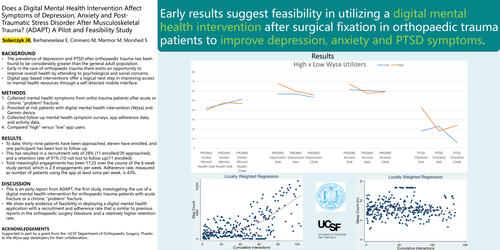
To date, thirty-nine patients have been approached, eleven have enrolled, and one participant has been
lost to follow up. This has resulted in a recruitment rate of 28% (11 enrolled/39 approached), and a
retention rate of 91% (10 not lost to follow up/11 enrolled). For selected patient demographics, the
sample includes 6 women, 5 men, and a median age of 50.5 years. 10 patients underwent surgical
fixation for an acute fracture, and 1 patient underwent surgical fixation for chronic “problem” fracture.
Of the 10 active patients recruited, there are adherence data available for analysis for 7 participants,
three have been recruited within the past three weeks and investigators receive monthly reports from
the Wysa app developers. Adherence to the Wysa application, as measured by the median of total
meaningful engagements has been 17.25 over the course of the 6 week study period, which is 2.9
engagements per week. This figure of 17.25 is used as the median split, resulting in 3 “high” utilizers and
4 “low” utilizers. Three high-utilizers were all recruited at post-op week 2, and 3 out of the 4 low-
utilizers were recruited at post-op week 6. Adherence rate, measured as number of patients using the
app at least once per week, is 43%.
Secondary effectiveness analysis of self-reported measures of global mental health, PTSD, depression
and anxiety was performed. Median score improvements on the PROMIS Global Mental Health survey
were 2.1 for high utilizers and 3 for low utilizers. Similarly, median improvements for PROMIS
Depression (high 7, low 3.7), PROMIS Anxiety (high 7.4, low 7.8), and PTSD Checklist (high 18, low 8)
were analyzed with Wilcoxon rank sum aka Mann Whitney U Test resulting in no significant differences
between high and low utilizers. A locally weighted regression of Wysa adherence and Garmin-gathered
activity and sleep data was performed for all users, and also for each individual participant with
sufficient adherence and Garmin data. These regressions resulted in a positive correlation between step
count and adherence.
Discussion/Conclusion:
This is an early report from ADAPT, the first study investigating the use of a digital mental health
intervention for orthopaedic trauma patients with acute fracture or a chronic “problem” fracture. We
show early evidence of feasibility in deploying a digital mental health application with a recruitment rate
that is similar to previous reports in the orthopaedic surgery literature, a relatively higher retention rate,
and an adherence rate that is similar to those reported in the extant literature.
The planned final sample size of 50 total patients has not yet been reached, and the study is ongoing
and continues to actively recruit. Promising qualitative data has been collected that will inform future
steps of the study. More data is needed to determine if a digital mental health app can improve or
prevent psychological sequalae after orthopaedic trauma.