145 posters, 12 topics, 25 sessions, 145 authors
ePostersLive by SciGen Technologies S.A. All rights reserved.
UCSF 2023 Inquiry Symposium
10 May | University of San Francisco

P084
Treatment of OSA using PAP Therapy and its Effects on Anxiety and Depression for Patients in the Central Valley
Poster Presenter
Authors
Part of Topic
Clinical & Translational Sciences
Introduction: Obstructive sleep apnea (OSA) is a highly prevalent sleep disorder that affects approximately 23% of individuals worldwide. OSA has been associated with a range of poor health outcomes, including mood symptoms, with most studies focusing on the impact of OSA on depression. Although this relationship has been widely observed, the effects of treatment of OSA using positive airway pressure (PAP) on mood, especially anxious symptoms, has not been well investigated. Our retrospective study aimed to further explore this relationship beyond solely depression for patients in the Central Valley. The results of the study are highly relevant to this area, where increased rates of OSA and psychiatric disorders are seen as rates of obesity, lower socioeconomic status, and substance use exceed that of other regions.
Hypothesis: If patients with OSA and co-existing anxiety and/or depression treat their OSA with PAP therapy, their mood symptoms will improve which will result in a reduction of scores on the GAD-7 and/or PHQ-9.
Aim 1: To assess co-prevalence of anxiety and/or depression for patients diagnosed with OSA after overnight sleep study
Aim 2: To assess the adherence and efficacy of PAP therapy in patients with mood symptoms based on repeat Apnea/Hypopnea Index (AHI), percent compliance, average hours and days of use, and Epworth Sleepiness Scale (ESS)
Aim 3: To identify the effects of PAP therapy on PHQ-9 and GAD-7 scores within the first three months following treatment for patients with OSA
Project Design: The project was designed as a retrospective cohort study. Baseline PHQ-9 and GAD-7 scores at time of overnight sleep study or home sleep study done at University Sleep and Pulmonary Associates were stored in a locked file cabinet in the private investigator’s office. Records were reviewed to identify those that met inclusion criteria. Subjects included adults 18 or older diagnosed with OSA (defined by AHI of 5 events/hour or greater) between Feb. 2022 and Oct. 2022 who scored 5 or greater on the PHQ-9 and/or GAD-7 and agreed to start PAP therapy. The charts of patients who met criteria were investigated on EPIC to identify PAP therapy compliance (defined as wearing the device for 21/30 days for at least 4 hours/day), and PHQ-9 and GAD-7 scores at the follow up appointments within the first three months of starting therapy at either University Sleep and Pulmonary Associates or Family Healthcare Network in Fresno, CA. Charts were also investigated to document doses of psychotropic medications (if the subject is taking any) at baseline and follow-up. The data collected was de-identified prior to conducting statistical analysis, which was performed using STATA software with ANOVA and independent and paired samples t-tests. The primary and secondary outcomes investigated were compared between subjects who were PAP therapy adherent and those who were non-adherent. These included AHI, ESS, PHQ-9, and GAD-7 scores.
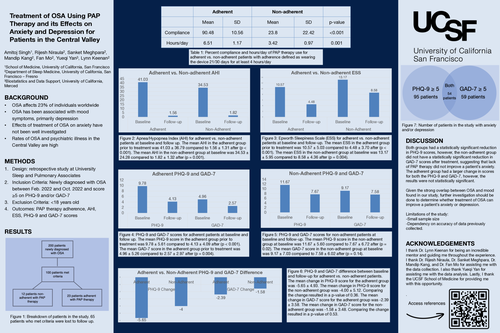
Results: Of the 200 patients newly diagnosed with OSA, 100 (50%) met inclusion criteria of scoring ≥ 5 on the PHQ-9 and/or GAD-7. 95 (47.5%) scored ≥ 5 on the PHQ-9 and 59 (29.5%) scored ≥ 5 on the GAD-7. 35 of those patients had completed a follow-up appointment. 23 of those patients were determined to be adherent with their PAP therapy, and 12 patients were non-adherent with treatment. In the adherent group, the mean hours/day PAP therapy used was 6.51 ± 1.17 compared to 3.42 ± 0.97 in the non-adherent group (p = 0.001). In the adherent group, the percent compliance was 90.48 ± 10.56 compared to 23.80 ± 22.42 in the non-adherent group (p < 0.001). The mean AHI in the adherent group prior to treatment was 41.03 ± 36.79 compared to 1.56 ± 1.31 after (p < 0.001). The mean AHI in the nonadherent group at baseline was 34.53 ± 24.28 compared to 1.82 ± 1.32 after (p = 0.001). The mean ESS in the adherent group prior to treatment was 10.57 ± 5.03 compared to 4.48 ± 3.70 after (p < 0.001). The mean ESS in the non-adherent group at baseline was 13.17 ± 5.95 compared to 8.58 ± 4.36 after (p = 0.004). The mean PHQ-9 score in the adherent group prior to treatment was 9.78 ± 5.61 compared to 4.13 ± 4.09 after (p < 0.001). The mean GAD-7 score in the adherent group prior to treatment was 4.96 ± 5.26 compared to 2.57 ± 2.97 after (p = 0.004). The mean PHQ-9 score in the non-adherent group at baseline was 11.67 ± 5.60 compared to 7.67 ± 6.72 after (p = 0.02). The mean GAD-7 score in the non-adherent group at baseline was 9.17 ± 7.03 compared to 7.58 ± 6.02 after (p = 0.14). The mean change in PHQ-9 score at baseline vs. follow-up for the adherent group was -5.65 ± 4.93. The mean change in PHQ-9 score at baseline vs. follow-up for the non-adherent group was -4.00 ± 5.12. Comparing the change in PHQ-9 score between the two groups resulted in a p-value of 0.36. The mean change in GAD-7 score at baseline vs. follow-up for the adherent group was -2.39 ± 3.58. The mean change in GAD-7 score at baseline vs. follow-up in the non-adherent group was -1.58 ± 3.48. Comparing the change in GAD-7 score between the two groups resulted in a p-value of 0.53.
Discussion: Our study showed a strong overlap between OSA and mood for patients in the Central Valley, thus supporting the need to study whether treatment of one can impact the other. Patients in the adherent group had a statistically significantly higher hours/day of PAP therapy use and percent compliance compared to those in the non-adherent group. However, both groups had a statistically significant reduction in ESS suggesting that strong adherence to PAP therapy did not necessarily improve a patient’s subjective feeling of their quality of sleep. Both groups had a statistically significant reduction in PHQ-9 scores, however, the non-adherent group did not have a statistically significant reduction in GAD-7 scores at follow-up, suggesting that lack of PAP therapy did not improve a patient’s anxiety. The adherent group had a larger change in scores for both the PHQ-9 and GAD-7 suggesting slightly increased improvement in mood with PAP therapy, however, the results were not statistically significant. Limitations of this study included small sample size and dependency on accuracy of data previously collected. Only 35 patients out of the 100 that met inclusion criteria had completed a follow-up appointment. Reasons for missed follow-up included subjective feeling of improvement, not receiving a PAP device (which was complicated by national back order of PAP machines after the Philips recall), and no longer wanting care. Furthermore, as a retrospective study, the scores were previously input into EPIC by the clinicians who saw the patients. Therefore, scores could have been incorrectly typed into the patients’ charts. Given the strong overlap between OSA and mood found in our study, further investigation should be done to determine whether treatment of OSA can improve a patient’s anxiety or depression. Our limited data did show improvement in a patient’s level of anxiety with PAP treatment and no improvement without treatment, which had not been well studied previously. Therefore, patients with mood symptoms should be encouraged to improve their quality of sleep, and clinicians should be inclined to diagnose and treat OSA early on.