145 posters, 12 topics, 25 sessions, 145 authors
ePostersLive by SciGen Technologies S.A. All rights reserved.
UCSF 2023 Inquiry Symposium
10 May | University of San Francisco

P081
Implementing child neurodevelopmental assessments in rural Tanzania: a pre-testing phase of the Child Health and Infection with Low Density (CHILD) malaria trial
Poster Presenter
Authors
Part of Topic
Epidemiology & Population Sciences
Title: Implementing child neurodevelopmental assessments in rural Tanzania: a pre-testing phase of the
Child Health and Infection with Low Density (CHILD) malaria trial
Introduction:
The CHILD malaria trial will examine the impact of interventions targeting low-density malaria infection
in rural Tanzania. Outcomes include a range of child health and wellbeing measured over 2 years of
follow-up including neurocognition and attention. To assess these domains, we will utilize
neurodevelopmental tools which have been designed for use in diverse, non-Western settings but not
necessarily in the distinct cultural and linguistic context of rural Tanzania, in particular in Bagamoyo
district. Given the novelty of such tools to the region, we will be piloting and validating these
instruments in two phases prior to trial initiation. Here, we complete the pre-testing phase of this
process.
Aim:
1. Quantify and visualize any floor or ceiling effects apparent in the tools
2. Qualitatively understand the cultural appropriateness and feasibility of the tools in the setting of
Bagamoyo, Tanzania and for children in various age ranges
3. Adapt the tools according to the above findings for use in the pilot validation and main trial
studies
Methods:
We recruited 30 children in the vicinity of Bagamoyo Ifakara Health Institute (IHI), the Tanzanian
institutional partner for the CHILD trial. We piloted the following measurements of cognition according
to age: for babies less than 3 years old, the Global Scales for Early Development (GSED); for toddlers 3-5
years old, the International Development and Early Learning Assessment (IDELA); and for children 6-12
years old, the East African Neurodevelopmental Battery. For assessing sustained attention, we utilized
two adaptations from the Test of Everyday Attention for Children (TEA-Ch): the pencil tap and code
transmission tests.
As GSED and IDELA have been extensively utilized in similar contexts, we included only a small
subsample of 6 children for each. For the East Africa Battery and TEA-Ch subtests which have been
minimally researched, pre-testing was completed with 6 kids from each of the following age groups: 5-7,
8-9, and 10-12. The pencil tap test was additionally used with the 4-year-old participants.
The core team was comprised of three examiners: an IHI researcher acting as primary assessor, an
investigator from the Swiss Tropical and Public Health Institute (TPH) collaborating on the project, and a
medical student from University of California, San Francisco (UCSF).
During and after each assessment encounter, all examiners collected qualitative information about the
experience. Test responses were recorded on paper answer sheets and scored after the participant and
their parent left. Participants were compensated for their time and travel costs.
Results:
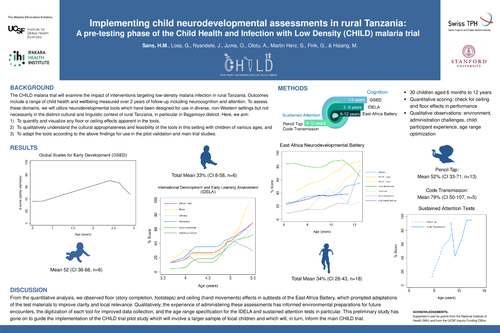
The mean percentage (95% confidence interval, sample size) performance for each test were as follows:
GSED 52.1 (CI 36-68, n=6), IDELA 33.0% (CI 8-58, n=6), East Africa Battery 34.3% (CI 26-43, n=18), pencil
Sans_Hannah_2023
tap 52.3% (CI 33-71, n=13), and code transmission 79.0% (CI 50-107, n=5). Portions of the East Africa
Battery demonstrated floor (story completion, footsteps, Kilifi naming) and ceiling (hand movements)
effects. The IDELA, GSED, and TEA-Ch did not contain items showing these effects.
Qualitative observations were discussed and summarized into issues related to environment (for
example, significance of distractions and set-up requirements), administration materials (for instance,
assessor guides and demands of switching between testing and scoring), and participant experience
(including perceived difficulty or lack of engagement with particular test items). The pencil tap test for
sustained attention proved too difficult for the 4-year-old children, and participants up through age 9
continued to appear engaged by the test. The instructions for code transmission were not well
understood by the kids 8 and younger.
Discussion:
Our findings have been incorporated into adaptations of the test materials to improve clarity and
cultural relevance. For GSED, minor adjustments to the Swahili translations were made to enhance
understanding. IDELA underwent minor adaptations such as reduced difficulty of puzzle activity (not a
common toy locally), rewording of Swahili prompts, and scoring clarification for acceptable answers to
questions regarding the concept of empathy (along with related translation challenges). The East Africa
Battery necessitated the most edits: visuals were redesigned with locally relevant images and
administration guides were remade to improve clarity for both the assessor and the child receiving the
instructions. For the TEA-Ch subtests, we designed audio files, practice guidance, and stopping rules to
improve the tools.
Additionally, scoring for each tool has been digitized into a web-based application to complement
necessarily paper-based components and to enhance data collection. The products of this project are
fully adapted versions of the GSED, IDELA, East Africa Battery, pencil tap, and code transmission tests
including corresponding administration guides, online scoring platforms, tool kits, and training materials.
In sum, as a preliminary phase, this work has gone on to guide the implementation of the CHILD trial
pilot study which will involve a larger sample of local children and which will, in turn, inform the main
CHILD trial.