145 posters, 12 topics, 25 sessions, 145 authors
ePostersLive by SciGen Technologies S.A. All rights reserved.
UCSF 2023 Inquiry Symposium
10 May | University of San Francisco

P061
Limited English Proficiency and Postoperative Complications after Total Knee Arthroplasty
Poster Presenter
Authors
Part of Topic
Epidemiology & Population Sciences
Title: Limited English Proficiency and Postoperative Complications after Total Knee
Arthroplasty
Introduction
While total knee arthroplasty (TKA) has been shown to improve patient symptoms and quality of
life, disparities in outcomes after TKA are understudied for patients with limited English
proficiency (LEP). The purpose of this study was to investigate the relationship between English
language proficiency and rates of postoperative complications after TKA.
Hypothesis
We hypothesize that patients with LEP, compared to English proficient (EP) patients, have
increased rates of postoperative complications after TKA.
Aims
To explore whether postoperative TKA complications correlate with LEP status, we compared
the rates of complications after TKA between patients with LEP and EP patients at a large
academic medical center.
Project Design
This was a retrospective cohort study of electronic health records of patients ≥18 years of age
who underwent elective TKA between January 2013 and December 2021 at a single academic
medical center. The primary predictor variable was English proficiency status, where LEP was
defined as having a self-reported primary language besides English. Primary outcome variables
were the proportions of patients who had postoperative complications. Complications included in
the analysis were 30-day deep venous thrombosis (DVT), 30-day venous thromboembolism
(VTE), 90-day surgical site infection, 7-day pneumonia, 1-day encephalopathy, and 7-day
myocardial infarction. Arthroplasty specific complications included periprosthetic fracture,
implant fracture, instability, implant loosening, and stiffness. Differences between EP and LEP
patients’ demographic and clinical characteristics were evaluated using t-test and Fisher’s exact
test. Adjusted odds ratios of developing a postoperative complication were calculated using
multivariable regression models adjusted for age, body mass index, gender, American Society of
Anesthesiologists (ASA) rating, smoking status, and length of hospitalization.
Results
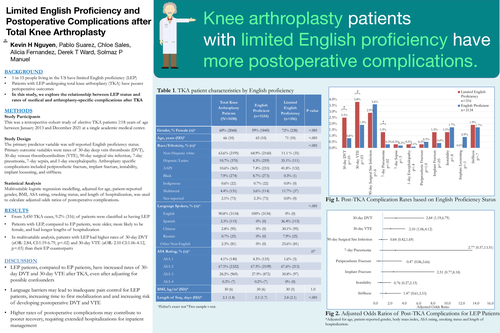
A total of 3,450 patients underwent TKA and 9.2% (316) of patients were classified as having
LEP. Compared to EP patients, LEP patients were older, more likely to be female, and had
longer average lengths of hospitalization. LEP patients had higher rates of 30-day DVT (2.5% vs
0.8%, p=.01), 30-day VTE (3.8% vs 1.9%, p=.03), and 7-day pneumonia (1.3% vs 0.3%, p=.02).
There were no differences in rates of arthroplasty specific complications. Multivariable logistic
regressions showed that patients with LEP have an adjusted odds ratio of 2.84 (CI:1.19-6.79,
p=.02) of developing a 30-day postoperative DVT and an adjusted odds ratio of 2.10 (CI:1.06-
4.12, p=.03) of developing a 30-day postoperative VTE.
Discussion
This study identified that patients with LEP undergoing TKA, compared to EP patients, have
higher rates of 30-day postoperative DVT and VTE, even after adjusting for confounding
variables. LEP status may have a multifactorial effect on risk of developing postoperative
complications, including longer lengths of hospitalization and decreased mobilization due to
inadequate pain control. While LEP status has been previously associated with higher rates of
postoperative complications after cardiac surgery and neurosurgery, this is the first study to
suggest that language barriers may also be associated with these healthcare disparities after
arthroplasty procedures. These findings are important for the field of arthroplasty and
perioperative management, because these complications increase risk of poorer postoperative
recovery, and they may require extended hospitalizations for inpatient management. This study
has several limitations. First, the electronic health records cannot offer insight into mediators of
these postoperative complications. Secondly, our study was limited to a single academic center’s
data. Future studies will aim to obtain qualitative data from stakeholders at several hospitals to
elucidate upon how language barriers may contribute to adverse outcomes for LEP patients.