145 posters, 12 topics, 25 sessions, 145 authors
ePostersLive by SciGen Technologies S.A. All rights reserved.
UCSF 2023 Inquiry Symposium
10 May | University of San Francisco

P001
Performance of a Novel Serological Test for Chagas Disease
Poster Presenter
Authors
Part of Topic
Epidemiology & Population Sciences
Introduction: There are an estimated 300,000 individuals with Chagas disease in the United States. Transmission of the causative parasite, Trypansoma cruzi, most commonly occurs via bite from an infected insect vector (Triatomine bug).. Chagas disease remains severely underdiagnosed due to lack of a widespread and clear approach to screening. Diagnosis in the chronic phase requires positive results from two different IgG serology tests. InBios (Seattle, WA) has the only FDA-cleared anti-T. Cruzi IgG lateral flow assay (LFA). In 2019, a test performance evaluation demonstrated high sensitivity, but low specificity by this test (Whitman et al., 2019). Since then, InBios has used this data to develop three new LFA prototypes for consideration of a new FDA submission.. We tested these new prototypes on the same American Red Cross blood donor specimens from 2019 and extracted comparative performance data. This data will aid in the development of widespread, systematic screening of Chagas disease in high-risk areas of the U.S., such as major metropolitan areas of California..
Hypothesis: We expect improved specificity of the InBios Chagas Detect Plus version 2 prototype with equivalent or improved sensitivity compared to the current FDA-cleared version.
Aims: - Determine which of the three novel InBios LFA prototypes has the highest sensitivity when tested on 800 Red Cross Donor specimens (500 seropositive, 300 seronegative). - Compare sensitivity and specificity of new prototypes to the original prototype from 2019 to quantify improvement
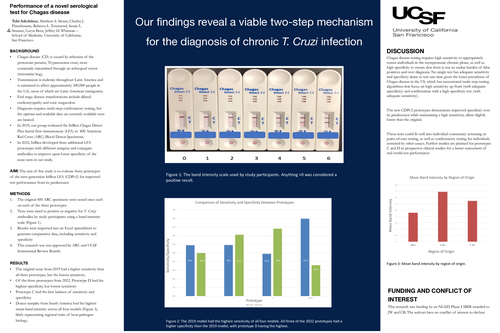
Project Design/Methods: 800 unique serum samples with known seronegative or seropositive T. Cruzi IgG status were deposited onto 800 corresponding LFA prototypes. Each sample was tested once on each of the three prototypes (Prototype A, Prototype C, Prototype D) for a total of 2400 tests. After deposition of the sample, a buffer reagent was added to the LFA. After 10 minutes, three blinded study participants judged each test as positive or negative based on intensity of the test band compared to the control band. Band intensity was rated on a scale of 1 to 6, with 0 being the least intense. Anything above a 0 was regarded as a seropositive result. These results were imported into an Excel spreadsheet alongside data from 2019 that designated each sample as truly positive or truly negative. Values for sensitivity and specificity were then calculated for each of the three prototypes. Maximum, minimum, and median differences in band intensity rating between 2022 and 2019 were generated and compared in Excel. Results were then stratified by the donor’s country of origin. Bar graphs representing band intensity were generated in Excel for each prototype based on the donor country of origin.
Results/Product: The prototype with the highest sensitivity was Prototype C, which had a sensitivity of 94.9%. The prototype with the highest specificity was Prototype D, which had a specificity of 96.8%. Although none of the three prototypes from 2022 surpassed the original model from 2019 in percent sensitivity, all three prototypes had higher specificities than the original, which had a specificity of 92.6% All three prototypes from 2022 exhibited lower mean band intensity than the 2019 model. Among the four countries of origin, donor samples from South America had the highest median band intensity across all three prototypes as well as the 2019 model.
Discussion: Our data provides preliminary evidence for development of a systematic protocol for screening and diagnosis of Chagas disease. The direct comparison of the three novel prototypes from 2022 against the original model from 2019 demonstrates a range of sensitivity and specificity estimates across tests as well as consistent variation in band intensity by country of origin. The overall decrease in both sensitivity and band intensity from 2019 to 2022 may be due to a variety of factors including use of different test interpreters between the two studies, or alterations in chemical composition of the donor samples while in storage. However, the consistent increase in specificity indicates improvement in detection of T. Cruzi antibodies. On the basis of these findings, we can develop initial guidance for optimal use of these tests, anticipate associated challenges, and identify where improvements are needed. As previously noted, diagnosis of Chagas disease in the chronic phase requires a positive IgG serology result across two separate tests. Historically, a test with high sensitivity is preferred as the initial test for a suspected case as a “rule-in” measure. Once a person of interest screens positive, their serology is confirmed with a high specificity test. Given these guidelines, the optimal testing method may entail combining the original model with one of the newer, higher-specificity models.