145 posters, 12 topics, 25 sessions, 145 authors
ePostersLive by SciGen Technologies S.A. All rights reserved.
UCSF 2023 Inquiry Symposium
10 May | University of San Francisco

P022
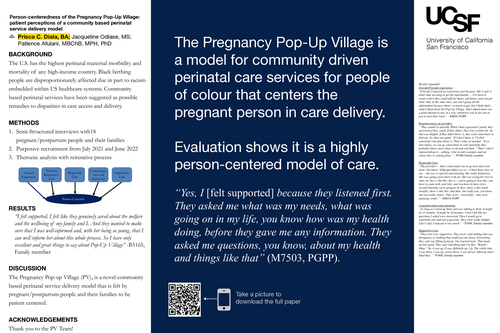
Person-centeredness of the Pregnancy Pop-Up Village: patient perceptions of a community based perinatal service delivery model
Poster Presenter
Authors
Part of Topic
Epidemiology & Population Sciences
Introduction: The United States (U.S.) has the highest perinatal maternal morbidity and mortality rate of any high-income country, yet the burden falls disproportionately on low-income birthing people of color, particularly Black, non-Hispanic birthing people. While there have been increased emphasis placed in understanding and addressing racism as the root cause of these adverse outcomes, systemic racism embedded within access and delivery of care in U.S. hospital systems continue to exacerbate inequitable outcomes. Community-based care systems have been proposed as a way to reduce gaps in care access and experience. Pregnancy Pop-Up Village (PV) is a novel community-health system-city partnership that addresses inequities in perinatal care in San Francisco, CA through collaborative community engagement aimed at providing perinatal services in a “one-stop-shop” framework. We explored pregnant and postpartum people’s perception of PV’s person-centeredness.
Hypothesis or question (if applicable): The purpose of this study is to assess pregnant/postpartum people and their families’ perceptions about the person-centeredness of PV.
Aims: PV participants were invited to participate in semi-structured interviews to assess personcenteredness, as measured by participants’ perceptions of provider responsiveness, respect, communication, and supportive care.
Project Design/Methods: Pregnant/postpartum people and their families were recruited from monthly PV events between July 2021 and June 2022. Participants were recruited by the UCSF PV research team using convenience sample and invited to complete a questionnaire. Following completion, 2-3 participants per event were purposively selected and invited to participate in a semi-structured interview via zoom. Interview guides were composed of 10 constructs with varied open-ended probes that address topics such as acceptability, person-centeredness, and perceptions of the PV concept. We focus on participants perceptions of PV’s person-centeredness as defined by 1) overall experience, 2) provider responsiveness, 3) respectful care, 4) communication and autonomy, and 5) supportive care. Verbal consent was obtained from participants before study administration. The interviews were conducted in either English or Spanish, audio-recorded, and transcribed. Transcripts were reviewed for accuracy and clarity by a member of the research team and data were analyzed using a thematic approach. We created a preliminary codebook based on topics from the interview guides. Transcriptions were imported and managed using Dedoose (v8.0.35, Dedoose). The transcripts were then coded Using topics from the independently by six analysts (OJO, PD, KV, EK, HS, and KM). Analysis was constantly compared and discussed in detail by the six analysts with revision of the codebook as necessary.
Results/Product: A total of 13 pregnant/postpartum people and 5 family members participated in the semistructured interview. Overall, participants had positive interactions with providers at the Pop-Up Village. They noted how kind and welcoming everyone was and the warm, uplifting, and supportive environment that providers created. Professional yet inviting, participants felt that providers were willing to share and provide information in a way that was tailored to each person. One participant noted, “Yes, I [felt supported] because they listened first. They asked me what was my needs, what was going on in my life, you know how was my health doing, before they gave me any information. They asked me questions, you know, about my health and things like that” (M7503, PGPP). Yet, some explained that despite the providers best attempts to explain the resources available, there was a lot of resources and some organizations needed to better improve follow up after the event: “Well, with [x organization] my experience was good up until they didn’t call me back. They didn’t follow up…So, I felt like that was pointless because that was like the main focus of why I wanted to go” (L468, PGPP). Beyond the overall structure, participants felt that providers went above and beyond to make them feel seen and to provide patient and detailed responses to their questions. Many remarked on the willingness of providers to reach out to other service providers to ensure participants’ needs were met. The Providers were felt to be compassionate, respectful, supportive, and provided clear communication. “The providers – that’s what makes me to go next time even more. [One provider] … she was so special and amazing. She really helped me. She was going everywhere with me. She was trying her best to show me this is like this, this is – you're going to love this, you have to come with your kids… there is this much benefits.. And … she was really smart…They were – everybody – they were amazing, really.” – H9619, PGPP
Discussion/Conclusion: The data from this qualitative study suggests that the structure of the Pregnancy Pop-Up Village (PV) was conducive to the provision of person-centered perinatal care in an urban area. Pregnant/postpartum people and their families had an overall positive encounter with providers at PV, often describing them as attentive, respectful, and supportive. Participants felt that providers were very understanding and attentive to their needs and that of other pregnant people and their families. In addition to providers’ well-meaning intentions, participants felt included in conversations and felt that providers took the time to answer all their questions leading to sense of agency in the care they were receiving. While novel, these findings support the ongoing discussion in literature to shift to community-based care delivery models, like PV, as a way to mitigate the disparities and barriers in receiving perinatal care for marginalized communities rooted in racism and lack of person-centered care. Our study has several potential limitations. Because participants are recruited during these events, it is possible that individuals who felt strongly (either positively or negatively) about the event elected to participate, potentially skewing the types of experiences represented in the data. However, in purposively sampling the participants, we attempted to recruit a sample with varying experiences. Additionally, we selected open-ended interview guide questions and probes that allowed participants to discuss both positive and negative experiences. Despite these limitations, our study provides a model of a community-health system partnership that addresses the disparities in care delivery to communities of color who have historically received poorer health care from traditional systems of care. Furthermore, the model was found by participants to be empowering, supportive, and person-centered.