145 posters, 12 topics, 25 sessions, 145 authors
ePostersLive by SciGen Technologies S.A. All rights reserved.
UCSF 2023 Inquiry Symposium
10 May | University of San Francisco

P026
High Satisfaction with the Friendship Line among Older Adults experiencing Chronic Loneliness
Poster Presenter
Authors
Part of Topic
Epidemiology & Population Sciences
Abstract
Introduction: Despite growing interest in loneliness as a modifiable risk factor in clinical outcomes, few
studies examine the effectiveness of long-standing, widely available interventions. The Friendship Line
(FL), created in 1973, is a nationally available accredited crisis and emotional support telephone service
for older adults.
Aim: We used mixed-methods to better understand how FL impacts older adults experiencing both
occasional and chronic loneliness.
Methods: We conducted baseline interviews of older adult FL participants (n=68) between October 1st,
2020 to April 30th, 2021, and monthly follow-ups for up to 6 months. Participants were categorized as
daily callers versus non-daily callers. We tested the association of call volume with chronic loneliness,
defined as scoring 6+ points on 3-item UCLA Scale (Range: 0-9 points) at two or more time points.
Participants’ free text responses in surveys and qualitative interviews of a purposive sample (n=12) were
analyzed thematically.
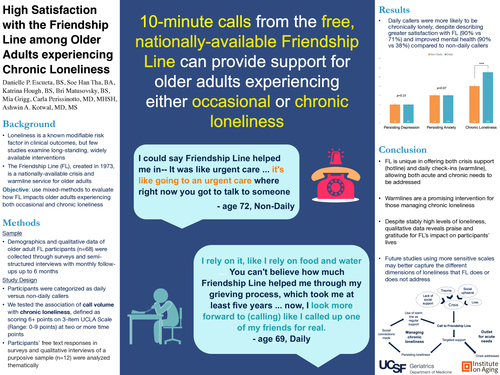
Results: 132 interviews were conducted with 68 individuals across 20 different states. Participants were
on average 69 years old (SD=7), 62% female, 2% Black, 4% Latinx, 3% Native American, 12% married,
and 9 . Daily callers were more likely to be chronically lonely than non-daily callers (61% vs 18%,
p<0.001). Although daily callers reported high levels of loneliness overall, they described greater
satisfaction with FL compared to non-daily callers (90% vs 71%) and that the FL improved their mental
health (daily: 90% vs non-daily: 38% non-daily). In interviews, daily callers described the importance of
a longitudinal relationship with the service for emotional support: “(Y)esterday, when I talked to that girl
at FL, I felt so connected. I stopped crying because for once, I felt understood.” In contrast, non-daily
callers frequently described FL as an outlet for acute needs or crises, similar to “urgent care ... like going
to an urgent care where right now you got to talk to someone.”
Discussion: Older adults calling daily to the Friendship Line were more likely to experience chronic
loneliness compared to non-daily callers. Quantitative and qualitative results suggest the Friendship Line
can be an important source of support for older adults managing chronic loneliness in addition to those
experiencing occasional loneliness.